
Linux in Government: Linux Desktop Reviews, Part 6 - Ubuntu

April 19th, 2005 by Tom Adelstein in

In less than a year, this free Linux distribution has become the most popular.
Your rating: None

In case you have not followed this series of articles on the Linux desktop (see Resources for Parts 1-5), we have been discussing the suitability of different distributions for enterprise use. So far, we have covered the Xandros Business Edition, Novell's Linux Desktop, Red Hat's Enterprise Desktop, Sun's Java Desktop System and Linspire. We evaluated those claiming to be ready for enterprise deployment against a set of modified criteria originating from Bernard Golden's Succeeding with Open Source and the Open Source Maturity Model. Specifically, we asked the following questions:

  • What kind of support organization does the desktop distribution have related to users? If a user runs into a problem, can she or he contact someone for help? How, over the phone or by e-mail? How big is the desktop distribution's support organization? Does the company out-source its support?

  • Does the desktop distribution have a professional services organization? If someone wants to buy a large number of desktops, how would the desktop distribution handle a big order?

  • Does the desktop distribution offers documentation for the user>? How about technical documentation; is there anything for the administrator?

  • What kind of solution-provider ecosystem exists? Does the desktop distribution have resellers? How robust is that reseller organization?

  • What is the desktop distribution's server strategy? Does the company provide back office functionality and identity management?

  • What tools exist for rolling out and managing the desktops?

  • Does the company offer on-site training?

  • How can administrators and help-desk people learn to provide desk-side support in their own companies? Does curriculum exist?

In addition, we wanted to know if the distribution has an active community of interest. Could users go to a forum or a mailing list to find answers or workarounds to common problems?

The first four articles in the series dealt with organizations that claimed they had a place in large enterprises, including governments, global telephone companies, manufacturers, health care companies and colleges, universities and schools. If their claims are valid, a CIO then could look at our criteria and evaluate the distribution's suitability for his or her company's needs.

Last week we covered Michael Robertson's Linspire Linux distribution. We said emphatically that Linspire did not claim enterprise suitability. So, we stressed the need for an organization to use an on-site Linux system administrator if it wanted to deploy that distribution in the enterprise.

This week, I turned my attention to Ubuntu. Ubuntu software also does not claim to be suitable for big government or big enterprise needs, but it does claim to be a desktop suitable for use in numerous contexts. In the United States, a vicious vendor lobby would attack Ubuntu and establish a bias against it. CIOs would avoid the use of Ubuntu, out of an unwillingness to go beyond initial impressions even though the software merits attention.

Although such a bias often proves unfair, CIOs of American organizations have proven to be more cautious about using open-source software than are their counterparts in other parts of the world. The scope of CIOs in US Federal government also is limited by procurement protocols as well as by Microsoft's Windows lobbyists.

For the rest of the world's governments as well as for schools, emerging businesses and the established Linux user population, Ubuntu recaptures the excitement of open-source innovation. It provides a remarkably stable environment, and it takes from the best of open source and works for new users as well as for veterans.

While other distributions can cost upwards of $250 for a single desktop, Ubuntu comes free of charge. The company even mails copies to people without asking for shipping and handling reimbursements. One might ask, then, "what's the gimmick?"

Readers Meet Ubuntu

If a reader asks, "what's the gimmick?", that question might be proof that he or she lives in an enculturated world, where everyone seems to have a gimmick. History has shown us, however, rare cases of individuals who discovered that giving provided a greater reward than did accumulating. As for Ubuntu, the Ubuntu Linux Web site provides a clue to it motivations:

"Ubuntu" is an ancient African word meaning "humanity to others". Ubuntu also means "I am what I am because of who we all are". The Ubuntu Linux distribution brings the spirit of Ubuntu to the software world.

You should visit the distribution's Web site in order to learn more about Ubuntu's philosophy. If you do not, though, you still should know that:

Ubuntu is suitable for both desktop and server use. The current Ubuntu release supports Intel x86 (IBM-compatible PC), AMD64 (Hammer) and PowerPC (Apple iBook and Powerbook, G4 and G5) architectures.

Ubuntu includes more than 1,000 pieces of software, starting with the Linux kernel version 2.6 and GNOME 2.10, and covering every standard desktop application from word processing and spreadsheet applications to internet access applications, web server software, email software, programming languages and tools and of course several games.

In less than a year since the initial release, Ubuntu has become the top-ranked Linux distribution by Distrowatch. Considering that the first release of Ubuntu occurred on October 10, 2004, one has to see Ubuntu as one of those rare instant successes.

Where Does Ubuntu Fit?

In the United States, Ubuntu fits what some self-appointed gurus call the hobbyist market. Those of us familiar with Linux find Ubuntu an acceptable, refreshing and long-awaited version of our favorite operating system. It's not a clone of Microsoft Windows, so users do not see fancy splash screens on boot-up. Instead, users see Linux booting up. Users also find a cleverly modified desktop that uses native GNOME icons and toolbars. It fits Linux guys needs and preferences like a glove.

In addition, Ubuntu works in the home market, where it fits in with other operating systems, including Mac and Windows. Experienced Linux users should find that Ubuntu also is a nice fit for laptops, especially older ones. You can bring your laptop home and become part of the home network with wireless or wired connectivity.

If you have a Linux system administrator or a contractor on staff, Ubuntu also works in small- to medium-sized business environments. Municipal governments, schools, government-sponsored agencies, call centers and so on should find Ubuntu to be a suitable platform. This distribution provides large repositories of applications for users to download. The developers thoughtfully gave Ubuntu the advantage of having to turn on the repositories.
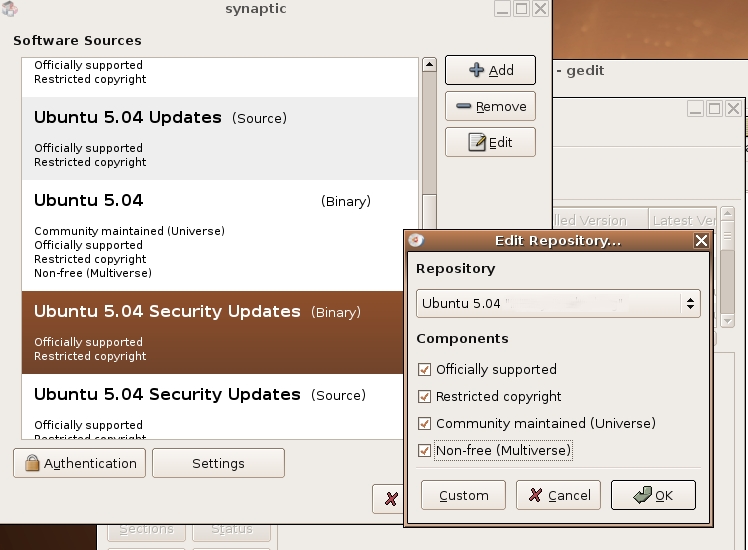
Figure 1. Configuring the Synaptic Package Manager

With Ubuntu, the package manager restricts access to two large repositories, Universe and Multiverse. In Figure 1, you can see that the restricted repositories can be added easily by the administrator. One simply checks the boxes to the left of the Community Maintained and Non-Free selections. Otherwise, the user has a limit on the applications available to him or her.

In Figure 2, you can see a screenshot of the Add/Remove Programs (the Synaptic Package Manager) the user sees if Universe and Multiverse have not become part of the users choices.
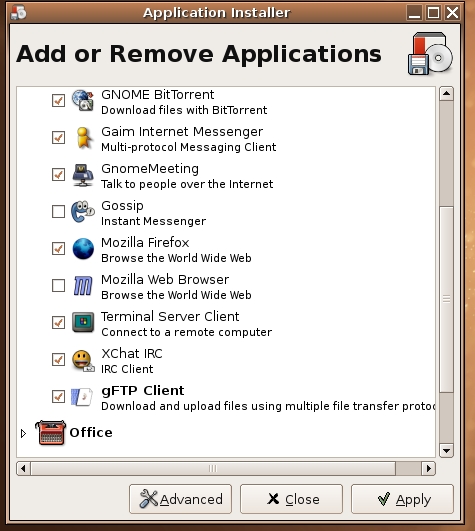
Figure 2. Add/Remove Programs Screen from Applications/System Tools Menu

Overall, the restrictions on a user's ability to download programs gives more control to the system administrator.

For users who install and configure their own Ubuntu workstations, they can access configuration tools by setting up the administrator's password. This provides a compromise for the consumer market and the enterprise.

Now, let's continue our discussion of where Ubuntu fits. In addition to the markets discussed above, Ubuntu fits enterprises in emerging nations around the globe. The global market should have less of a knee-jerk reaction to the African name of the distribution than some Americans might have.

Eventually, Ubuntu should appeal to the market segment beyond the innovator/early adopter class we discussed in Part 5 (see Resources) and also appeal to mainstream users in the US. If a company called Yahoo can gain acceptance in the starched-shirt world of Wall Street, Ubuntu likewise can become acceptable to a vast number of users looking for a fun Linux distribution.

My Thoughts

A friend suggested Ubuntu to me several months ago at a Linux users group (LUG) meeting. I did not take advantage of the opportunity to try the distribution at that time. However, I did listen to my friend's description of Ubuntu, and based on his enthusiastic manner of speaking, I later downloaded and tried it.

The Ubuntu distribution uses Debian as its base, as does Xandros and Linspire. Debian-based distributions have not impressed me in the past. However, Ubuntu combines the stability of Debian with the leading-edge features of RPM-based distributions such as JDS, Red Hat and SUSE. Therefore, I see Ubuntu as the best of both worlds.

I put the distribution through some tough tests and found that I had to do less customizing with this desktop than any of the others I have tested. Figure 3 is a screenshot of CrossOver Office 4.2 installing a Win32 application I find useful.
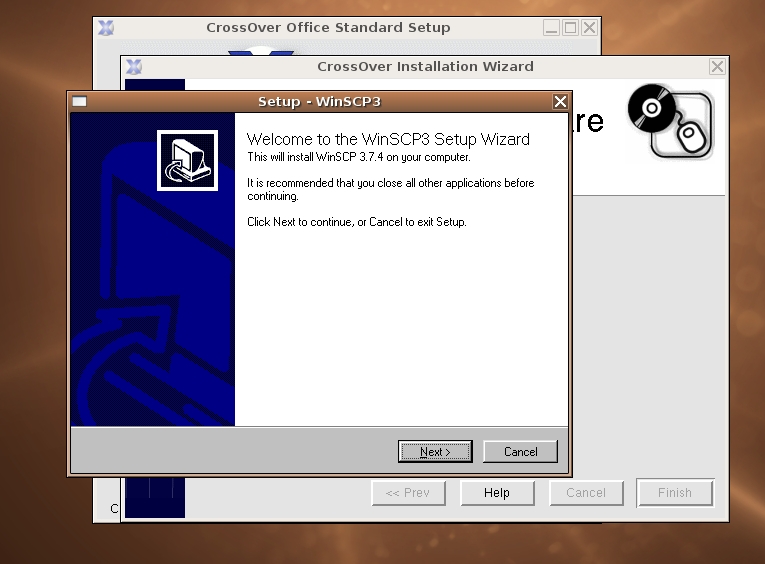
Figure 3. Installing WinSCP with Codeweavers CrossOver Office 4.2

The installation of CrossOver Office went smoothly. I installed it from the command line with a simple dpkg -i command, after which the Crossover menu came up without a problem.

Although I have access to any pricey distribution I want, I have started using Ubuntu as my standard desktop. I installed Skype and several other programs I use regularly. Overall, this distro performs well.

Part of my work day involves using a Linux desktop as a window manager on which I can open multiple terminals and use the command line. Ubuntu allows me to use multiple desktop workspaces correctly. I can switch between virtual workspaces without having to see every application open on the system.

At other times, I use OpenOffice.org's word processor, The GIMP, Evolution and Firefox. For all of these, Ubuntu opens applications quickly and has a pleasing look and feel. It fits my needs as writer and author.

As a system administrator, I would deploy and use Ubuntu. Although the enterprise tools I have written about in past articles are not yet available for Ubuntu, they will arrive in the near future. Ubuntu's sponsor, Canonical Ltd., has the necessary funding and a history of succeeding quickly and efficiently.

I anticipate that Ubuntu will become the mainstream Linux distribution globally. As the saying goes, though, only time will tell. However, if you do your due diligence on the company, the sponsor, the spirit of innovation and success of the Ubuntu people, you probably will come to the same conclusion. All the elements have gone into play for rapid success. As they say in my part of the country, this dog can hunt. In addition, it can point and win a show or two if need be.

Tom Adelstein works as an Analyst with Hiser+Adelstein, headquartered in New York City. He's the co-author of the book Exploring the JDS Linux Desktop and author of an upcoming book on Linux system administration, to be published by O'Reilly and Associates. Tom has been consulting and writing articles and books about Linux since early 1999.

__________________________


Special Magazine Offer -- 2 Free Trial Issues!
Receive 2 free trial issues of Linux Journal as well as instant online access to current and past issues. There's NO RISK and NO OBLIGATION to buy. CLICK HERE for offer

Linux Journal: delivering readers the advice and inspiration they need to get the most out of their Linux systems since 1994.

Sorry, offer available in the US only. International orders, click here.

Comment viewing options

Select your preferred way to display the comments and click "Save settings" to activate your changes.

linux

On October 2nd, 2007 enigmas mp3 (not verified) says:

stack we the user-space? Can networking/TCP into put Thanks.

acztfkgr

On October 1st, 2007 Anonymous (not verified) says:

ijqrwzvr

On September 29th, 2007 Anonymous (not verified) says:

One of the very best Linux Distro around

On October 18th, 2005 Andre Proulx (not verified) says:

Ubuntu is truly outstanding. Based in Debian and so easy to pilot.
Beautiful article.

On a role

On April 21st, 2005 IT-dude (not verified) says:

Tom,
Since you're on a role with these articles (I've enjoyed them very much), I suggest you consider looking at Libranet for your evaluation. They just released a new version a few days ago, and judging by the response from the users on the forums, it looks like it might be the ticket.

In addition, they claim on their website, that commercial organizations and educational institutions are using Libranet. Whether there is any truth to those claims is another matter, but an objective evaluation (based on your outlined criteria) can still be made for this promising distribution.

http://www.libranet.com/

Cheers mate.

tdfxwtnf

On September 7th, 2007 Anonymous (not verified) says:

zancfbls

On September 7th, 2007 Anonymous (not verified) says:

Great Article - Fantastic Distro

On April 20th, 2005 Steve Beamer (not verified) says:

I switched to Ubuntu late last year when I purchase a new machine that came with Fedora Core 3. I had been using a very similar distro called Libranet since I switched off of Redhat when their support model changed. I find this the best distribution for the "knowledgable user" and I'm glad to see it's popularity showing that others agree with me.

Ubuntu != Canonical/Mark Shuttleworth

On April 20th, 2005 jsg (not verified) says:

Sure Ubuntu has gotten pretty popular in the charts lately, but you didn't consider the bit community behind it. Canonical does employ people to develop Ubuntu, but the larger part of it is the Ubuntu community - volunteers to be exact. For Ubuntu to become mainstream, it needs community acceptance just like what happened to Red Hat before they became commercial...

You can't just ignore the community effort. Canonical/Mark Shuttleworth's funding is a good push, but its not all about money to make it No. 1

I don't understand the tone of your comment. Did I miss something?

We didn't mention Mark or Canonical Ltd. - in fact, the article discusses the community. I haven't seen the kind of excitement Ubuntu has generated in the Linux community for years -- and I have worked in this community for years.

IMHO, when the mainstream Linux distributions went commercial, the excitement in the community seemed to wane. I'm glad to have Ubuntu because of the excitement. I filed my first bug report last weekend and got several emails about it within an hour.

I haven't seen that in a long, long time.

I think we acknowledged the community here. I also don't believe any open source product has enterprise viability without vibrant and supportive community involvement.

Having read several of Shuttl

On April 20th, 2005 Anonymous (not verified) says:

Having read several of Shuttleworth's list postings, I feel certain that he would agree with you. Ubuntu has done well in a short time and the members of the Ubuntu community should be proud, as should the developers of the Free Software distributed by Ubuntu. That reminds me, I need to send in my small donation for the wonderful system that they have given me. Thanks, to all you wonderful Free Software people!

ubuntu fails to boot from external USB 2.0 hard drive

On April 20th, 2005 Anonymous (not verified) says:

I could install ubuntu 5.04 just fine on external usb 2.0 hard drive. But at boot time it gave kernel panic. FYI, from same drive, I can boot mandrake 10.1 without any problem.

ubuntu fails to boot from external USB 2.0 hard drive

On April 20th, 2005 Anonymous (not verified) says:

Linux Journal is not the appropriate place to post issues that are normally handled by a comunity mailing list or forum.

ubuntu fails to boot from external USB 2.0 hard drive

On April 20th, 2005 Anonymous (not verified) says:

Yep. Trolling's best handled at /. You're a Mandrake fanboy taking a shot. Do it somewhere else.

I don't think he was trolling

On April 23rd, 2005 Anonymous (not verified) says:

I don't think he was trolling; I think he was mistaken about where to post problems.

Ubuntu looks good, but missing proactive security defenses

On April 19th, 2005 David A. Wheeler (not verified) says:

Ubuntu looks good in many ways. However, it doesn't seem to include many proactive security defense mechanisms that deal with imperfect applications. Sadly, it doesn't appear that perfect code is available this year, so operating systems need to include mechanisms that detect and counter common vulnerabilities caused by common errors in applications. For example, ExecShield (included in Red Hat's Fedora Core and Enterprise Linux) protects against buffer overflow attacks. Of the 16 secuirty issues published by CVE that were more grave than a denial of service, and for which there was an exploit available, 75% of them were countered ExecShield.
Temporary file races, double-frees, and other security-relevant errors in applications can often be detected and countered by the operating system. I don't think it'd be too hard for Ubuntu to add this, but they should do so for safe use by an Enterprise.

ExecShield

On April 19th, 2005 Ralph (not verified) says:

Howdy,
At the risk of being characterized as a self appointed guru, I don't think Ubuntu is quite ready for the Enterprise market, either. It is a real fun little distro and has come along quickly. If they set their sights on the Enterprise market they could be competitors before long. In addition to the proactive defense mechanisms you mention, they need a way to manage and deploy client. They will get there, I bet and it is a nice hobbyist distro for now.
Good day

proactive security defenses

On April 19th, 2005 tadelste says:

David,

Thank you for your well regarded remark and suggestion. Also, thank you for the kind way you expressed yourself. I hope everyone will read the link on ExecShield in your post. You passed along extremely valuable information and I hope it doesn't get missed because of the nice manner in which you stated it.

All the best

Tom

A green light for Ubuntu in the Enterprise...

On April 19th, 2005 Curtis (not verified) says:

Your review seems to indicate a green light for Ubuntu in the Enterprise. I noted an interesting trend last year in some of the corporations using Linux. There were a number of stories about large companies that had been using Red Hat or other "Enterprise Ready" distros changing to Debian. Having worked at two Linux companies before, I had seen this same migration happen within the engineering staff in both companies. (Even with a policy to use a given distro.)

Having started using HJ Lu's linux floppys years ago (This would be the year 1 B.D. (Before Distributions)) and having migrated through many distros I have ended up using Debian most of the time. I must say it is interesting to note the mind share that all the Debian based distros have when combined.

The fact is that if you have an IT staff that is familiar with Linux you will get more out of a Debian based distro then any other distro and with less effort. (The reverse may be true (in some instances) for newcomers to Unix/Linux.) Thus we see the experienced making the migration.

Ubuntu is an absolutly great addition to the Debian family of distros. They are removing the (small) newcomer learning curve barriers to using Debian.

Having helped a number of people through the learning curve I would highly recommend either Ubuntu or Debian for setting up computer systems to solve real world problems.

I'd also encorage participation in both projects and to say thanks to the Debian and Ubuntu developers.

P.S.
(Debian is fine if you have used Unix before, have good HW knowledge (know what an MBR and boot record are), or have a helper who uses Debian.) In fact there have been instances on some machine that I could not install Red Hat or Madrake but Debian worked fine. That can be the price of trying to simplify for some lowest common denominator. A process that required a little HW knowledge also allows working around minor problems or oddities.

Ubuntu is great, but...

On April 19th, 2005 Ashland (not verified) says:

I like Ubuntu and use Kubuntu (KDE version) for some of my systems. I like the philosophy and the Debian roots.
but...
I love Libranet 3.0
It is not free, but has been so well debugged that it will save me money in time not wasted. It uses pure Debian, so all the Debian sources work and has the easiest install I have ever seen in any OS. Everything just works.

Wish you would consider trying a Desktop Review on Libranet.

http://www.libranet.com

Ubuntu is great, but...

On April 19th, 2005 Anonymous (not verified) says:

You might consider writing a comment like this to the editor rather than as a comment to article. Libranet as a software product is one thing, as an organization it's quite another.

Since I've been reading this series, Tom keeps reiterating that this is about enterprise desktops or distributions capable of providing desktops for the enterprise. He even reiterated it here.

You can go get exact clones of Red Hat Enterprise Linux from a number of places, but that's not the same thing as getting Red Hat's enterprise package. Software is one thing but delivering it to a large organization such as a school district (my case) is a totally different proposition.

I'd go with Ubuntu because it is free, developed with historically underprivileged organizations and countries in mind. You can pass out the disks and it's exciting. My 2 cents.

Yoohoo for Ubuntu

On April 19th, 2005 Ralph (not verified) says:

It was good to see this distro reviewed. It is the best new Linux distro I have seen in the last 2 years, at least. With the Debian hackers they have attracted and the support that Canonical is giving it, I think the author is right when he says:
"I anticipate that Ubuntu will become the mainstream Linux distribution globally"

Hoary has been better than Warty for me, except for some kind of problem in the sound system. I have noticed, when playing videos, that the sound gets out of sync. I did not have that problem with Warty and I do hope they get it resolved.

And I want to point you to two useful resources for Ubuntu
http://www.ubuntulinux.org/wiki/FrontPage/recentchanges
http://www.ubuntuforums.org/

I enjoyed the review.

Ubuntu is the first Linux I r

On April 19th, 2005 Anonymous (not verified) says:

Ubuntu is the first Linux I really feel attached to. Its been working so perfect for me :). I cannot see using anything else...

ubuntu

On April 20th, 2005 Anonymous (not verified) says:

dito, i have been a linux boy for ~7 years now & have rolled out linux distros on the desktop in 2 enterprises. ubuntu is the best that i have ever seen.

in the last 2 months, i have use, fedora, mandarake, suse, knoppix, pure deb (sarge), kanotix & ubuntu. i'm on the road a lot & in need a distro on my notebook that 1) won't fall over 2) detects all my new hardware & it has to be multi-lingual japanese, chinese, korean, spanish, french, & i don't want to pay a cent for it, though i don't mind paying for service. While there are some bugs in ubuntu, out of the distros I have tried (& I think i have covered most of them) this is the only distro that is delivering a fast, stable, everything working multi-lingual environment for free.

i cant help

On September 30th, 2007 sohbet (not verified) says:

i cant help

Perhaps you should all take a

On April 20th, 2005 Anonymous (not verified) says:

Perhaps you should all take a look at Mepis. (www.mepis.org), it is far easier than Ubuntu to deal with and install.
I used to use Ubuntu, but found that even with Universe enabled, their repository is still a bit limited. Add to that the have added Xorg to the mix and you will find that you don't have a lot of backwards compatibility with the Debian repositories.

Will see

On April 20th, 2005 Anonymous (not verified) says:

I'll surely check out mepis.. but how can it be more easy than Ubuntu?

Anyways, i think ubuntu will become most popular of all and will gather the largest development community.

Ubuntu and another

On April 28th, 2005 William Roddy (not verified) says:

I'm impressed with Ubuntu. The small-repository-selection is a red herring. It's a great distribution with a great future.

For those of you who need a proven enterprise solution, why not use the one that's on thousands of machines, x86 and 64, at the top physics research facilities throughout the world (Fermilabs, CERN, Cambridge, Johns-Hopkins, Los Alamos, MIT, the University of Kansas, Laboratori Nazionali di Frascati in Italy, and so many, many more, it's hard to keep track).

Scientific Linux is Red Hat EL4, rewritten from the source, scrutinized by the best programmers in the world, and used by the most important scientists. It is stripped of vendor ID, perfectly legal, has a history that goes back almost a decade, and yet no one knows about it. If ERRATA is needed, that, too, is thoroughly scrutinized before it is sent out into the field.

Scientific Linux will work in any environment Red Hat would, and even better. www.scientificlinux.org. It's a work of art and genius, and in the filed of high-energy physics, if this Linux didn't work, it wouldn't be used.

Yet it is useful to anyone. If you demand stability and security, you will not do better. It will always be there and it will always be free.

Ubuntu and another

On April 28th, 2005 William Roddy (not verified) says:

I'm impressed with Ubuntu. The small-repository-selection is a red herring. It's a great distribution with a great future.

For those of you who need a proven enterprise solution, why not use the one that's on thousands of machines, x86 and 64, at the top physics research facilities throughout the world (Fermilabs, CERN, Cambridge, Johns-Hopkins, Los Alamos, MIT, the University of Kansas, Laboratori Nazionali di Frascati in Italy, and so many, many more, it's hard to keep track).

Scientific Linux is Red Hat EL4, rewritten from the source, scrutinized by the best programmers in the world, and used by the most important scientists. It is stripped of vendor ID, perfectly legal, has a history that goes back almost a decade, and yet no one knows about it. If ERRATA is needed, that, too, is thoroughly scrutinized before it is sent out into the field.

Scientific Linux will work in any environment Red Hat would, and even better. www.scientificlinux.org. It's a work of art and genius, and in the filed of high-energy physics, if this Linux didn't work, it wouldn't be used.

Yet it is useful to anyone. If you demand stability and security, you will not do better. It will always be there and it will always be free.

Ubuntu and another

On April 28th, 2005 William Roddy (not verified) says:

I'm impressed with Ubuntu. The small-repository-selection is a red herring. It's a great distribution with a great future.

For those of you who need a proven enterprise solution, why not use the one that's on thousands of machines, x86 and 64, at the top physics research facilities throughout the world (Fermilabs, CERN, Cambridge, Johns-Hopkins, Los Alamos, MIT, the University of Kansas, Laboratori Nazionali di Frascati in Italy, and so many, many more, it's hard to keep track).

Scientific Linux is Red Hat EL4, rewritten from the source, scrutinized by the best programmers in the world, and used by the most important scientists. It is stripped of vendor ID, perfectly legal, has a history that goes back almost a decade, and yet no one knows about it. If ERRATA is needed, that, too, is thoroughly scrutinized before it is sent out into the field.

Scientific Linux will work in any environment Red Hat would, and even better. www.scientificlinux.org. It's a work of art and genius, and in the filed of high-energy physics, if this Linux didn't work, it wouldn't be used.

Yet it is useful to anyone. If you demand stability and security, you will not do better. It will always be there and it will always be free.

Ubuntu and another

On May 2nd, 2005 Anonymous (not verified) says:

The small repository exists by design. Ubuntu users can enable universe and multiverse repositories and obtain the largest set of applications on the planet.

Saying that "Scientific Linux is Red Hat EL4, rewritten from the source, scrutinized by the best programmers in the world, and used by the most important scientists" is a fraudulent statement. It is not Red Hat EL4. Who says its programmers are the "best" in the world?

Whatever value it had, you have tainted it by misrepresentations.

Seasoned Linux professionals would not attempt to suggest RHEL 4 to the general user as it is complicated and requires training.

it cant help

On September 30th, 2007 sohbet (not verified) says:

it cant help

I agree on Scientific

On October 17th, 2005 Anonymous (not verified) says:

I agree on Scientific Linux.
Note that there are 2 main versions of Scientific Linux:
1. Scientific Linux 3/4 - with homepage at https://www.scientificlinux.org
and
Scientific Linux CERN 3/4 - with homepage at http://linux.web.cern.ch/linux/

Although they sound so similar and have similar roots...they are not exactly the same. And the CERN edition of Scientifi Linux is the one that is most deployed in CERN and it's subsequent middleware (SLC) - like LCG and other GRIDs, note that SLC uses apt-get for high level package management ( deps tracking etc. )

Another aspect is: SL is NOT RHEL, so you won't have any RH support whistles, you are on your own.

Those above are great distributions: they give you Enterprise Linux, for free.

but, Ubuntu has nothing to do with them. the moment Ubuntu declares it has an installation selection for enterprise server - then we shall compare them.

By the way, there's a new version of ubuntu already out, 5.10, and thanks to it my laptop (LG LS50A) can suspend to RAM smoothly. I only have to get the driver for SD cards reader, then I can declare it is FULLY supported.

Cheers.

xltvyxlb

On September 8th, 2007 Anonymous (not verified) says:

It is fascinating how Ubuntu

On December 8th, 2005 JanD (not verified) says:

It is fascinating how Ubuntu in less than a year has become the most popular linux distro. Check out this Ubuntu community as well, good site for Ubuntu beginners.

You got me convinced.

On January 5th, 2006 lennart (not verified) says:

ok you got me. I will check out ubuntu. :)

sohbet

On October 16th, 2007 sohbet (not verified) says:

Featured Videos

Email is one of the least private and least secure forms of communication, although few people realize this. MixMaster is one way to allow secure, anonymous communication even over the very public medium of email. This tutorial will get you started with MixMaster quickly and easily.

In case you were wondering about the fun side of Linux World Expo, we thought we'd give you a peek at our shenanigans. We at Linux Journal love what we do so much, that we can't help but have a ball wherever we go.

From the Magazine

September 2008, #173

Feeling a bit like a Thermian? Never give up, never surrender! Someday, you could go from underdog to top dog. Just take a look at a few of the underdogs we highlight in this issue: Mutt, djbdns, Nginix, Gentoo, Xara and the program voted mostly likely to fail just a few years back—Firefox. If Firefox not radical enough for you, check out Chef Marcel's column for some more alternatives. Having trouble mapping your program data to your relational database? If so, Rueven Lerner shows you some tricks in his At The Forge column.

Need to run GUI applications on your server in the next state? In his Paranoid Penguin column, Mick Bauer shows you how to do it securely. Kyle Rankin keeps hacking and slashing and shows you a few split screen secrets you may not be familiar with. Finally, we all know what happens next February, but only Doc knows what happens afterward.

Read this issue