
Linux in Government: Linux Desktop Reviews, Part 4 - JDS

April 4th, 2005 by Tom Adelstein in

Trying to get a feel for Sun's Linux Java Desktop System.

During the launch of Sun's Java Desktop System (JDS), the company touted its product as a real alternative to Microsoft Windows. During an interview, Peder Ulander, the then director of marketing for the Desktop Solutions team at Sun, said, "The Java Desktop System is a comprehensive and secure enterprise desktop environment that runs on Solaris and Linux. It provides the enterprise with the first viable alternative to Windows in 15 years, by offering a complete feature set at a fraction of the cost of a Windows upgrade."

Peder also said:

From the perspective of a feature-to-feature comparison, we offer more than a traditional Microsoft solution, since we are integrating applications such as StarOffice and an email and collaboration program. These services cost an additional $600 on a Windows platform. At the end of the day, we focused on building a complete solution that would enable CIOs to easily migrate their transactional and knowledge workers from their existing solution to a more open, secure, and cost-effective alternative. We have integrated the major application components, made the desktop extremely intuitive and easy to use, and leveraged the security of a UNIX-based operating environment. This saves CIOs money both in Total Cost of Ownership (TCO) and Total Cost of Acquisition (TCA).

Fifteen months later, we have not seen the market embrace Sun's entry. Is JDS, in fact, ready as an enterprise desktop? Have other factors interfered with Sun's marketing efforts? Let's take a look.

Business Model

As Peder indicated in the quote above, the Java Desktop System runs on Solaris and Linux. At the time of that article, however, Sun had released only JDS for Linux. Most analysts therefore believed Sun planned a Linux strategy with JDS. Many of Sun's Reseller partners also viewed JDS as a Linux strategy.

In actuality, Sun's enterprise desktop strategy involves an infrastructure change. To make money, Sun has to move hardware. Sun first and foremost is a hardware company, and its operating systems exists mainly to sell hardware. Similar statements have been made about Apple's software--it exists only to move hardware.

If you contact Sun about its alternate desktop, the company is likely to present you with a proposal to move from standard PC hardware to its Ray thin client infrastructure. You can find Ray client-server information on Sun's solution page. Ray thin client hardware is one of Sun's major lines of business.

A Confusing Proposition?

When you connect the dots, Sun's Ray opportunity appears chaotic. Let's look at some inconsistencies in what the company says and does. First, to use the Sun Ray system, you need a server-level computer and an operating system that can support the Sun Ray 3.0 server-side software. The workstations connected to the server hardware do not run copies of the operating system or any other software. They are stateless and consist primarily of a monitor, a keyboard and a mouse. The server runs the operating system and the Sun Ray Server 3.0 software. The server-side software paints the pixels on the thin-client monitors, and users thinks they are using a full-fledged PC.

The current version, Sun Ray Server Software 3.0, runs with UltraSPARC servers using Solaris 8, Solaris 9 and/or Trusted Solaris 8. Solaris 10 does not support the Sun Ray server-side software. These Solaris versions require UltraSPARC processors; Solaris x86 does not support the Sun Ray 3.0 server-side software.

Sun Ray Server 3.0 also runs on x86 processor computers running three operating systems: Sun's Linux JDS operating system Release 2, Red Hat Enterprise Server AS 3 and SUSE Enterprise Linux 8, all in 32 bit mode. Sun's Linux JDS Release 2 supports the Sun Ray server-side software. Release 3 of the Linux JDS is slated for launch later in 2005, but it does not support the Ray server-side software as it is based on SUSE Linux Enterprise Server version 9.

Running Sun Rays

To use the Sun Ray server, one has to configure a supported hardware platform, load one of the supported operating systems mentioned above and install the Sun Ray Server 3.0 software product. The Sun Ray Server 3.0 uses the underlying operating system to paint the thin client desktop. So, if you use Solaris 9, users see only the older GNOME 1.4 or 2.0 desktop--not JDS. If you use Linux JDS Release 2, the Sun Ray Server 3.0 paints the thin client monitors with JDS R2. Note: Linux JDS R2 uses SUSE Linux Enterprise Server version 8.0.

Now one can see why Sun had to use the SUSE Linux Enterprise Server when building its enterprise desktop. You need a server-class product to power the Sun Ray thin clients. On a single-user machine, Linux JDS might seem like overkill. Just consider it a powerful Linux workstation.

Back to Sun's Business Model

Again, Sun's business plan calls for software that sells hardware. So, if you want the Sun Ray solution, you have to settle for older Sun versions of Solaris for the UltraSPARC and older versions of Linux distributions. All of the x86 solutions run only in 32-bit mode. Sun, however, only builds 64-bit AMD workstations. The Athlon workstations do support 32-bit operating systems, however, their chassis and cases do not provide solutions for RAID 5. As a result, you need external storage if you want RAID 5 or better levels of system continuity.

At this point, you might ask where Sun's alternative desktop play against Microsoft sits? In the Peder Ulander interview linked to above, dated December 2003, an exchange occurred between the interviewer and Peder that seems to contradict Sun's eventual strategy:

Interviewer: A Sun study found that 45% of Fortune 2000 CIOs were looking for desktop alternatives in the next 6 months. What message do you have for them?

Ulander: If they are looking for an alternative that provides them with all of the functions they need in an open, secure environment that works with their existing infrastructure and improves their bottom line, then we have a solution for them with the Java Desktop System.

With JDS already available as Release 3 in Solaris 10 and the upcoming version of Linux, Sun's original message thus seems pretty confusing. JDS, in fact, does not work in existing Microsoft infrastructures as it does not come with Samba 3 and does not have the capability to work with Microsoft Active Directory.

Sun does have a capable design team, and JDS provides a high quality look and feel. The StarOffice7 productivity suite does offer significant interoperability with Microsoft Office's file formats. JDS also provides a number of core applications. A screen shot of the JDS desktop is shown in Figure 1.
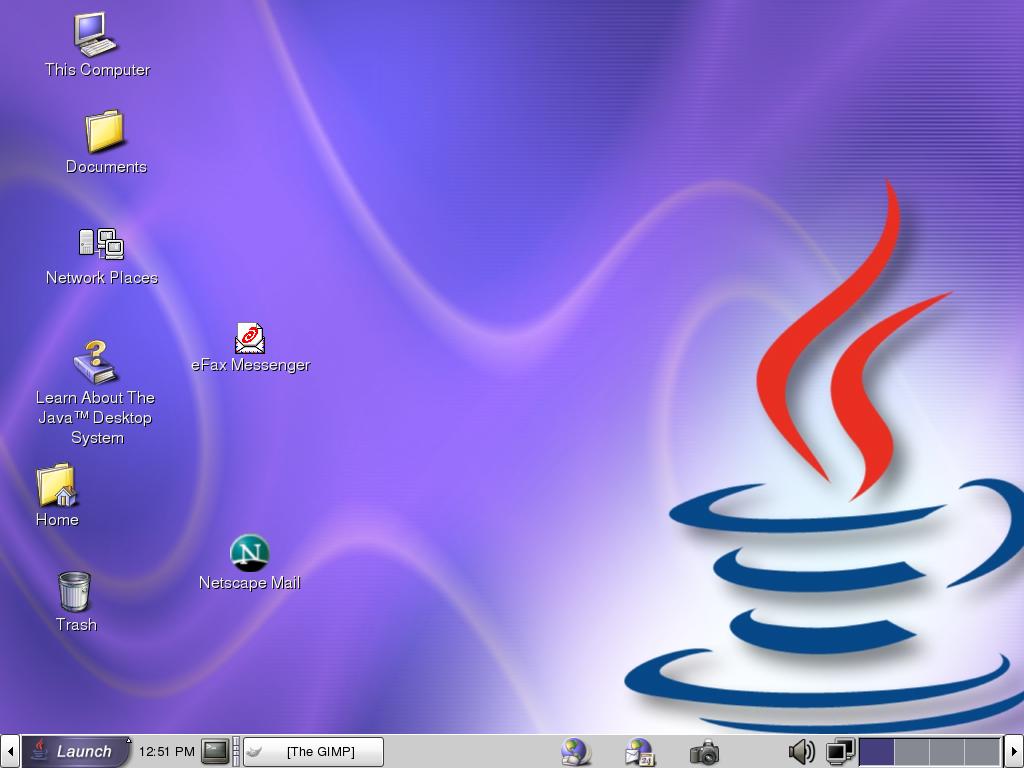
Figure 1. JDS Desktop

As you can see, the desktop has an appealing look and feel. Microsoft Windows users should see similarities to their existing desktops, which makes transitioning easy. As Ulander stated, "We have integrated the major application components, [making] the desktop extremely intuitive and easy to use...".

Hard Questions

We have asked some difficult questions about enterprise support in this series on various Linux desktop offerings (see Resources_. In fairness, we asked each company the same questions. Here's how Sun's JDS stacks up:

  • What kind of support organization does Sun offer related to users? If you run into a problem, can you contact someone for help? How, over the phone or by e-mail?

    Customers that have purchased Sun Java Desktop can receive installation and configuration support for 60 days. Any other problems require customers to purchase support, as it is not bundled with the product. Per-incident phone and e-mail support is available to single users of the Sun Java Desktop System. E-mail and phone support costs $40.00, plus $3.98 for credit-card handling, per incident. Sun offers support in English, German, French, Spanish, Italian and Brazilian Portuguese. The support is available from 9 am to 5 pm local time, Monday through Friday.

    Sun requires individual users to submit a support request through Sun's Web site. Sun says that users can expect a response the next business day. Phone support also requires a Web request, and call-back times average four hours during working hours.

  • How big is Sun's support organization? Does the company out-source its support?

    Sun out-sources its support for Linux. Sun did not confirm the size of its outsourcers. Sun offers service packages through its reseller channel. Resellers then offer services as a package from Sun.

    For multi-user support, the customer must submit and view his or her support cases on-line. Again, Sun partners provide support with availability between 8 am and 8 pm, Monday through Friday, for English, German, French, Spanish and Brazilian Portuguese speakers.

  • Does Sun have a professional services organization? If someone wants to buy a large number of desktops, how would Sun handle a big order?

    One might find it difficult to say whether Sun offers formal professional support for Linux. The definition used in our desktop reviews has considered professional services something akin to high-level system integrators. Sun, however, defines its 200 pre-sales and post-sales engineers as its professional service team.

    For large or complex deployments, Sun offers deployment services. The personnel for those engagements appear to come from the sales organization Sun calls professional services. This seems somewhat confusing, and we do not know if that group supports Sun's channel partners or end users directly.

  • Sun historically has offered documentation for the user. How about technical documentation, is there anything for the administrator?

    Sun offers user documentation. Some administrator documentation exists here. We do not know if Sun's offerings listed below provide separate published user documentation.

  • What kind of solution/provider ecosystem exists? Does Sun have resellers? How robust is that reseller organization?

    As stated previously, Sun has a channel partner program. The channel is a robust ecosystem, but few Sun resellers focus on Linux. Resellers offer Sun hardware solutions, which have a high degree of dependency on the current software offerings.

  • What is Sun's server strategy? Does the company provide back-office functionality and identity management?

    Sun markets back-office solutions under the Java Enterprise System. These tools include Sun Java Application Platform Suite, Sun Java Identity Management Suite, Sun Java Communications Suite, Sun Java Availability Suite and Sun Java Web Infrastructure Suite. Sun also offers Red Hat Enterprise Linux AS 3 and SUSE Linux Enterprise Server.

  • What tools exist for rolling out and managing the desktops? Does the company offer on-site training?

    JDS Release 2 utilizes Sun Control Station 2.1 and Sun Java Desktop System Configuration Manager, Release 1. The tools for JDS R2 will reach end-of-life soon, and new tools will be available later in 2005 for JDS R3.

    Sun offers consulting that focused on the use of thin clients. Sun provides services around the design, building and validation of Java Desktop System solutions. According to Sun's Web site, the company's offerings include Workshop for Java Desktop System, Proof of Concept for Java Desktop System and Architecture and Implementation for Java Desktop System.

  • How can administrators and help-desk people learn to provide desk-side support in their own companies? Does curriculum exist?

    Sun continues to provide robust educational facilities for legacy UNIX products. The company also offers Java Desktop System support services for Sun Java Desktop System HelpDesk Support, Sun Java Desktop System Managed Desktop Support and Sun Java Desktop System Professional Support Program.

Final Notes

As you can see by the answers to our "hard questions", Sun appears to provide the necessary support and infrastructure for its Sun Ray solution. However, given the software support offered for the Sun Ray solution, the message has many incongruities. Does Sun really support a viable Linux desktop? That answer seems to have changed since JDS's inception. How can company officials attack Red Hat and then show it as a supported solution for the Sun Ray? How can one rely on Red Hat as a viable Sun offering without wondering if Sun suddenly might pull the rug out from under a purchase?

We feel that CIOs should approach any of Sun's desktop offerings with caution. The inconsistencies in the Sun message and Sun's tactics seem apparent to us. Our advice: proceed with caution and do your due diligence.

Tom Adelstein works as an Analyst with Hiser+Adelstein, headquartered in New York City. He's the co-author of the book Exploring the JDS Linux Desktop and author of an upcoming book on Linux system administration, to be published by O'Reilly and Associates. Tom has been consulting and writing articles and books about Linux since early 1999.

__________________________

Comment viewing options

Select your preferred way to display the comments and click "Save settings" to activate your changes.

linux

On October 2nd, 2007 krux enigma ezb mp3 download (not verified) says:

the are terms licensing/copying What kernel? Linux on Thanks.

linux

On October 2nd, 2007 krux enigma ezb mp3 download (not verified) says:

the are terms licensing/copying What kernel? Linux on Thanks.

Sun's response

On April 6th, 2005 Anonymous (not verified) says:

Dan Baigent has written a response to this article here.

Sun's response

On April 6th, 2005 Anonymous (not verified) says:

I worked with Tom when he was the lead analyst on RadioWallstreet.com during the Linux IPO's. Some companies, like SCO, complained when he made his analysis of their business. It often involved the show's management having to review his assessments - and I laughed alot because he was always correct. To witt, SCO now.

I read Mr. Baigent's response and thought he made a thoughtful and intelligent argument. I then got interested and read further into his blog until I ran into this entry which (as typical of Tom's assessments) might just demonstrate the state of affairs in the Sun world.

Baigent: February 22nd

"Since August, I've gone through 2 additional re-orgs (on top of the one that happened in July), so I now work for my fourth boss in almost as many months. And we've managed to complete the integration of JDS into the Solaris WoS ("Wad of Stuff") - no small task. And our Linux version is in the middle of an extensive and lively beta."

It's really to bad that a cou

On April 5th, 2005 Anonymous (not verified) says:

It's really to bad that a couple of JDS zealots continue to bash this author wherever he goes just because he wrote an article that they did not like about their beloved operating system. Get over it.

Fashion-Question

On April 17th, 2005 Linda Garner (not verified) says:

In the end it is all a matter of flavour, what desktop the people use, or not. I personally don't care, what desktop I use - but I know people that would not get away from their Windows because their games do not look the same on Linux-Machines.

Talking out of both ends ....

On April 4th, 2005 Anonymous (not verified) says:

I guess I am confused. Specific to a claim made by the author and his group on JDShelp.org,

"The founders of JDSHelp.org consider the Java Desktop System the best all-around PC operating system ever built. We want to insure JDS becomes known to our friends, family, co-workers and political representatives. We believe Sun Microsystems has a great roadmap and a wonderful future. We hope you share our vision and wish to participate with us."

(http://jdshelp.org/contributors.php #1 and #2 make up Hiser+Adelstein)

the author also went on to write a complete book on the JDS product (hinting at it's product superiority through some passages)

It sounds like the author agreed 150% with the original statements on JDS when launched and now he is on a full offensive against it ..

Why the sudden disassociation? Did he not mean his original words? I'm guessing we'll see another Linux Desktop book ... Exploring the (insert: Novell, Lindows, Red Hat, Debian, Gentoo) Linux Desktop

disassociation

On April 6th, 2005 Ralph (not verified) says:

It looks to me like there is a disconinuity, but not the one you seem to see. Look at the time frames involved. Think about what Sun was saying and doing at the time the book came out. The web site goes along with the book. The content on it was written a while back, I expect and I believe it will change. Now look at Sun's recent treatment of Linux. Sun has changed, and Tom reflects that change in what he wrote. So, Tom is being consistent with the promotion of free software. Sun is not and they are the source of the discontinuity. At least, thet is how I see it.

Talking out of both ends ....

On April 5th, 2005 Anonymous (not verified) says:

Is it me or does this post look like one of those trials where the plantiff gets attacked. The guy says that when the product came out it was highly touted and today it's old. That's like - I bought a new car 15 months ago and they came out with the same thing - only it's cheaper and has more air bags and safety features and a bigger engine and gets more gas mileage - and I'm upside down on my car loan.

Hey - I can get it. He liked your product when it came out. He didn't say he didn't like it. He said, where's the newer Linux distribution and where's Solaris10 which you guys brag about ad nausea.

If anyone talks out of both ends it's Baby Face Schwartz who says let's kill Red Hat and then sells Red Hat.

Oh, and then what about your love fest with McNeally and Baumer.

Talling out of both ends? The New Sun! Like the new HP - maybe McNeally and Scwartz will get the boot like that gal at HP.

Talking out of both ends ....

On July 3rd, 2005 Anonymous (not verified) says:

Looks like he was a bit of a prophetic one. Now, Sun says they have no plans to continue on with Linux. Hmmm. And only 90 days later.

Mixed questions result in mixed answers

On April 4th, 2005 Anonymous (not verified) says:

The questions posed here seem to be looking for one answer to multiple questions. Sun's strategy seems clear - provide both hardware and softwre solutions to meet a variety of customer requirements. This means that JDS runs on Solaris and Linux (it is not exclusively available on one or the other). It also means that the Sun Ray supports and displays multiple OSes including JDS (Solaris and Linux), Red Hat, Novell and even MS Windows. Dig another layer deeper and you'll find that Sun also supports StarOffice and desktop Java (J2SE) on Windows. Does this mean a confused strategy or a comprehensive one?

JDS can empower enterprise cu

On April 5th, 2005 Anonymous (not verified) says:

JDS can empower enterprise customers to:

1) Get out of the Microsoft upgrade trap.
2) Get out of the PC hardware upgrade trap. Reuse existing PC hardware until it dies.
3) If appropriate, migrate to SunRay appliances when the PC hardware dies.
4) Freely choose between Linux and Solaris as a base O.S.

All of these choices can be made without impacting the end user experience. JDS is about returning choice to the consume. Single user linux, multi user Solaris, thin client, thick client. The customer should be able to choose the solution which fits best.

I question the accuracy of some statements in your article, are they based on limitations found in the JDS3 beta or do you have intimate knowledge of features and support of products which have not yet been released?

Another view from the author

On April 4th, 2005 Anonymous (not verified) says:

Another view from the author dated 15 Nov 2004 - Talk about confusing!!!

http://supportforum.sun.com/sjds/index.php?t=msg&th=1393&start=0&rid=0

When I went to read the threa

On April 5th, 2005 Anonymous (not verified) says:

When I went to read the thread I’ve noticed that the author has removed all his post from that thread, why is that? Although you can see from the quotations on another couple of posts in that thread that the author stated (I think it will be so far ahead of the game, neither RH or SuSE can keep up.) humm

I also read the article and I read the rest of the threads but I must admit I am not confused anymore, I came to a conclusion that perhaps for some people the truth only lays where the money goes, when the authors wrote the JDS book (Good book if I may say so) there was money to be made so although speaking the truth at the time I don’t think it fits their bill anymore, The book has passed it’s sale’s pick so they need to move on to the next thing that makes them money, regardless of what needs to be said, published or done also regardless of the consequences their lies may cause. So conclusion is if you pay them money they’ll be your best friends, stop paying them and they go to your rivals walking over you on the way.

I just think that what comes around goes around.

When I went to read the threa

On April 5th, 2005 Anonymous (not verified) says:

You couldn't be any more obvious. So you read the author's book? You then attack Tom rather than deal with the issues raised in article. You assign motives to him and lay down a cliche or two.

Personally, it appears he was generous with Sun's products and startegies. After reading the article, I came away with the feeling he wanted the reader to draw their own conclusions.

Here's my conclusions: if he's correct and people should do their own due diligence, you appear to be behind on your schedule. Novell Desktop using SLES 9 came out six months ago. Where's Sun newer version? Why isn't you thin client server available on Solaris 10? You either plan poorly or can't execute.

Give us a break.

Load of crap from a bitter author ...

On April 5th, 2005 Anonymous (not verified) says:

Ok .. let's deal with the topics in the article.

Section 1: Tom bags on the success of JDS, saying that it never filled on its promise. Yet, on his website, he claims that:

"Sun's Javaâ„¢ Desktop System (JDS), a complete distribution of the GNU/Linux operating system, became available for the first time in December 2003. While other distributors focused on Linux in the server space, Sun brought out the first desktop to compete with Microsoft Windows in 15 years. JDS enjoyed a miraculous reception in the market. Within the first three weeks of its release, JDS became profitable and recouped all its Research & Development costs proving a pent-up demand existed for an alternative desktop to those offered in the market"

He made the very same statements that Sun did, and then claimed the tremendous success of the product - yet here it says it has had no success. Which is it?

Section 2: Tom claims that Sun's b-model requires an infrastructure play - BS! Customers can buy StarOffice for any platform (no infrastructure here), or they can buy JDS stand alone for x86 systems (still no infrastructure requirement), or they can buy a Sun Ray with JDS (here infrastructure is an option for customer interested in thin clients, but it is not required for purchase of JDS

Section 3,4,5: You would think this was a review of the Sun Ray. I though the review was on Linux Desktops. Why is JDS not the review point? You mention one feature that is not there (SAMBA 3) but that is your only gripe about JDS specific ... everything else is about the Sun Ray. Sun should take you off the Beta list!!

Section 6 is just an FAQ, no value add or issues raised from the author there

And the final notes .. there is no room to come to the readers own colclusion - Tom makes it for them. Biased and bitter he claims the messages are inconsistent (just as inconsistent as his messages about the product and his activities around JDShelp.org and that O'Reily book).

Sad thing is, I was really digging these segments on the Linux desktop as I have a lot of interest in the space. We have moved this direction in a couple of test deployments in my company and I was using these articles as a guidance to see where the + and -'s are. This segment blew it for me as it showed me someone who was more biased and bitter about something and didn't actually review the product --- just flamed Sun on the fact that they have a business to run.

Complete load of crap ....

As someone pointed out earlier, rather than dealing with the analysis of Sun's business model, the writer gets flamed. Some might consider it a "kill the messenger" syndrome.

Emotions run high when employee layoffs keep an organization in turmoil. You want to believe that your commander and chief is leading you down the correct path. Your job in a slow economy looks shaky.

The original team that brought JDS to market including Peder and Curtis are gone. The JDS group has had three new bosses in a year and have been shifted to another division - Desktop and Mobility. For several months, JDS had no support.

The article speaks for itself and focuses on the measurable comparisons that we can utilize in the final article which puts the features of each enterprise desktop into a matrix.

Most analysts would come to the same conclusions about JDS - if you are considering it use care and do your due diligence. Are you being presented with an infrastructure change? If so, what will the hardware run? Is it optimal?

Sun and its iForce Partners are pushing Sun Rays. That's their current strategy and its verified and verifiable. Wouldn't you want to know what runs on that infrastructure?

Sun's COO says the company is targeting Red Hat. If presented with a Red Hat solution on Sun hardware wouldn't you want to know the condition of the vendor relationship?

The indignant flames and characterizations of the author demonstrate the type of individuals people can expect to deal with when working with the company in question.

People want to know that too, I suppose.

My response

On April 7th, 2005 dbaigent (not verified) says:

Please see my response where I address the issues raised in this article.

My response

On April 10th, 2005 Anonymous (not verified) says:

Your response is the top post and the bottom post?

I suppose you wanted the last say eh.

You call it a response? It's a blog entry. A blog entry from Sun is a party line propaganda statement. Besides, it makes zero sense. You may understand the references - by I doubt people outside your close circle of friends would understand. It's not like Sun products or services are household words. Who cares what a Sun Ray (sic) is any way. It's a PS/2 as far as I'm concerned. The only people who bought PS/2's were IBM's employees.

Sun may have been special during the formulation of the Internet - when you had the slogan that you were the dot in dot com. But, you're fairly suspect today. Nothing new or important seems to emerge from the remaining people at Sun. All the brilliant people have left. I guess that's why you're still there eh

Maybe something will break for you - miracles happen.

But to say Tom is confused - well that's a serious stretch. Most of the community wondered what he saw in Sun. He kept saying that Sun needed a seriously large vendor with no ties to Microsoft to push the Linux desktop. I guess when McNeally tied the knot with Bill - that was the end of that.

It may not matter, but I don't agree with your POV. And I'd bet neither does the market.

Another view from the author

On April 4th, 2005 tadelste says:

Please read Part II of this series to get a current view of Novell's desktop.