At the Sounding Edge: A September Trio
This month's column is in three sections, indicating the rather busy
month I've been having. In truth, it's been more fun than business.
So without further ado, here's the 411 from Studio Dave for September 2005.
SooperLooper
At long last, I present my promised profile of Jesse Chappell's
SooperLooper. Alas, it's going to be brief, due to the other items
I wanted to plug into this month's column. But, I think you'll find
that SooperLooper is straightforward enough to need only a brief
introduction. Afterwards, you can jump right in and start playing with
the program. If you need to know the rationale behind phrase looping
software, please see
my previous column
profiling the Freewheeling looper. Here's what Jesse says about his software on
the SooperLooper Web site:
SooperLooper is a live looping sampler capable of immediate loop
recording, overdubbing, multiplying, reversing and more. It allows
for multiple simultaneous multi-channel loops limited only by your
computer's available memory. The feature-set and operation was inspired
by the impressive Gibson Echoplex Digital Pro (EDP). When used with a
low-latency audio configuration SooperLooper is capable of truly realtime
live performance looping.
SooperLooper requires the JACK audio connection software, and Linux users
need the ALSA sound system as well. The SooperLooper engine can be
controlled with OSC (the Open Sound Control protocol) and/or MIDI. A
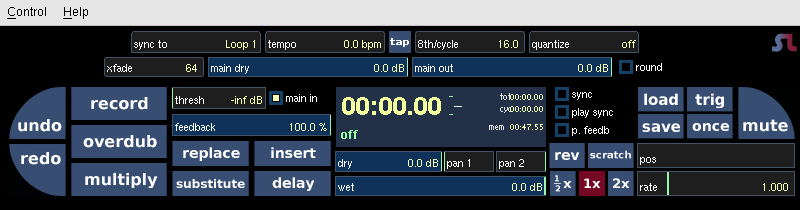
user-friendly GUI (slgui, see Figure 1) can be used as a front-end to
control multiple instances of SooperLooper, even over a network. But, the
author advises that this kind of performance tool is used optimally with
MIDI hardware controllers, including footpedals, fader boxes,
switchboards and so on.
Figure 1. The SooperLooper GUI
SooperLooper is available from its Web site as a source tarball for Linux
and in a compiled package for Mac OS X. Planet CCRMA includes an RPM package
for Red Hat and Fedora systems, and a quick search on Google reveals the
whereabouts of DEB packages for Debian-based systems. If you decide to
build SooperLooper yourself, be advised that although compiling it isn't
a difficult task, SooperLooper does require a number of support components
that may not be standard parts of mainstream Linux distributions. Study
the requirements list on the SooperLooper Web site's Downloads page, and
be sure to install the development packages for each component. Users
of Planet CCRMA, AGNULA/Demudi and similar audio-optimized systems
already should have most or all of the required packages, but you
still may need to install their devel packages. Use your preferred package
management software to determine which packages need to be installed
on your system. With the required pieces in place, all that's left is
to invoke the autotools mantra of ./configure; make; make
install and your own SooperLooper awaits your bidding.
Okay, you've built and installed the program, now let's do something
super cool with it. First we need to start the JACK server. I use Rui
Nuno Capela's QJackCtl when I'm working in X, but you can control JACK
completely from the command line if you prefer.
After starting JACK, launch SooperLooper with its GUI by entering
the slgui command at an xterm prompt. You can view SooperLooper's
runtime options with the -h option, or you can read all about them in the
program documentation. They're mostly concerned with your JACK, OSC
and MIDI connections, all of which can be left at their defaults during
your initial experiments. However, three options are interesting more
immediately. The -l (loopcount) option sets the number of instances of
SooperLooper to launch; -c (channels) defines the number of audio
output channels desired; and the -t (looptime) option sets the amount of
memory (in seconds) available per channel. You can leave them at their
default values, but you probably will want to come back and play with them.
Make your audio and MIDI connections, and you're ready to play. Note
that JACK's flexible connectivity combines nicely with SooperLooper. Each
looper has its own I/O connection, giving you great freedom in routing
signals in and out of SooperLooper.
For my first example, I treat SooperLooper as a desktop composition
tool, building audio segments to use as blocks in a larger piece. To
begin, I want to have separate loops for drums, synth bass and two
guitars. I also want a "scratch pad", so all together I want five instances
of the Looper. I already know the time duration of my drum loop, so I
restrict the looptime for all other loops. My launch command looks like
this:
slgui -l 5 -t 3
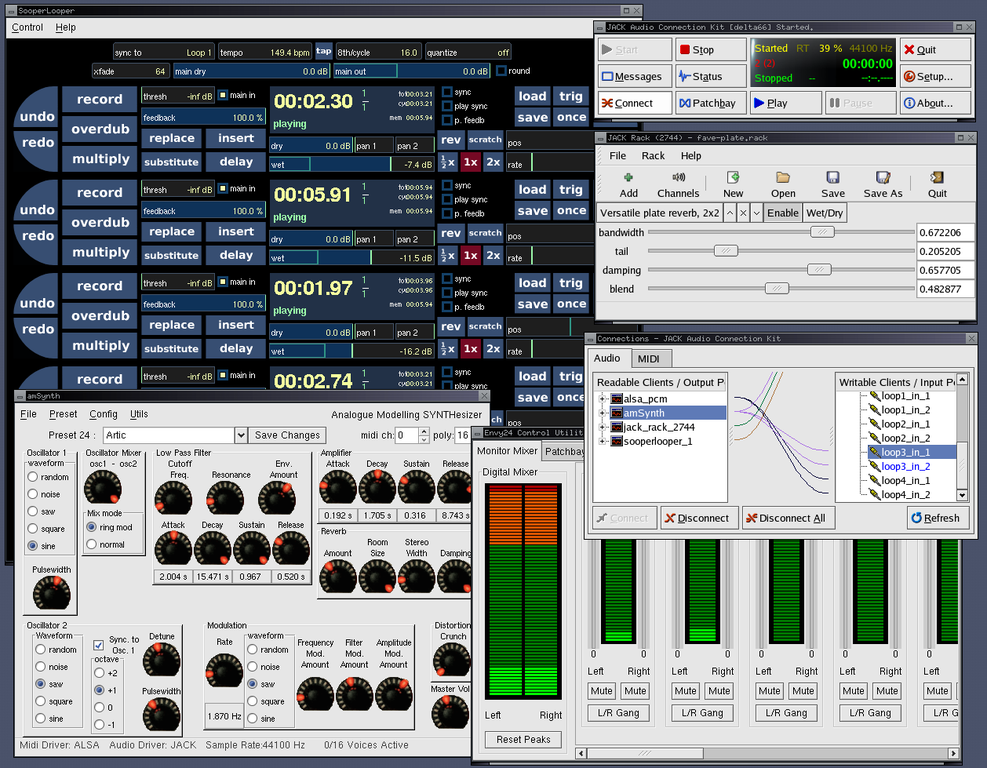
Figure 2 shows the results, along with QJackCtl, Jack Rack and Nick
Dowell's amSynth. I loaded a drum loop into the first looper, recorded
bass and guitar parts in the others, and voila, I made a loop you can
listen to
here. Okay, so it's not
super cool, but it was fun to make as a quick example of what can be
done with one drum loop, one guitar and one Linux softsynth.
Figure 2. A SooperLooper 5-Pack
SooperLooper's graphic interface is mostly
self-explanatory. Experimentation is the key to learning how to use
SooperLooper, and its GUI invites play and discovery. For my example
loop, I purposely restricted myself to the Record and Overdub buttons, recording
all parts in real time, except the drum loop, of course. Recording is as
simple as clicking on Record or Overdub and playing away. If you like
the results, you can save them as a WAV file. If not, simply click on Undo
and start over.
By the way, the example loop was recorded with ecasound. I used the
Versatile Plate Reverb LADSPA plugin in the Jack Rack to process my loops,
and the fades in and out were made with the Snd soundfile editor. URLs for
these programs can be found in the listings
here.
Alas, I have no MIDI foot pedals or slider boxes here in Studio Dave,
so I haven't played yet with SooperLooper's real-time MIDI control. I
also have to learn more about SooperLooper's various synchronization
options. Thankfully, SooperLooper's documentation can help you get
started with its MIDI and sync configurations. I have to make way for
the rest of this column anyway, so I leave the rest of SooperLooper for
you to explore.
Toledo Hip-hop/TALUG
On September 17, I drove to Toledo (Ohio) to attend a meeting of
a remarkable coalition of local hip-hop music producers, community
activists and members of the Toledo Area Linux Users Group (TALUG). Their aim: to
build and operate a community-centric recording studio to showcase
and promote local musicians, poets, singers, rappers and other artists
in need of such a resource. My part was to advise the group on the use of
free and open-source software in the context of a studio designed to
produce professional-quality recordings.
The coalition already has assisted in the birth of another audio
project, the recording and production of the outstanding Reboot: Pass
The Message CD. This disc focuses on the varying impact of technology on
the communities and individuals most severely affected by the digital
divide. Reboot is filled with intelligence, humor and positive
admonition, with the clear message that there is a real and present
danger looming before the digitally divided. This message is no mere
report, though, and the disc includes solid advice for its listeners
about their own participation in making truly free worlds.
The Toledo Area Linux Users Group
(TALUG) is
a great example for other Linux groups looking for ways to become more
involved with their local communities. TALUG was instrumental in setting
up an all-Linux system for the Murchison Center during the center's
establishment of the Cyberchurch project, an Internet gateway to more
than 500 Toledo area churches. The Reboot project was planned during this
conversion to Linux, TALUG got involved, and now they're on board for the
studio project. Given the level of community activism already displayed,
Linux is a logical next step for the project's software base. TALUG's
role will be to provide training in the basics of operating a Linux
system and support for the software base.
Toledo Hip-Hop is a cooperative project
for bringing together and promoting area hip-hop artists. The group
recruited artists and performers for the Reboot project and donated
its production abilities toward creating a professionally polished
sound. Reboot was created and produced with proprietary software, but its
creators acutely are aware of the desirability of switching to Linux. As
my AGNULA T-shirt says, there is no free expression without control
of the tools, and the people I met at the meeting are aware of
the importance of this level of control. They also are practical people
who recognize the need for reliability and capability in a professional
recording circumstance. They wanted to know if Linux audio software
could compete effectively with and ultimately replace their familiar
proprietary tools, such as ProTools, Cubase and VST/VSTi plugins.
I presented the case for a careful choice of hardware and a gradual
adoption of programs such as Ardour, JAMin and Rosegarden. A gradual
approach was advised due to the complexity of the tasks, and I felt that
a sudden change could be too much of a paradigm shift. Professional
recordists invest non-trivial amounts of time learning their tools,
and time is needed before they'll be comfortable with a new operating
environment and its unfamiliar software. Nevertheless, the coalition
members have real vision and can see that free and open-source
software (FOSS) provides a way out of the ghettos created by the digital
divide. They understand that FOSS can offer a way into a world in which
the user exercises more profound control of his tools.
Fortunately, this project arrives at a time when it is not only conceivable
to build a pro-level recording studio around free software, it's already
being done in some professional studios, most notably Ron Parker's
Mirror Image Studios in
Minneapolis. Time will tell how smoothly the coalition makes the switch, but given
the level of dedication I witnessed, I think they'll reach lift-off in a
relatively short time.
I hope to report on the progress of this project within the next
few months. In the meantime, you can check out and chill with the
Reboot CD.
Further information and inspiration can
be found on the Toledo Hip-Hop Web site and the
Cyberchurch site.
LAM And Radio Csound
By now it should be evident that Linux is eminently well suited for
content creation and production. We have tools that rival commercial
products and users who know how to put those tools to their best use.
But talk is cheap, so I suggest you take a little trip right now to Hans
Fugal's excellent
Linux Audio Music (LAM) site.
Hook up to the RSS podcast feed or M3U playlist to hear exactly what
the Linux audio community is really doing with all these cool tools.
LAM is the result of Hans's interest in learning Ruby On Rails. It's
a simple site, consisting only of the song list, an entry form for
new submissions, an About blurb and connections to the RSS and
M3U feeds. The song list contains links to the individual pieces--no files
are kept on the LAM site--so you can listen to selections
instead of the entire playlist. All files are in MP3 or Ogg format.
The brief entry form for new additions provides fields for title,
author, file URL, license information and comments. No licensing rules
currently are specified, although Hans recommends the Creative Commons
licenses. Of course, posting commercially copyrighted material is
strictly prohibited.
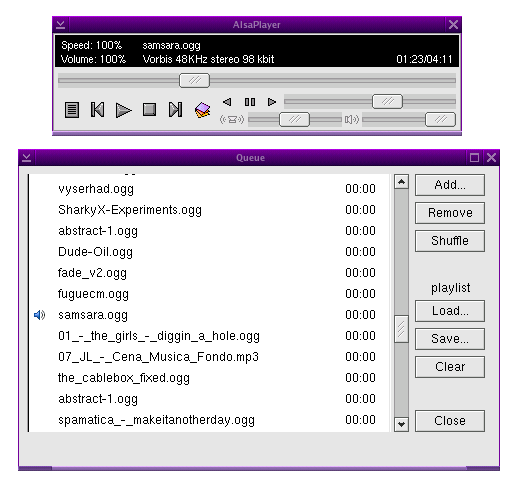
As I write this article, I'm listening to the playlist via Andy Lo A
Fo's outstanding AlsaPlayer (Figure 3). The range of music represented
is impressive, with popular song styles performed by soloists and
bands, electronic and experimental music, techno and other dance
styles, classical music and some stuff that's just plain tough
to categorize. I already have some favorite pieces that I have to
hear everyday, including Robert Jonsson's "Spamatica" tracks; Greg
Wilder's "Vyserhad"; Pete Bessman's "F4"; Juan Linietsky's "JL" pieces;
Escape From The Head Cube's cool "Souled"; Steve Doonan's piano music
and his collaborations with James Stone and Thorsten Wilms; and Ivica Bukvic's
"Symmetries", which premiered at last year's
Linux Audio
Conference in Karlsruhe.
Production values range from the "obviously produced on the desktop" to
full-strength professional finishes. You may not like everything on the list,
but you'll certainly notice the fun and creativity that went into their
productions.
Figure 3. AlsaPlayer Plays the LAM List
So the next time someone asks whether Linux can be used to make music,
send them to the LAM page. The list grows daily, and if you're already
a Linux-based musician, perhaps you should add your work to the site.
If the LAM playlists interest you, be sure to check out
the Csound Internet concerts and radio shows available
here. These broadcasts show off the great variety
of music possible with Csound, from pop and groovy styles to highly
experimental works. Many of the pieces are quite beautiful, representing
some of the finest examples of music whose possibilities depend on the
computer. If you've ever wondered what people actually do with Csound
or if you'd like to listen to something guaranteed to be different,
tune in to the shows, brought to you by the indefatigable
Dr. Rick Boulanger & Crew, on-line 24 hours a day, 7 days a week.
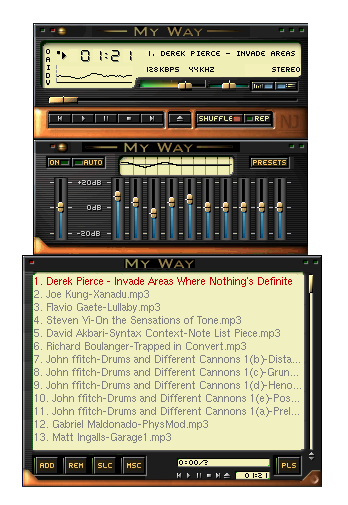
Figure 4. A Csound Internet Concert on XMMS
Is it any wonder that I never listen to commercial music anymore?
Signing Off
That's it for this month. I've learned my lesson, so I'm making no
announcement about next month's topic. I guess you'll just have to
tune in then. Meanwhile, you can loop yourself to total distraction
with SooperLooper, dig the Reboot CD, check out the LAM playlist and
settle back for some relaxing (?!) contemporary music from the Csound
community. That should keep you occupied for a while.
Resources
SooperLooper Home
Michael Noble's Mini-Review of SooperLooper
Profile of
Reboot producers Brian Zelip and Akil Muhammad
Dave Phillips is a musician, teacher and writer living in Findlay,
Ohio. He has been an active member of the Linux Audio community since
his first contact with Linux in 1995. He is the author of The Book of
Linux Music & Sound, as well as numerous articles in
Linux Journal.