At the Sounding Edge: Dave's Distractions
I know I announced
last month
that I'd be reviewing Jesse Chappell's
Sooper Looper in this column, but to be honest, I've been sidetracked.
Fortunately, my diversions have provided the material for this month's
column, so here we go with Dave's Distractions for August 2005.
Distraction #1: The Rosegarden Companion
I confess that this is the latest distraction, but it's already
got me avoiding other necessary tasks. D. Michael McIntyre has been
writing The Rosegarden Companion for two years, and
it's easy to tell that
it's been a labor of love. The author's presentation style is informal
and friendly, and he definitely is knowledgeable about his subject. For
those of you don't know about Rosegarden, it is an integrated audio/MIDI
sequencer with advanced features, including extensive system control
and impressive notation facilities. The program has been in development
since the early 1990s, beginning with a GUI based on the Xaw widget set
and coming at last to a beautiful Qt interface. But Rosegarden is not
only a pretty face, and McIntyre is an excellent guide to what's
behind the program's good looks.
Figure 1. The Rosegarden Companion
The Rosegarden Companion is arranged in nine chapters
covering the following aspects of Rosegarden:
- What is Rosegarden?
- Producing Sound
- First Look Around
- The Studio
- Managing Instruments
- Recording
- A Different View
- The Notation Editor
- Mastering to Disk
After a brief introduction to the program, the author introduces the
basics of getting sound from your computer and other gear. The detail
of this chapter is necessary: of all the troubles that users have with
audio and MIDI under Linux, certainly the worst problems appear right
at the start of their explorations. Thirteen pages are devoted to this
topic, and still more could be added. However, McIntyre does a
fine job of getting the new user up to speed with his sound-producing
capabilities, and the next chapter dives into Rosegarden's main interface
windows. Rosegarden's design purposely imposes a particular approach to
composing with the program. Of course, you can use it any way you find
suitable, but you'll probably move along faster in Rosegarden if you
pay attention to its basic organization.
The next two chapters deal with the concepts of what Rosegarden calls a
"studio" and "instruments". Those chapters naturally lead
to a presentation of Rosegarden's various recording modes, followed
by a chapter dedicated to the program's various editing modes. Given
Rosegarden's excellent music notation capabilities, a separate chapter
appears for the notation editor. The main part of the book ends with a
chapter on using Rosegarden as a "mastering" tool to put the finishing
touches on your recordings. Four brief appendices and an index close
The Rosegarden Companion.
So how is it? For the Rosegarden novice, the book is indispensable. It
provides a low-key introduction to a complex program, presenting
every major feature of the program with just enough explanation to clarify
their functions and usage. As we might expect in a book dealing with such
a GUI-intensive program, The Rosegarden Companion is heavy on helpful
illustrations and screenshots. However, clarifying text has been added
to many images, most of which look good, but some are poorly printed
and have obscured the text.
The assessment is a little different for a relatively advanced user of
Rosegarden. The book avoids technical discourse whenever possible, and
its brevity--less than 190 pages--restrains in-depth exploration of the
program's features. Synchronization capabilities are ignored, and there
is no mention of Rosegarden's ability to export scores to the Csound
audio synthesis language. Nevertheless, even advanced users can learn
something new and interesting. I now have a much better understanding of
the MIDI event editor, and I must say that the chapter on the notation
editor is a blessing.
The author attempts to generalize environment issues, but it seems fair
to suggest that The Rosegarden Companion will be especially useful
for users working with the KDE desktop environment. Users of Fervent
Software's Studio To Go! also might realize some advantages using that
system's version of Rosegarden along with the book.
The Rosegarden Companion is the first book to be dedicated to a single
Linux audio application, and I'd love to see more. At a list
price of less than $20US it should be affordable for most users, and it's
certainly within the budgets of most libraries. All in all, for price and
value I found The Rosegarden Companion to be a most profitable distraction.
Distraction #2: DSSI
Chris Cannam and his crew must be working overtime to make sure my
attention is constantly drawn towards their projects. Not only have they
been responsible for the awesome Rosegarden and the wonderful Studio
To Go! (to be reviewed in a later column), they've also devised the DSSI,
the Disposable Software Synthesizer Interface. DSSI can be considered the
logical successor to the LADSPA plugin API, a programmer's interface for
the creation of effects and other signal processing plugins. Alas, LADSPA
was not designed to support the features needed for plugin synthesizers,
hence the DSSI.
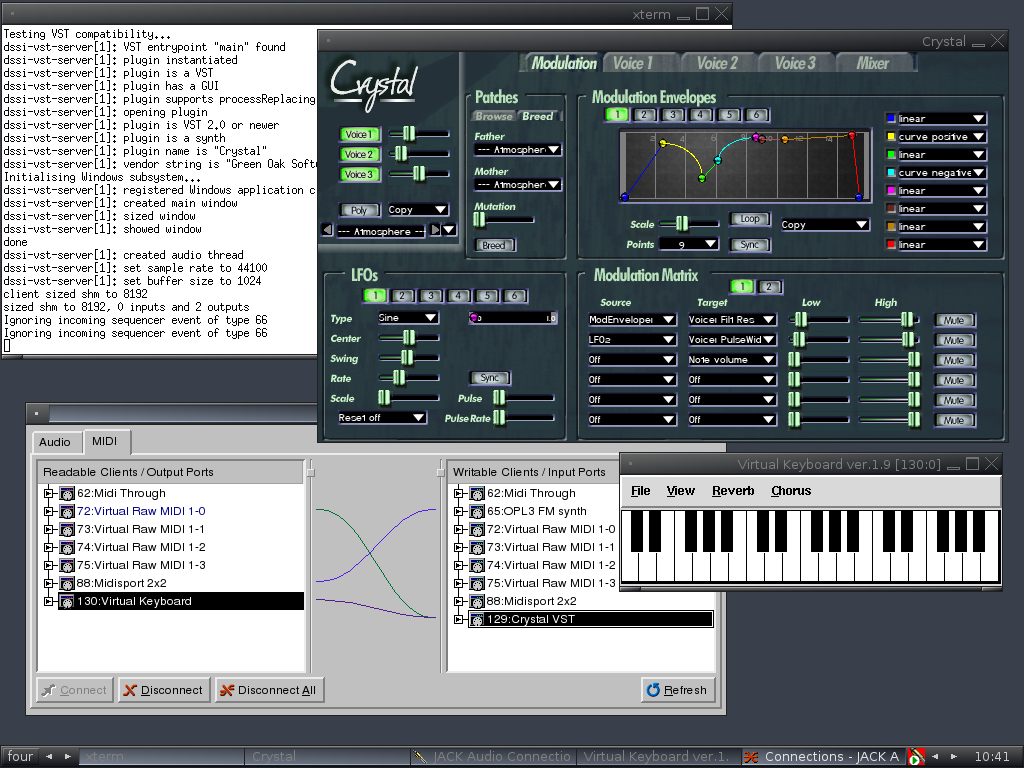
Figure 2. The DSSI vsthost Running the Crystal VSTi
Plugin
The DSSI API is relatively new to the Linux audio development scene, and
only a few native DSSI synths have been written. However, the available
examples are outstanding, particularly Sean Bolton's Hexter. Hexter
models the FM synthesis sound of the Yamaha DX7, loading DX7 patch
files--if they're in the correct .syx format--and even accepting DX7
system-exclusive messages for editing patches. As an owner of many
Yamaha FM synths, I was skeptical of Hexter's claims, but I must say
that Sean's done a terrific job of emulating the crisp, clean sound of
my hardware boxes.
Other neat examples of DSSI-savvy software include Sean Bolton's Xsynth,
which models the sound of classic analog synthesizers, and Florian Schmidt's
dssi-convolve, a DSSI wrapper for his libconvolve convolution effects
engine. I hope to see more developers embrace DSSI, and it already has
been written into Rosegarden and soon may be available in
Werner Schweer's outstanding MusE MIDI sequencer.
Now, you might be wondering how I can claim distraction status for a
small handful of plugins, and again I must make a confession: I've really
been playing around with the dssi-vst software. Yes, the DSSI interface
includes a mechanism to support the use of VST/VSTi plugins under Linux,
following and extending a path started upon by Kjetil Matheussen's
vstserver and continued with the libfst project from developers Paul
Davis and Torben Hohn. The dssi-vst bridge differs from those projects
in its ability to be compiled with recent WINE builds. All
current support for VST/VSTi plugins under Linux is dependent on WINE,
but recent WINE development breaks vstserver and libfst. However, I
successfully built and tested the dssi-vst package under wine-20050725,
one of the most recent public releases.
I'm still testing the dssi-vst software, but I've already been happy to
discover that most of the plugins I ran with the previous projects also
run on the dssi-vst bridge. As with the other VST support projects, dssi-vst
requires JACK, and Figure 2 shows off the Crystal VSTi synthesizer
running in a Debian-based Demudi 1.2.1 environment that includes JACK,
operated by QJackCtl in the figure, and a virtual MIDI keyboard. A vast
number of VST/VSTi plugins are available, many for free-as-in-beer,
so it looks like I'll be busy testing this software for quite some
time. Thanks to Chris, Sean, Steve Harris and everyone else working on
DSSI for another most profitable distraction.
Distraction #3: Demudi vs. the Omnibook
Recently I decided to clear my laptop's drive and replace its aging
Red Hat 9 with a brand new Demudi 1.2.1 Debian system. The Red
Hat installation worked fine, it was a Planet CCRMA system, but its
2.4 kernel was growing old. I wanted to step up to the 2.6 series,
and I wanted to work in a Debian-based environment. I downloaded the
Demudi ISO from the AGNULA Web site, burned it to disc with gcombust,
put the disc in the laptop's CD-ROM drive and began the installation
process. Booting from the CD was no problem, and the installation process
was trouble-free. When I finally saw the handsome Demudi login screen
I thought I was ready to rock. I logged in, and my troubles began.
I'm running out of space for this article, so I'll simply cut to the
chase and report that 1) Demudi rocks, it's a beautifully designed system
and 2) my laptop hardware did not like Demudi 1.2.1 "as is". Through no
apparent fault of Demudi, I was forced to compile and reinstall ALSA in
order to get the necessary driver modules to install under the Demudi
2.6.12 kernel. All is not perfected out there on the edge, and my aging
laptop kicked and struggled all the way to my now-working Debian-based
system. The Demudi developers are aware of the problems I encountered and
already have made additions to the repositories to expand some aspects of
hardware support. Updated kernel and ALSA systems are also in the works,
and I'm sure the situation will improve with regards to ancient equipment.
The 2.6.12 kernel itself appears to be the more serious problem,
though it's also possible that the new X server from Xorg is not
yet fully optimized for my funky video chipset, the NM256, same as
my soundchip. However, debugging the system at this level is beyond
my means, both in abilities and time, so I'll either reinstall a Red
Hat system on the laptop and install Demudi on my desktop machine, whose
hardware is far more Linux-friendly, or I'll wait a little longer and
see what Free Ekayanaka comes up with for the next release of Demudi.
By the way, potential users should not be deterred by my experience
reported here. Demudi is also available as a live CD, enabling users
to test the system without installing it. I advise testing your system's
friendliness towards Demudi by checking out its live CD first, installing
only after you're certain that your hardware is supported. More modern
machines seem to have little or no trouble with the system, but if you're
at all concerned with problematic hardware, check out the live CD first.
Distraction #4: Notes from the Metalevel
Yes, another book, and yes, it's another book about sound software that
runs on Linux. However, this one is a more general text that explores
the world of computer-assisted music composition by way of Rick Taube's
amazing Common Music. I've mentioned Common Music in previous articles; it's
a Lisp-based language with a set of remarkable sound and music
elements. Common Music has been in consistent development for many years,
and it currently includes amenities such as real-time output and a GUI
for selecting and configuring its targets. Common Music creates files
and streams for MIDI, with real-time support from MidiShare or PortMIDI;
software sound synthesis languages such as Csound and Common Lisp Music;
and notation systems such as Common Music Notation and the more recent
FOMUS system.
Figure 3. Notes from the Metalevel
Notes from the Metalevel is Rick Taube's extended treatise on composing
with the computer. It covers an incredible amount of material, some of
which is rather complicated to understand, but the author maintains a
consistently engaging writing style throughout. Difficult things are
explained clearly, and the author has supplied hundreds of examples
and projects, all of which are available on the accompanying CD. The
disc also includes complete Common Music systems for Linux, Mac
and Windows, making it a simple matter to read the book with hands on
the described software.
Alas, I'm out of space and simply advise the interested reader
to buy and study this book. Unfortunately, the softcover edition has
a list price of $54.95 (US), but I must point out that the book is 338
pages long and includes the CD described above. I realize the price is
perhaps a bit high, but I honestly recommend it as being worth every
penny, or whatever currency you prefer. I carry Notes from the
Metalevel with me at all times, there's so much to learn from
it. And in my daily life, it has become a permanent and always welcome distraction.
End Distractions
So now you know why I didn't review Jesse's Sooper Looper. If I can
stay on track, I'll cover it next month. Meanwhile I must excuse myself,
I have some books I want to read, some plugins to test and some music
to write. Gotta go, see you next month !
PS: Electronic music pioneer Robert Moog passed from this mortal coil on
August 21, 2005. He was a true giant in the history of 20th century music
technology, and while he will be greatly missed on this plane I can only
imagine that he's already improving the music of the spheres. RIP Bob
Moog, all blessings upon him and his family.
Resources
The Rosegarden
Companion
DSSI (Disposable Software
Synthesizer Interface)
Caring
Bridge guestbook for Robert Moog
Dave Phillips is a musician, teacher and writer living in Findlay,
Ohio. He has been an active member of the Linux Audio community since
his first contact with Linux in 1995. He is the author of The Book of
Linux Music & Sound, as well as numerous articles in
Linux Journal.