
The Story of Firefox: from Underdog to Superhero
It took many years for Firefox to be an overnight success. Who would have thought back in March 1998, when the struggling Netscape released the source code for its Communicator Suite, that Firefox would be the favorite browser on the Linux platform and a formidable insurgent challenger to Microsoft's Internet Explorer (IE) on Windows.
Gradually over the past ten years, Netscape morphed into the Mozilla browser, which in turn gave rise to Firefox. Today, Firefox owns a market share of around 20% worldwide (and much higher in certain places). How was Firefox able to accomplish this rise from the ashes of Netscape and go from underdog to hero?
The story of Firefox also is a story of the coming of age of open source, of opportunities presented by Microsoft failing its users of IE, of Internet users hungering for something new and of cutting-edge innovation that blew our socks off.
Firefox Timeline
January 23, 1998—Netscape announces the release of the source code for Netscape Navigator 5.0.
February 23, 1998—Netscape announces the mozilla.org Project.
March 31, 1998—The first Mozilla code (for Netscape Communicator 5.0) became publicly available under the terms of an official open-source license and a governing body for the project, the Mozilla Organization, began its public work.
March 18, 1999—America Online acquires Netscape.
June 5, 2002—The Mozilla 1.0 suite, the open-source progeny of the proprietary Netscape Communicator, is released.
September 23, 2002—Phoenix 0.1 (Pescadero) is released, the first official version of a standalone browser that will later be renamed Firefox.
April 2, 2003—Mozilla announces intent to develop what would become Firefox (code-named Firebird at the time) as a standalone application rather than as part of an integrated suite.
June 30, 2003—Mozilla 1.4 is released with pop-up blocking.
July 2003—The not-for-profit Mozilla foundation is spun off from AOL.
August and November 2003—Mozilla wins the Linux Journal Editors' Choice Award for Best Web Browser and Readers' Choice Award for Favorite Browser for the first time.
February 8, 2004—The new release Firefox 0.8 (Royal Oak), leaves behind the old name Mozilla Firebird.
June 17, 2004—Mozilla 1.7 is released with speed improvements and better standards support.
November 9, 2004—Firefox 1.0 is released.
December 2004—The Mozilla Foundation places a full-page ad for Firefox in the New York Times with financial contributions from more than 10,000 users.
October 19, 2005—Firefox reaches milestone of 100 million downloads.
November 29, 2005—Firefox 1.5 is released.
August and November 2005—Mozilla wins the Linux Journal Editors' Choice Award for Best Web Browser and Readers' Choice Award for Favorite Browser for the second time.
October 24, 2006—Firefox 2.0 is released.
November 19, 2007—Firefox 3.0 beta1 is released.
March 31, 2008—The Mozilla Project celebrates its 10th anniversary.
June 17, 2008—Firefox 3.0 is released (projected at the time of this writing), with Download Day to set the Guinness World Record for Most Software Downloaded in 24 Hours.
Certainly you remember the browser wars of the mid- to late-1990s—the ones that Netscape lost handily. Although we were fortunate that Netscape cared enough to maintain a Linux version, we used the Communicator out of necessity, not passion.
Little did we know at the time, but the seeds of change (and the beginnings of the Firefox browser) would be planted on January 23, 1998, when Netscape announced the release of source code for Netscape Navigator 5.0. Recall that back in 1998, the open-source model still was viewed with widespread skepticism. At that time, Eric S. Raymond had written the on-line version of The Cathedral and the Bazaar, which made open source tangible to more people. Raymond, who guided Netscape through its open-source strategy, noted that his contacts at the company had such a huge sense of relief, or even gratitude, because market conditions had become so bad, they could justify doing what they wanted to do anyway.
Netscape's Vice President of Products, Marc Andreessen, said his company open-sourced Netscape because, “we're at an inflection point, a trigger point, when there's an alignment with the energy of growth. Linux is hot. The technologists have adopted it, and it's growing fast all through the Open Source community. This gives us the confidence that we couldn't screw it up if we tried.”
Raymond also called Netscape's decision, “the long-awaited breakout of free software into the commercial world”. Little did he know the prescience of his words at the time.
A few months later, in March 1998, mozilla.org was founded, the source code for Netscape Communicator 4.0 was released and the community went to work.
It took some time for Mozilla to come of age post-Netscape. Although Netscape Communicator's source code was released in early 1998, the Mozilla 1.0 suite, or applications framework as it is technically called, was not finished until June 5, 2002. Despite Mozilla's Netscape-like look and feel during this period, much was changing under the hood. In November 2000, Linux Journal writer Mike Angelo commented that “if you have any notions that Mozilla, the browser suite, is an upgrade from Netscape Communicator 4.x, please lose them. Picture Mozilla as a browser suite that is new from the ground up, but just looks and feels lots like the Netscape 4.x browser suite, thanks to its skin”.
In spite of the overhaul, Mozilla retained Netscape's “all-in-one” suite orientation, which was later to be shed by the self-standing Firefox. Mozilla consisted of the applications Mozilla Navigator, Mozilla Composer, Mozilla E-Mail, Mozilla News and ChatZilla.
During this period, in March 1999, Netscape went off to become part of America Online. Nevertheless, the two organizations retained close ties—for instance, many of Mozilla's developers were inside Netscape/AOL, and Netscape/AOL continued to assist Mozilla financially. Furthermore, while Netscape/AOL utilized the Mozilla code as a base for its own Netscape 6, the company added its own proprietary features, such as AIM.
Development-wise, these six interim years were productive. Most important, the Mozilla development team built the Gecko browser layout engine from scratch and ensured full W3C (World Wide Web Consortium) standards compliance. In addition, changing skins on the fly, security features and the plugin model were expanded and improved significantly.
After four long years of development, Mozilla 1.0, mostly free of its Netscape Communicator past, was at last released on June 4, 2002. CNET.com's Rex Baldazo raved that “The four-and-a-half-year wait is over—Mozilla 1.0 has gone gold, and from what we've seen, it's been worth the delay.” Immediately, users were impressed with Mozilla's speed, stability and features, such as tabbed browsing, pop-up blocking and custom skins.
Mozilla's features caught the surfing public's attention and re-ignited the browser wars of yore. Several different Web analytics firms reported that Microsoft's Internet Explorer dropped from a 97% market share in 2002 to 93% in late 2004. During the same period, Mozilla went from a 2% market share with Netscape to more than 5% with all of its open-source browser offerings.
While the Mozilla browser was out in the world making Web surfers everywhere gleeful, the development team at mozilla.org, led by Chief Technology Officer Brendan Eich, already was laying the foundation for a much better browser. On September 23, 2002, the Mozilla team released Phoenix 0.1 (Pescadero), the first official version of a standalone browser that would later be named Firebird and, eventually, Firefox. Phoenix was a redesign of Mozilla's browser component but written using the XUL user interface language and designed to be cross-platform. Phoenix's developers stated that “Phoenix is not your father's Mozilla browser. It's a lean and fast browser that doesn't skimp on features”, loading pages in half the time as Mozilla 1.1. Furthermore, they added, “Not only does Phoenix aim to match the feature set of Mozilla—subtracting features deemed geeky and better offered as add-ons—but it extends it. We also believe Mozilla, in general, is going in the wrong direction in terms of bloat and UI, and see no reason for our releases to carry those connotations.”
On April 3, 2003, Mozilla announced its intent to develop what would become Firefox (code-named Firebird at the time) as a standalone application rather than as part of an integrated suite.
Mozilla's Eich summarized the new browser's philosophy in its development road map as follows:
[Firefox] is simply smaller, faster, and better—especially better not because it has every conflicting feature wanted by each segment of the Mozilla community, but because it has a strong “add-on” extension mechanism....Attempting to “hard-wire” all these features to the integrated application suite is not legitimate; it's neither technically nor socially scalable.
Six years, seven months and nine days after the birth of mozilla.org, Firefox 1.0 was born on November 9, 2004. Looking back to the earliest days of Firefox 1.0 with three and a half years of perspective and comfortable browsing, it's easy to forget how exciting the post-release vibe was. Firefox saw more than 100,000 downloads in the first few hours and nearly 10 million per month shortly after the release. Toward the end of its run, Firefox 1.0 reached 100 million downloads in October 2005. This success translated into a market share of around 5%. By early December 2004, according to OnStat.com, Internet Explorer's market share dropped yet again to below 90%.
There was a palpable hunger for an alternative. As part of the Spread Firefox campaign, 10,000 Firefox supporters coughed up some of their hard-earned money to show support for their browser by contributing to fund a full-spread advertisement in the New York Times. Spread Firefox is the nexus of global community volunteerism to promote Firefox via guerrilla marketing activities.
The left page of the masterful New York Times ad features the names of all 10,000 contributors over a shadowed Firefox logo. The ad asks the reader, “Are you fed up with your Web browser? You're not alone. We want you to know there is an alternative.” On the right page, it featured, “Introducing Mozilla Firefox 1.0” in bold type, followed by quotes from satisfied users and the advantages of Firefox, such as speed and browsing free of pop-ups and spyware. “Find out what 10 million users from around the world already know: there is an alternative.” Unfortunately, the Times ad is not printable in this space due to size constraints, although you can see it at the Spread Firefox Web site.
There also was hunger for better security. On the Windows side, it seemed that IE was once invincible. However, IE's security problems pushed millions of users and countless organizations out to the far edge of the plank; Firefox was the nudge that made them jump ship in droves.
For most people, however, the reason to move to Firefox was its features. They ate up the tabbed browsing, better standards support, integrated search, a user-friendly plugin management system, easy installation and removal procedures and, of course, better security. The latter was possible, because Firefox lacks the deep hooks into the operating system as is the situation with IE, which therefore suffers greater impact from flaws.
During 2005, Firefox gained 10% of global market share from its rivals, a feat that the proprietary Netscape could not muster after falling behind Internet Explorer. The success train continued to roll down the tracks, and Mozilla released Firefox 1.5 on November 29, 2005.
In Firefox 1.5, the Mozilla development team added new features, such as even speedier page loading, drag-and-drop search, integrated RSS reader, tab re-ordering, better pop-up blocking, binary patching for upgrades, clearing of personal data with a single button and partial SVG 1.1 support—not to mention all the new extensions that continue to accumulate, which leave practically no limit to what you can do with Firefox.
Despite the increased complexity of version 1.5, the Firefox development team continued to prove itself more worthy than its rivals, not only attending to serious flaws but also avoiding them in the first place.
We need another metaphor for inertia, because Firefox 2.0 has it too. As we sit on the verge of version 3.0, we can see that Firefox 2.0 has carved out another 8% of market share to reach 18%, according to Net Applications. This translates into approximately 170 million users worldwide.
For features, the 2.0 release added Google's anti-phishing software, Live Titles for bookmarks, spell-checking, improved UI and improved support for SVG and JavaScript 1.7.
As I finish this article, I longingly look ahead to the release date for Firefox 3.0, which looms just a few tantalizing days out at the time of this writing. The day is also Download Day, an initiative by Spread Firefox to set the Guinness World Record for Most Software Downloaded in 24 Hours. As of mid-June, the number stands at 1.1 million and growing. Clearly, now that open source has taken hold, it is possible to assert that one should never underestimate the effectiveness of disciplined bands of inspired volunteers to change the world of computing.
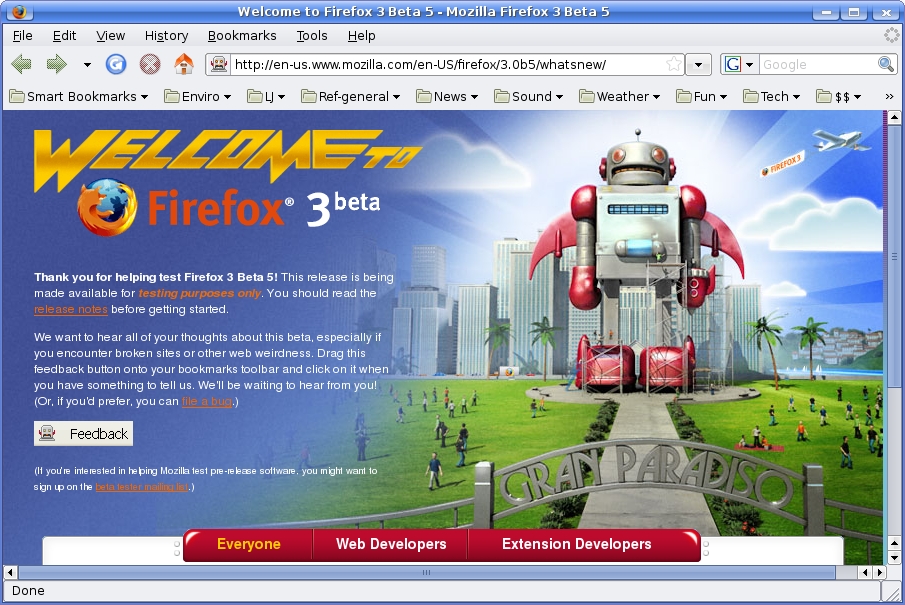
Figure 1. Firefox says that Version 3.0 has more than 15,000 updates. Will it keep Firefox's momentum going?
Mozilla has raised expectations for Firefox 3.0, saying that it will run double the speed of its predecessor and use much less memory. Furthermore, the browser will be much smarter, as you can simply begin typing into the location bar, or “aweome bar”, to find what you are looking for, and Firefox offers a list of options it thinks are most relevant to you.
Version 3.0 also implements the updated Gecko 1.9 layout engine, which allows it to pass the Acid2 test, a standards-compliance test for Web-page rendering.
Firefox's trajectory—from proprietary Netscape to Mozilla to Phoenix/Firebird and finally Firefox—is an incredible story of triumph. What began as the outdated, proprietary Netscape browser, with shrinking market share from a struggling company, was set free with open source to transform itself into a technological and organizational powerhouse. Firefox now ranks with Linux and Apache as one of the world's premier open-source applications. Although it has taken a decade, Firefox has valiantly clawed back to nearly 20% market share worldwide, with 29% in Europe and more than 40% in countries like Finland and Poland. This is quite an accomplishment, given that Firefox's main competitors, IE and Safari, have huge pre-installation advantages.
Firefox came of age with open source and, as Technetra's Alolita Sharma observed, “has helped make open source mainstream” and that “its success as a constantly evolving open-source product has validated the open-source development model”. Hats off to the pioneers like Eric S. Raymond who helped Netscape see the light in 1998 and get started on the right foot, as well as the hundreds of developers and activists who contributed to Firefox technically and promotionally. Without the army of Spread Firefox volunteers, who never would be so enthusiastic about a proprietary product, Firefox's success would be much less viral.
Many thanks also go to Microsoft for so many things—its horrible attention to security, lack of innovation and IE's overly tight integration with Windows—all of which made users so fed up and thirsty for an alternative. It helped tip so many millions to Firefox.
The past decade has been quite a run for our friend Firefox. It has matured admirably over time, and version 3.0 continues the positive, upward trend. As mentioned, however, competitors are in the wings who would love to experience similar success and grab hold of some of Google's millions that Firefox currently receives. Already there are signs that Safari is eating into some of Firefox's market share in North America. Regardless, if our fledgling hero can ride its current wave of technical innovation and popular support, we should see Firefox residing on ever more desktops of satisfied computer users.
Resources
Apple Computer's Safari Browser: www.apple.com/safari
Mozilla Foundation: www.mozilla.org
Spread Firefox: www.spreadfirefox.com
Spread Firefox campaign's advertisement in the New York Times: www.mozilla.org/press/nytimes-firefox-final.pdf

