
Go Green, Save Green with Linux
A new age of environmental awareness appears to be upon us. The meteoric economic rise of India, China and other large countries has not only unleashed a spike in petroleum prices and the spectre of dry gas pumps in our lifetime, but also has raised fears of our fragile planet's ability to support an SUV-lifestyle for billions. Furthermore, the scientific community feeds us daily evidence of our climate changing right before our eyes. The problems seem so daunting. What can we do to fight back and do well by the planet?
Although hybrid vehicles, wind turbines and ethanol get the green glory, many people in IT, including in our own Linux and Open Source communities, deserve attention for their green initiatives. With a global problem to solve that requires creativity, transparency and massive collaboration, who else would you call but the Linux folks? This article explains how Mother Nature's Mayday calls have inspired our community to innovate and do more with fewer resources. Whether your motivation is to green the earth or save greenbacks though improved efficiency, read on to find out more about how you can go green, and save green, with Linux.
A typical Linux server gulps about 225 Watts or more of power, meaning that the millions of Linux servers out there, now at around a 27% market share, are responsible for nearly 5 million tons of carbon emissions annually. Furthermore, Springboard Research recently reported that an average-size server has the same carbon footprint as a mid-size four-wheel-drive vehicle. In response to this and other daunting evidence, the color of Linux is purposefully going green. The number of green, Linux-based initiatives and projects is proliferating, and I'd like to share some of them with you. In this article, I discuss initiatives to save energy related to the Linux kernel, distributions and applications; virtualization; and exceptionally green Linux-based products (such as hardware).
An initiative is only as good as the people and resources behind it. Three green-Linux initiatives have formed recently: two deep-pocketed ones, IBM's Big Green Linux initiative and Intel's Lesswatts.org; and a dot-org effort, the Linux Foundation's Green Linux Initiative.
In August 2007, IBM launched its Big Green Linux initiative, intended to help its clients integrate Linux into the enterprise “as a way to reduce costs and energy consumption by building cooler data centers”, says IBM. Big Green Linux is a subset of Project Big Green, a broader initiative to reduce energy consumption in the data center, both internally and for its clients. Although sparse to date, some of the Big Green Linux initiatives have included improved data-center ergonomics, encouraging server consolidation onto System p servers and System z mainframes, expanding on Linux innovations like the tickless kernel and collaboration on power management with the Linux community.
Intel is another IT titan trying to go green at both the processor and application levels. The firm readily admits that its green innovations historically have been further ahead on the hardware side than the software side. For instance, Intel first focused power management improvements on the mobile Centrino processor and is now migrating those technologies to server platforms. Regrettably, the advantageous hardware engineering often exists but remains unexploited.
In order to bridge the gulf between hardware and software development, Intel created Lesswatts.org. The site is a nexus of collaboration on projects that “drive improvements in power consumption that will lead to a cleaner environment and allow companies to spend less money powering their IT infrastructure.”
Some of the projects included on Lesswatts.org are:
PowerTOP: a Linux-based tool that helps find programs that are needlessly consuming extra power when a computer is idle, as well as the magnitude of overconsumption.
Power Policy Manager: a layered, system-wide power policy framework that provides a way for users to select multiple power policies to fit their systems.
Processor Power Management: a project to leverage the power management features of Intel processors fully. Lesswatts.org contains all the features, solutions and enhancements related to processor power management. One example is the Intel Dynamic Acceleration Technology, which allows one processor core to deliver extra performance while the other core is idle.
Display and Graphics Power Saving: a project that aims to exploit the power-saving features of Intel's graphics chipsets without sacrificing performance.
Besides those listed above and several other projects, Lesswatts.org contains numerous power-saving documents, whitepapers and tips, such as utilizing the Aggressive Link Power Management feature on SATA controllers or utilizing Gigabit Ethernet only when a system needs it.
Lesswatts.org is directed by Intel's Open Source Technology Center, the firm's nexus of Linux and open-source initiatives.
Over on the dot-org side of things is the Linux Foundation's (LF) Green Linux Initiative. The Linux Foundation is a product of the 2007 fusion of Open Source Development Labs and the Free Standards Group, whose mission is to support Linus Torvalds' and other efforts that move Linux forward technologically and out in the field. According to Amanda McPherson, LF's Director of Marketing, LF was inspired to set up a Green Linux Workgroup in June 2007, at its Collaboration Summit, where “concern for the planet [and] power management emerged as a top project to work on.” LF, says McPherson, is pleased with how the tickless kernel, PowerTOP and other projects have progressed, adding that “developments by the community have been very impressive over the last few years” and that enterprises are gradually adopting them as the technologies are supported in the conservative enterprise distributions. “Enterprises are understandably cautious about upgrading kernel/distribution versions and taking advantage of new features. As time goes on, these features will be used more and more.” The Green Group is ramped up or down according to project needs and will ramp up again this-coming June to address potential new issues, such as “Energy Star compliance and better optimization of device drivers for power management.” McPherson also cited the importance of Intel and IBM “rallying behind this topic” to move it forward.
The two most significant recent innovations in Linux regarding power management are tickless idle and virtualization. The various Linux distribution makers deserve credit for supporting these innovations, integrating them into their distributions and pushing forward initiatives like Lesswatts.org.
The idea behind tickless idle is that Linux, starting with kernel 2.6.21 for 32-bit and 2.6.23 for 64-bit machines, keeps track of time in a completely new way in order to take advantage of low-power states in modern processors. The strategy involves keeping the processor in its lowest power state for as long as possible, interrupting that state only when necessary. For instance, on an Intel Core 2 Duo processor, the power states, or C states, vary between 1.2 and 35 Watts—a significant difference. Before kernel 2.6.21, Linux pulled the processor out of the lower C state with a timer tick to inform the processor of the need to perform housekeeping tasks. This tick, occurring every few milliseconds, functionally reduced the usefulness of the lower-power states. Without the tick, Linux now chills out and conserves power until the next timer event is scheduled to occur. Multisecond idle periods now are possible.
The power savings from tickless idle can have positive benefits in any type of machine—from longer battery life on brawny notebooks to significantly lower electricity bills for home users and data centers.
Although Intel, through the Lesswatts.org Project, is more public about exploiting the tickless kernel and publicizing its power management tools, representatives at AMD assured me that their less-publicized initiatives and partnerships in the Linux community are just as or more significant than Intel's. Margaret Lewis, AMD Director of Commercial Solutions and Software Strategy, asserted that the tickless-kernel features are fully supported on both AMD's 32-bit and 64-bit processors. Furthermore, Brent Kerby, Product Manager for AMD Opteron, noted that AMD's PowerNOW!, Cool'n'Quiet and CoolCore technologies, including the dynamic adjustment of individual processor-core frequencies (and not just in pairs), all function well and automatically under Linux and contribute greatly to power savings. Lewis added, “These technologies give you a lot more power management control and are cumulatively perhaps more important than the tickless kernel.” AMD also emphasized its green efforts in other areas, such as the Green Grid, a consortium of companies working together to address environmental issues holistically throughout the data center, addressing hardware, software, building design, storage, cooling and more.
Linus Torvalds has stated that work on the tickless kernel is mostly done and, thus, can take advantage of low-power states in processors; however, much remains to be done to maximize its effect. Although Linux gladly would remain dormant, other superfluous, busybody processes from various applications keep waking it needlessly. To solve this problem, Intel's Arjan van de Ven created PowerTOP, a tool that finds culprits in the kernel and user space that are bothering the processor needlessly and reports the energy wasted by those activities. PowerTOP also reports on the time spent in each power state.
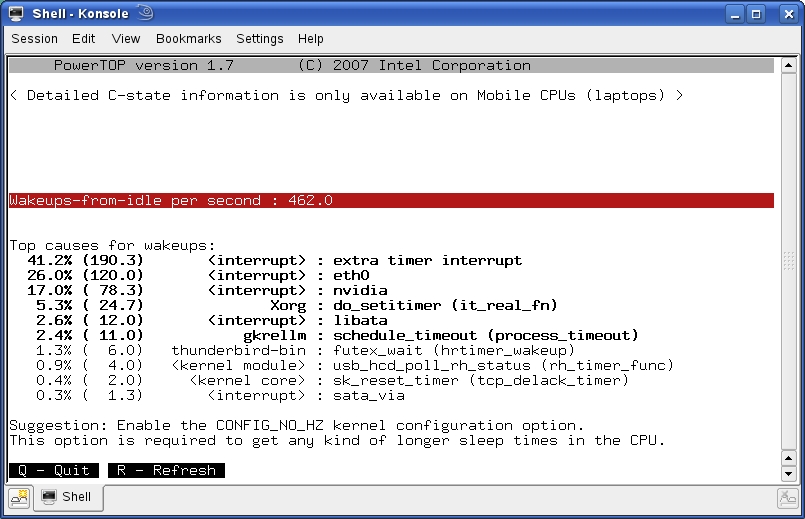
Figure 1. Intel's PowerTOP tool helps sleuth out applications that are consuming extra power needlessly.
Making more efficient use of existing computing resources through virtualization, such as consolidating multiple virtual servers onto fewer physical machines, has been a major trend in the Linux space. Little do we realize we are saving a great deal of juice in the process. Thus, not only does one reduce server sprawl and the expense of purchasing and maintaining more machines, but also electrical power utilization is improved by approximately 10–20 Watts per idle virtual machine, according to AMD. Additionally, as Jon 'maddog' Hall says, “Utilizing fewer systems and sharing the load is goodness.”
The power savings from virtualization on Linux has been enhanced further by the arrival of tickless idle. The existence of ticks in each virtual machine would otherwise put multiple extra loads on the virtualization platform and greatly reduce efficiency and the number of VMs per machine. For instance, if you have 30 VMs on one machine, with each one creating hundreds of ticks per second, a significant load is created before any real work is done.
Beyond virtualization itself, a number of vendors are exploring ways to manage their virtualization strategies to streamline their data-center operations and reduce power usage further. One example is Cassatt Corporation's Active Power Management Technology, which has released a platform-agnostic product to turn off servers safely when they are not needed or idle. Rather than leaving machines automatically running round the clock or relying on manual decision making, administrators can set priorities and policies to mandate how, where and when to power down idle servers, as well as power them back up. The net result is better management of both virtual and physical infrastructure. Interesting for us Linux-lovers, Active Power Management is easy to install and nondisruptive, as it relies on internal power controllers found inside most servers rather than on installation of software on managed servers.
Scalent V/OE offers another approach, namely dynamic server repurposing. V/OE allows administrators to shift their data centers between different configurations or go from dead bare metal to live, running, connected servers in just a few minutes and without physical intervention. Scalent's Director of Marketing, Alana Achterkirchen, pointed out that Pacific Gas & Electric (PG&E), California's largest electric utility, offers rebates to companies that deploy IT virtualization projects that result in the removal of computing equipment. The incentive, says PG&E, “is based on the amount of energy saved, predicted through a calculation model” and ranges from $150–$300 per server. Way to go, California!
The main distribution providers are core contributors to many a green project and are integrating them into their releases as rapidly as possible. For instance, Red Hat, Ubuntu and SUSE Linux all committed publicly to contribute to and make available the innovations from Lesswatts.org.
Nick Car, Red Hat Chief Technical Spokesperson, emphasized that his firm's green efforts “extend considerably beyond consolidation”, including “the provision of highly optimized paravirt device drivers for fully virtualized guests.” This means more and more systems will be able to be virtualized, broadening the utilization and impact of the technology.
Car also touted Red Hat's collaboration with chip vendors and Open Source communities to optimize power consumption in areas such as:
CPUfreq clock scaling in collaboration with Intel. Clock scaling allows for changing the clock speed of the running CPU on the fly, thus reducing the power the CPU consumes.
AMD's PowerNow! speed throttling and power-saving technology (includes CPUfreq work).
Intel's PowerTOP Project and using it to identify power-inefficient algorithms on all server applications, as well as to audit the kernel for pollers. Car points out that “We have been doing this work for the past year, and it has accumulated to the point where we are seeing meaningful power savings.”
Suspend/resume/hibernate work on laptops, including features such as automatic screen backlight intensity reduction as a laptop becomes idle.
Red Hat also will integrate the new tickless kernel in Fedora 9 and subsequently in Red Hat Enterprise Linux. “Red Hat has been a key developer of this technology”, says Car, “which allows the kernel to properly idle itself when appropriate.”
Over in Ubuntu's camp, Gerry Carr, Canonical's Marketing Manager, stressed that his company “is not directly involved in green computing per se, but indirectly we are massively involved”, adding that “we built an enabling technology for green computing without it being directly built for this purpose.” Regarding virtualization, Carr also stressed the “optimization of the kernel for paravirt ops, which is a long way of saying you can run more VMs on less iron using Ubuntu, thus saving energy there.”
Carr also highlighted the presence of Ubuntu on low-cost computers, which typically utilize less energy, such as Intel's Classmate PC. The Classmate is targeted at students in poor countries. Similarly, Ubuntu actively supports thin-client computing through partnership with NComputing and other providers. One example is the deployment of terminal desktops for every child in the Republic of Macedonia (180,000 terminals) on only 20,000 PCs.
Carr further explained that the Xubuntu version of its distribution “is built specifically to run on older, less-powerful machines and thus extend their shelf life significantly”, and that it has evidence that “a PC running Ubuntu is significantly more power-efficient than one running Windows”.
Finally, Carr notes that “As an organisation, we are great believers in the multiplier effect, in providing the means for others to take action. We couldn't try to directly support the number of initiatives that happen purely by providing a product that is free to use and redistribute and that we freely maintain.”
Regarding SUSE Linux, Roger Levy, Senior Vice President and General Manager of Open Platform Solutions for Novell, noted that his company is focused on “improvements in policy-driven power management and system monitors for servers, along with better suspend functionality for laptops”.
Just because a piece of hardware is cheap, doesn't mean it is cheapest in the long run. Whether that hardware is expensive in environmental terms is harder to calculate, but is fortunately becoming easier as hardware providers seek competitive advantage via green credentials and tools to evaluate product impact.
The difference between running Linux with its tickless kernel on AMD or Intel processors is probably a wash. Both companies have strong commitments to environmental protection and reducing energy consumption. A more important choice is whether your hardware solution is built with an environmental ethos in mind and offers maximum power conservation, avoidance of toxins and recycling options. A few exceptional, Linux-focused companies are worth considering in this regard.
Zonbu is perhaps the hardware provider most obsessed with being green and sees its environmental laurels as core selling points. The company offers two interesting and green machines, the Zonbu PC and the Zonbu Notebook. Both machines are pre-installed with Gentoo Linux and offer environmental advantages like few other PCs do. Zonbu also offers interesting features, such as on-line storage plans and separate versions for newbies and experienced users. (See the February 2008 issue of Linux Journal for a detailed review of the Zonbu desktop.)
Zonbu is attempting to cover all the environmental bases, which is summed up in its Electronic Product Environmental Assessment Tool (EPEAT) Gold rating for strong overall environmental performance. Only 12 desktop machines have reached this mark to date. The Zonbu sisters deliver significant gains in energy efficiency, achieving the US EPA Energy Star 4 rating. This translates to a power requirement of only 10–15 Watts, depending on the load. Most PCs of similar caliber (without monitor) will gulp 60–100 Watts or more, depending on numerous factors. Zonbu's marketing people tell me that you'll save over 1,200 kilowatt hours during the course of a year, which seems generous given their assumption that a typical PC averages 175 Watts. However, even with a more-conservative savings estimate of 600 kilowatt hours per year, you'll probably save more than $60 on electricity during the course of a year, based on a cost of $0.10 per kilowatt hour.
A unique Zonbu bonus involves automatic purchases of carbon offsets from the firm Climate Trust, which invests in projects that reduce net carbon emissions society-wide, such as wind energy or tree planting. In addition, Zonbu builds its hardware with recycling in mind and follows the European RoHS Directive, such that no more than 25% of the hazardous substances (such as lead, mercury and cadmium) that go into typical desktops are used. Finally, when you're ready to upgrade, Zonbu takes back your old device and foots the bill for its recycling. Zonbu says it is “determined that no Zonbu device contributes to the problem” of e-waste.
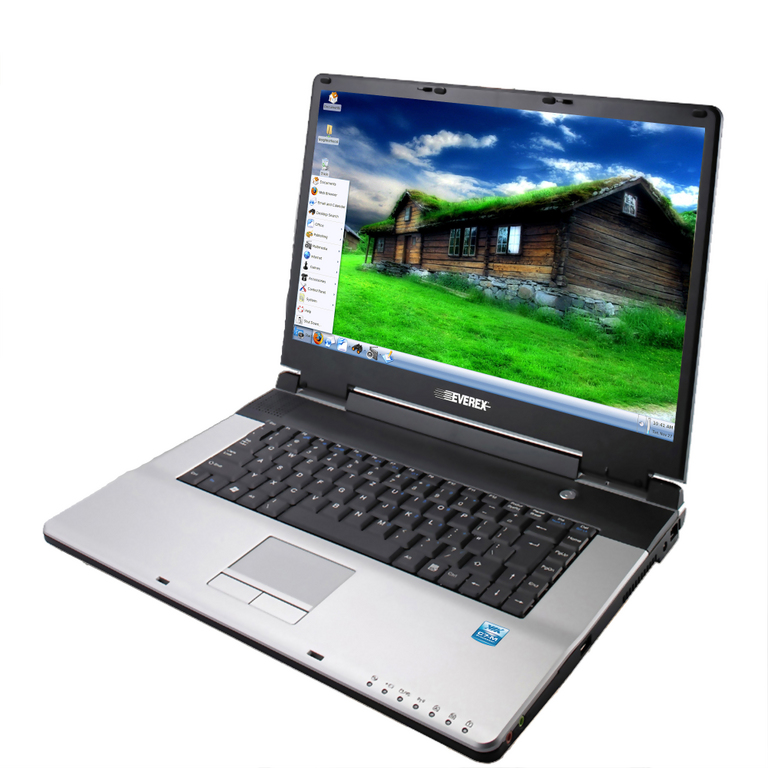
Figure 2. The new Zonbu laptop follows in the green footsteps of its older kin, the Zonbu PC. Zonbu even will offset your carbon emissions for you!
Not much different philosophically from Zonbu is Koolu, a Canadian firm that aims to save a tonne (Canadian for ton) of carbon emissions with its thin clients and Net appliances. With Jon 'maddog' Hall as Koolu's CTO and Ambassador, you are sure that the concept is robust and open source. The products run Ubuntu.
Koolu's (and many other firms') thin clients, says Hall, require only 10 Watts or less and “allow better sharing of CPU power, memory, disk and even people power”. Meanwhile, Koolu claims that the fanless Net appliances will save you up to 90% on electricity costs and 50% on PC capital costs. Furthermore, like the Zonbu twins, Koolu's products are RoHS-compliant. Unfortunately, Koolu does not currently offer a recycling program, nor does it purchase carbon offsets.
Besides the above information, there are many other ways to compute that are gentler on the environment. Here are a few suggestions:
Avoid e-waste by avoiding Windows Vista—a 2007 study by Softchoice Corporation and amplified by Greenpeace stated that “50% of all PCs are below Windows Vista's basic system requirements” and “94% are not ready for Windows Vista Premium edition”. A similar study by the British government found that Linux users need to upgrade their hardware only half as often as Windows users.
Investigate the environmental footprint of your next equipment purchase with Electronic Product Environmental Assessment Tool (EPEAT).
Look for the Energy Star logo, with its tough new requirements, for energy efficiency and power management capabilities.
Recycle your old CRT monitor—according to ViewSonic, a 19" LCD monitor sips only 40 Watts compared to 100 Watts for a comparable CRT monitor. The company estimates you'll save around $20 annually in electricity costs.
Although most news about the environment and energy consumption is alarming, the plethora of new Linux-focused technologies and initiatives related to green computing is a cause for hope and optimism. Many barriers, such as data-center complexity, lack of information and societal apathy, must yet be overcome, but the Linux community and many IT firms have laid a laudable foundation from which to build. The initiatives outlined in this article—IBM's Big Green Linux, Intel's Lesswatts.org, Linus' tickless kernel, virtualization, Zonbu and Koolu PCs, Energy Star, EPEAT and more—are excellent tools that can help you to do well while you do good. Linux Journal encourages you to keep Mother Nature in mind as you green up your data center or PC, but if you do your homework, going green likely will not be a burden to bear but a substantial long-term competitive cost advantage as well.
Resources
IBM's Big Green Linux Initiative: www-03.ibm.com/press/us/en/pressrelease/22006.wss
Intel's Lesswatts.org: www.lesswatts.org
The Linux Foundation's Green Linux Initiative: www.linux-foundation.org/en/Green_Linux
Cassatt Corporation: www.cassatt.com
Pacific Gas & Electric Rebates for Virtualization Projects: www.pge.com/biz/rebates/hightech/htee_incentives.html
Red Hat: www.redhat.com
Ubuntu: www.ubuntu.com
Intel's Classmate PC: www.classmatepc.com
Macedonia Computer Project: www.ubuntu.com/news/macedonia-school-computers
Xubuntu: www.xubuntu.org
Zonbu: www.zonbu.com
US EPA Energy Star Program: www.energystar.gov
Climate Trust: www.climatetrust.org
Koolu: www.koolu.com
Electronic Product Environmental Assessment Tool (EPEAT): www.epeat.net
James Gray is Linux Journal Products Editor and a graduate student in environmental science and management at Michigan State University. A Linux enthusiast since the mid-1990s, he currently resides in Lansing, Michigan, with his wife and cats.

