
EOF - The Hacking of Infrastructure. And Vice Versa.
At the MIT end of Massachusetts Avenue in Cambridge, for a few blocks on either side of Central Square, the sidewalks are wider than two traffic lanes. The widest part, alongside the street, is paved with nice red brick. Much of the sidewalk is shaded by small trees planted in squares covered with four iron grates, each with a round bite off the inside corner, to make room for the tree. On the sidewalk and the road, the brick and asphalt are covered with spray-painted markings, in blue, red, orange, yellow, green and white. Roots under some of the trees are lifting and spreading the grates.
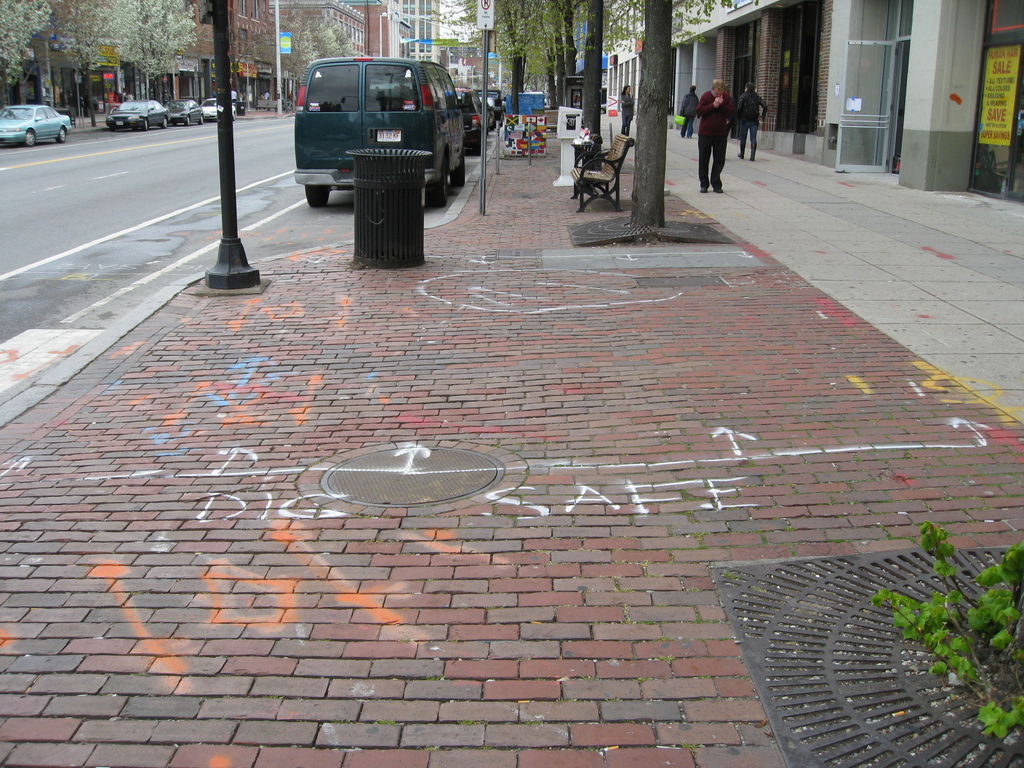
The graffiti is official. The markings are made by professionals who identify different forms of underground utility infrastructure, with color coding on the “Dig Safe” standard: blue for potable water, red for electric wiring, yellow for gas lines, orange for communications cabling (mostly phone and TV), green for waste water and white for planned digging perimeters. The colored markings say what lies beneath. Think of Dig Safe as the open sourcing of utility infrastructure.
What Dig Safe recognizes and codifies is the innate hackability of infrastructure. It's all temporary, all improvable, all replaceable. Bricks can be turned over to erase markings. Grates can be removed when trees outgrow them. Wires draped on poles can be buried, dug up and buried again. In some towns, buried service requires a trench the depth and width of a grave, with minimum spacings of three feet each between electric, cable television and telephone wiring. Some towns now are getting ready to eliminate all that deep digging and are requiring that communications utilities use fiber-optic cabling, which can run through conduits as narrow as a half-inch across, right next to electric wiring. Trenches then will be shallower and cheaper, but on the surface, the markings still will be red and orange. The simple necessities of construction and re-construction outweigh those of aesthetics.
Many years ago Ron Wilson, then the public voice of SFO (San Francisco's big airport) was a guest on a radio talk show, explaining the airport's improvements. A caller complained that the airport always seemed to be under construction. His response: all major airports are going to be under construction for as long as we have aviation.
The same thing goes for operating systems. With durable ones, such as Linux, all the parts are improvable and replaceable, while the architecture persists. In fact, improvability is an architectural imperative.
When most of us think about architecture, what usually comes to mind is the idealized sort. “The mother art is architecture”, Frank Lloyd Wright said. Wright was perhaps the greatest architect of the 20th century. Wright also said the job of the architect was to bankrupt the builder.
At the other end of the aesthetic scale is the practical architecture politely called vernacular: informal, common and arising out of local or regional usage. The word was borrowed from linguistics, where it means the same thing, but with one important difference: vernacular architecture looks to the future. It anticipates changes and uses that might come along. It is built to adjust and adapt.
In How Buildings Learn (Penguin, 1995), Stewart Brand said the best example of vernacular architecture was MIT's Building 20. Called “the magical incubator”, it lived from 1943 to 1998. Wrote Fred Hapgood, “The edifice is so ugly...that it is impossible not to admire it, if that makes sense; it has ten times the righteous nerdly swagger of any other building on campus, and at MIT any building holding that title has a natural constituency.” Among the nerds who swaggered there was the Tech Model Railroad Club, which coined the label “hackers” (also foo, mung, cruft and much more), while also spawning countless hacks, including the first video game, Spacewar. Among Building 20's other credits are radar, microwave, spectroscopy, quantum mechanics, atomic and molecular beams, masers and lasers, atomic clocks, radio astronomy, linear particle acceleration, magnetron phasing, fiber optics and digital data transmission.
Think of those as things that happened in user space, made possible by Building 20's kernel space. With Linux, user space exists because kernel space is there to support it. And, user space expands as kernel space becomes progressively more supportive of more uses.
The fact that Linux is practical, however, does not diminish the need for an aesthetic sense. On a Linux Journal Geek Cruise in 2003, Linus gave a “State of the Kernel” talk in which he presented a slide titled “People”. The first bullet read, “Calm, rational, non-flaming—and good technical tastes too! In a word: rare.”
Since then, Linux has become far more infrastructural, because far more of the world depends on it. For example, Netcraft.com reports that Microsoft's new Bing.com runs on Linux in Akamai netblocks. And why wouldn't it? Microsoft wants Bing to work reliably, just like Google has always done—on Linux. Hey, we all have room for improvement. Here, Linux gave some to Microsoft.
Doc Searls is Senior Editor of Linux Journal. He is also a fellow with the Berkman Center for Internet and Society at Harvard University and the Center for Information Technology and Society at UC Santa Barbara.
