
KDENLIVE Is a Promising Work in Progress
I had a stage play to edit. I didn't shoot it, and that lack of quality control on the head end meant that the editing was not the straightforward matter it should have been. It was shot in HDV, which is stored as an MPEG-2 transport stream, and my normal editing program doesn't play nicely with MPEG-2. Because it was a rushed job, I didn't have time to pull in a developer to add HDV support to it. So, I was faced with the task of turning around a difficult edit on a short timetable, using footage in a file format my favorite editor couldn't read.
Fortunately, this is open source. And, the odds are that somewhere, someone has run into the same problem before and done something about it. In this case, my friend Dan Dennedy (developer of Kino) pointed me to a new video editing project named KDENLIVE (yes, it really is an acronym: the K Desktop Environment Non-LInear Video Editor), which is based upon his multitrack engine MLT (Mutton, Lettuce and Tomato—the XML file format it writes to, appropriately enough, is called Westley).
I had run across KDENLIVE before, but had run away just as fast. Yes, Virginia, there is a hell. And, it's a very special hell, more heinous than that reserved for child molesters and people who talk at the theater, grander than Dante's ninth circle reserved for the Borgia dynasty of Popes, with more exquisite torments. This tenth circle, invented in the digital age, exceeding any that came before it, is the bane of Linux users everywhere, Dependency Hell!
This special torture is reserved especially (though not exclusively) for those of us intent on bending the mighty Linux dragon to our will, forcing it to perform feats of derring-do in the creation of art. Occasionally, in this never-ending struggle to do with open source what people with bigger wallets do easily on a Mac, the erstwhile adventurer stumbles upon a tool, just on the point of maturity, suitable to be appropriated to the task at hand.
This time, I didn't have the option to run away from KDENLIVE. Blender wouldn't do—the Video Sequence Editor doesn't perform well enough on my machine to edit HD with real-time playback. Cinelerra wouldn't do—a program that crashes every few mouse clicks isn't my idea of fun. I could have done it in Kino, but that would make for nightmares conforming the audio later, as I'd have to patch it up manually in Audacity when the video cuts had to jump in the middle of a word (not to mention the necessity of converting to DV beforehand, which meant chewing up another 200GB of hard-drive space I wasn't keen on parting with).
None of the other projects on the radar looked like they offered any significant advantage over KDENLIVE, so I bit the bullet and downloaded the thing, steeled with a vial of holy water for my descent into that very special Dependency Hell.
I started working my way through the list and...everything worked. The install was almost flawless, aside from a couple tweaks that had to be made to the MLT build parameters to accommodate a 64-bit environment. Within about an hour (and that spent building the extensive list of dependencies from source), I was up and running.
Well, running might be overstating it a bit. This was KDENLIVE version 0.4, and it was dog slow. To bisect a clip, the work flow went like this:
Select razor tool.
Choose cut point.
Click on the cut point to make the cut.
Go into the kitchen, pour a fresh glass of iced tea.
Come back 45 seconds later just in time to see the cut update to the interface, and continue working.
No, I'm not exaggerating for comic effect.
This clearly was not going to work. I couldn't bill my client for time spent on a laggy interface, and I didn't much relish the thought of spending several orders of magnitude more time on the project than I could honestly bill for. As a last-ditch-effort before borrowing a Final Cut HD machine for the weekend, I gave the KDENLIVE SVN version a try.
This one worked. It was still a little slow, but it was certainly serviceable. It played the HDV back in real time, and its lack of an HD edit profile, while annoying, was not a deal-killer as my client wanted a standard-definition DVD as the end product.
KDENLIVE presents itself pretty much as a standard multitrack editor—its interface looks similar to versions of MainActor and Premier from years past. All visible and within easy view in nested, dockable tabs are as follows:
An asset management window.
Effects control dialog with the standard crop of basic transitions.
Clip selection, timeline and video capture viewer ports.
A multitrack a/v timeline supporting infinite tracks.
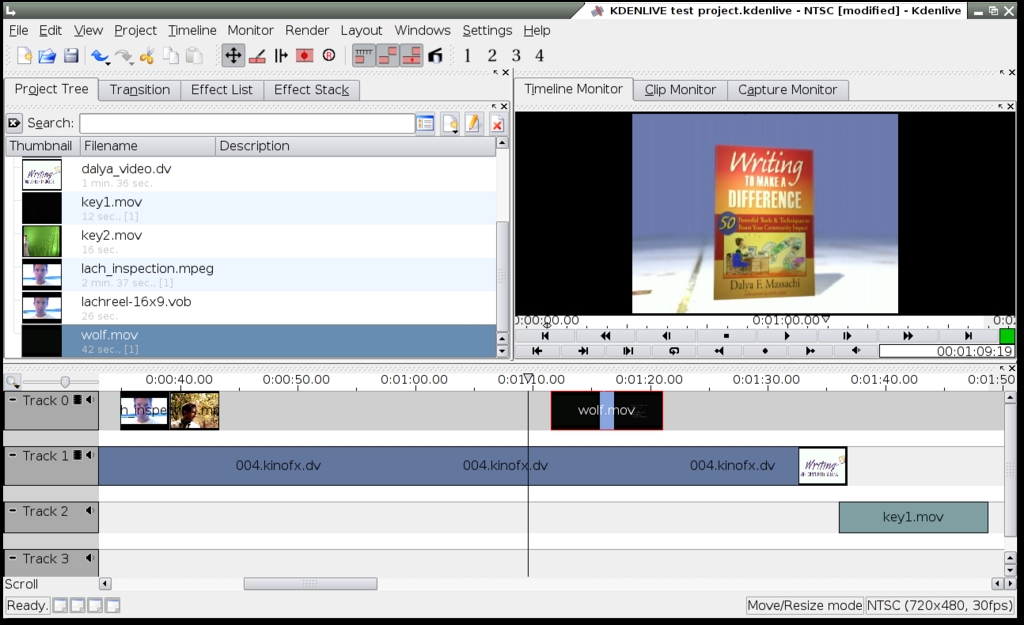
Figure 1. Manipulating the Project Tree in KDENLIVE
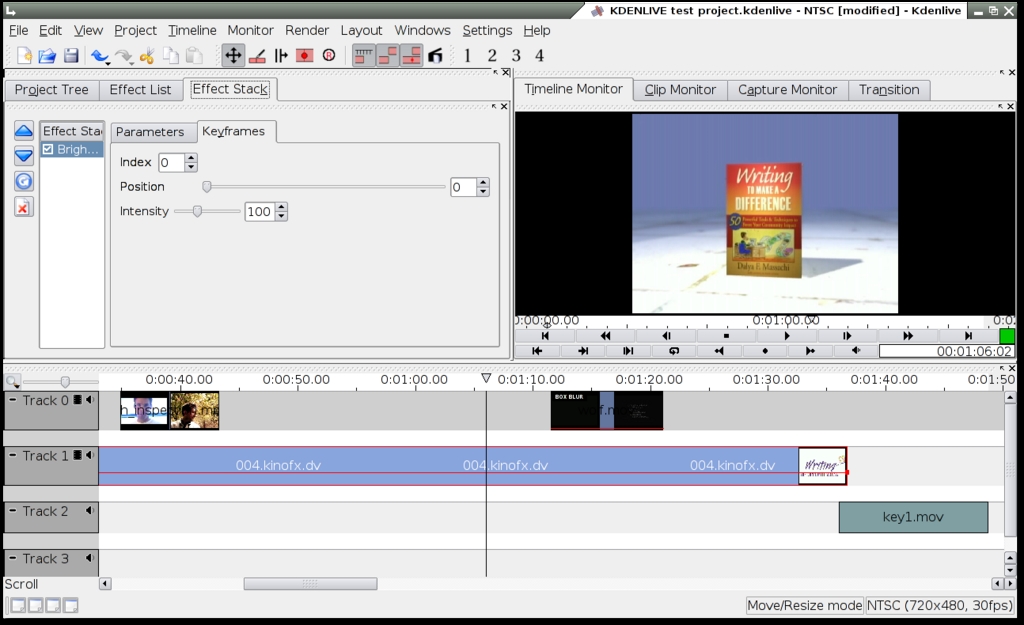
Figure 2. Adjust Effects through Keyframes
Stacking up against previous open-source forays into multitrack editing, KDENLIVE shows definite areas of improvement. It is the only NTSC-capable multitrack editor besides Cuisine (not currently maintained) that is suitable for doing long-form projects in Linux (at least, without plopping down upwards of $15k for a used Discrete Smoke workstation). To date, I've used it on three long-form projects, and the hours spent in front of it have been more than enough to shake out its better and worse points.
On the credit side of the equation, it doesn't seem to suffer from the sound-sync problem introduced by unlocked DV audio (a format that is, mercifully, beginning to ebb away as HDV with its constant bit rate audio replaces it). In most open-source editors (and some commercial ones), the slightly variable sampling rate of DV audio was enough to cause gradual sync slippage, running into several seconds of slippage over the course of an hour-long DV tape. Good DV editors, like Kino, had internal resampling that kept things on track in the editor, but upon format conversion for a DVD, the sync problem would show up in spades. Kino fixed this problem by integrating audio locking upon export. Although KDENLIVE does not obviously do this, it nevertheless seems not to suffer from this problem—or, if it does, I haven't detected it yet.
KDENLIVE's variety of export profiles also is worth cheering about. Presets (customizable) for most conceivable end formats are here, from Flash to H.264, from DV to DVD—a full range of standard-definition and Web profiles is here for the asking. The list of importable formats is no less impressive; because it uses FFMPEG for its encoding and decoding engine, it imports anything FFMPEG can read. This alone places KDENLIVE near the top of the heap for format compatibility.
Finally, the list of available video effects and transitions, although limited, are well implemented and have sensible, accessible interfaces. The maintainers' determination to make a program that “just works” shines through in many areas, even at this early beta stage.
On the other side of the scale, KDENLIVE underperforms because of its unfinished status and some basic design oversights. The first set of issues will doubtless be fixed in future revisions, but the second are things not yet on the road map, or they are out-and-out software bugs. In the first category, the lack of high-definition profiles is a significant drawback; however, it is rumored that the next release of the software will fix this issue. The ability to create videos from still image files is nonfunctional at the moment due to a software bug, and the titler, while fully implemented, suffers from the same bug and thus doesn't actually create titles that show up in the viewer windows. The performance on the current SVN version, although respectable, is still sluggish enough to be irritating, and it could use some interface optimization.
In terms of major oversights, three come readily to mind. The audio fader envelopes are not directly editable on the timeline, but may be accessed only through the effects control interface—a situation that is cumbersome at best. The faders are limited further by the ability to insert only two keyframes in any given clip, so doing something as simple as a fade-out at the end of a clip necessitates slicing off a separate clip solely for the purposes of fading out—a definite work-flow impediment. Other effects suffer from similar limited keyframe-ability.
Another oversight is the lack of deinterlacing in the scaling work flow. This is significant when switching between resolutions and between aspect ratios in a single project, as if one does not deinterlace before down-scaling interlaced footage, significant unattractive artifacting results. At the moment, for example, the only way to edit interlaced HD footage is to convert it to a deinterlaced high bit rate H.264 before importing it into KDENLIVE. The same rigmarole is necessary for working with interlaced 16x9 SD footage. Although AVIDemux does this handsomely with HD footage, it's an incredible waste of time waiting for the computer to chew down all the raw footage rather than implementing deinterlacing into the output work flow as a check-box option. AVIDemux does not work on raw DV footage at all, so when working in standard-definition DV, one has to resort to hand-converting things on the command line or on (shudder) a Windows machine.
Finally, nondestructive exporting does not seem to be implemented yet. In experiments I conducted with regular DV footage pushing through KDENLIVE, there was a noticeable quality drop between the footage I started with and the footage I wound up with at the other end of the pipeline. Dan Dennedy suggests to me that this may be a limitation with the underlying MLT framework, but the digging I've done seems to indicate that the output is handled by FFMPEG scripts rather than by MLT. If this is indeed the case, tweaking the scripts should be all that's necessary to correct the problem.
Other than those fairly obvious weak points, the only major drawback with KDENLIVE boils down to a failure of imagination on the part of the interface design. The layout of the screens is entirely conventional and fails to leverage some of the more interesting innovations made by other open-source multitrack projects, such as Cuisine's multicamera track-switching paradigm and OpenMovieEditor's clip bin asset management strategy. KDENLIVE is building a solid base to work from, but as it grows, it should not neglect borrowing effective innovations from other open-source projects.
In sum, KDENLIVE is a stable, usable multitrack editor that holds up well under the weight of long-form projects, so long as proper prep work is done to conform the footage before editing. Even though in beta stage, it's worth adding to one's toolbox and using often. Its limitations are significant, but forgivable at its current stage of development. Although not suitable for every project, it is ideal for long-format shows with basic editing needs. Hopefully, as it grows, it will expand its horizons and pilfer the good innovations of other nascent projects, and give us finally a powerful editing system suitable for a wide range of projects. The developers of this program deserve a pat on the back and a friendly beer, and hopefully perceive before them a wide vista for the future of their project.
Dan Sawyer is the founder of ArtisticWhispers Productions (www.artisticwhispers.com), a small audio/video studio in the San Francisco Bay Area. He has been an enthusiastic advocate for free and open-source software since the late 1990s, when he founded the Blenderwars filmmaking community (www.blenderwars.com). Current projects include the independent SF feature Hunting Kestral and The Sophia Project, a fine-art photography book centering on strong women in myth.
