
The 2006 LinuxWorld Canada Show
In 2005, the Toronto Linux User Group had a booth at the LinuxWorld Canada Show at the Metro Toronto Convention Centre, and this worked out very well for the group, as I noted in my article about the 2005 show (www.linuxjournal.com/article/8262). In planning for this year's show, our group looked at what went well and what could have been done better. Things that were done well included over-staffing the booth so that at any given time many of the volunteers could be looking at the other booths, drinking the show in. In the not so good category was the consensus that electrical power in the booth wasn't worth what the convention center charged us. In the "just different" category, during the past year as an organization, the Toronto Linux User Group had legally changed names to become the Greater Toronto Area Linux User Group (GTALUG), meaning that the banner and paperwork from last year could not be reused.
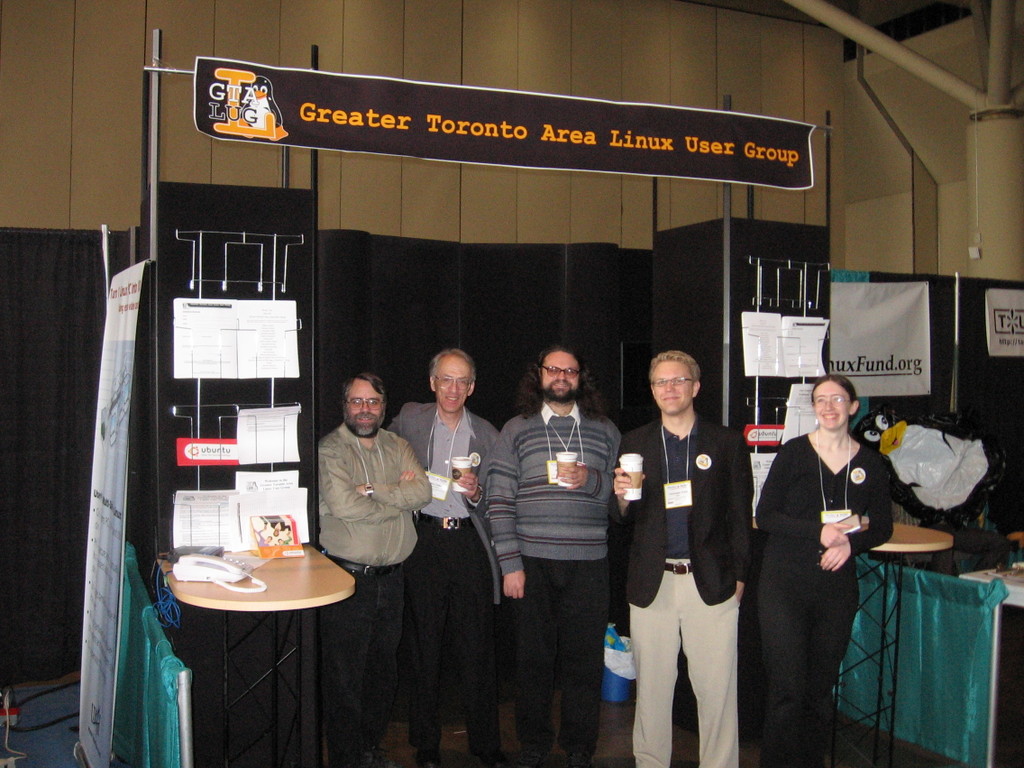
The GTALUG booth with (from left to right) Drew Sullivan (GTALUG President), Gordon Chillcott, Bill Thanis, Christopher Friedt and Seneca Cunningham (GTALUG board members). Present but not shown were Daniel Armstrong, Meng Cheah, Teresa Chin, Behdad Esfahbod, Andrew Hammond, Ivan Frey, Chris Johnson, Teddy Mills, Jeffrey Pikul, Don Rambajan, Herb Richter, Alan Rocker, Amos Weatherill, Kent Wong and Pavel Zaitsev.
Many in our group love swag--free stuff to get and/or to give away. So, when planning for the show, the question came up as to how we could give stuff away on an effectively zero budget. I approached several Linux distributors asking for CD-ROM and/or DVD-ROM disks. Canonical Limited (www.canonical.com) came through quickly with 1,000 Ubuntu (www.ubuntu.com) packages, some stickers, some fliers and a few T-shirts. The Fedora Foundation shipped some DVD disks, but between the shipment date and oddities of Canada customs, the disks didn't make it on time. Sorry! Further, we approached the convention center asking for an exemption in order to be allowed to offer snacks brought in from outside to offer to booth visitors. The convention center gave conditional permission to offer snacks, noting that the snacks had to be individually wrapped, bite-sized and nut free. So we offered inexpensive hard candy bought at a Zellers (www.hbc.com/zellers) discount store.
Other things I did included putting together dozens of 2.25" metal buttons with a GTALUG logo, using parts from Mr. Button (www.mrbutton.com) and a press from Badge-A-Minit (www.badgeaminit.com). The buttons made it easy for GTALUG members to find each other on the show floor--a moderate success in fact.
The presence of the free "swag" meant we wanted to change our booth furnishings so that we could store stuff in a way that was easy to access and be at out of view at the same time. The booth we used in 2005 had limitations when it came to storage. In the month before the event, I got out last year's booth parts, checked the parts out and then packed them back up. A search through the back of my employer's storage area at Innovation Toronto turned up another set of tradeshow booth parts that would offer what we needed.
In the weeks before the LinuxWorld Canada show, I went to several other tradeshows looking for ideas and thoughts as to how we could do a better booth. I researched the likes of the Voices on the Net (www.pulver.com/canada2006) and Storage Attached Networks show (www.sannas.ca/2006). It all helped.
The Saturday before the show, I was back at the office for some last-minute checks. While at the office, I saw co-worker Martina Ernst who was doing final checks for the volunteer work she was doing for the Society of Internet Professionals. Her group was to have two booths, one at LinuxWorld Canada and one at the Search Engine Strategies show, both occurring April 25th and 26th, both in different parts of the Metro Toronto Convention Centre. Her problem was that her group had furnishings for only one booth, leaving her looking to buy tables. I suggested she use last year's TLUG booth furnishings. This meant that I found myself helping with the set-up/tear-down of two booths. This also meant I was walking around with three badges at all times, one as a LinuxWorld Canada Exhibitor, one as a member of the press for LinuxJournal.com and one as an exhibitor for Search Engine Strategies show.
Monday morning, Len Despres from Innovation Toronto drove the booth furnishings for the two booths down to the convention center. With five people, this job went very quickly.
The first keynote speech on Tuesday was given by Ajay Royyuru about the Genographic Project (https://www3.nationalgeographic.com/genographic), a joint project between IBM and the National Geographic Society. Basically, the Genographic Project looks to trace human migrations and movements over the last tens of thousands of years by way of genetic variations in DNA. The project is one year into its planned five-year term and is supported by a group of IBM running Linux servers. Besides the corporate sponsors, the project is supported by sales of a $100 kit that will allow you to find out where your ancestors came from and have been over the last few tens of thousands of years. After the purchase of a kit, you mail in a genetic sample to be analyzed, and then the results are posted on a Web site; your user name and password are included with the kit. This way, you can see where you fit in, and the results can be kept anonymous. The talk was very interesting as a science talk, with a strong emphasis on genetics and but had only passing references to the servers supporting it.
Tuesday morning I also briefly looked in on the Search Engine Strategies show, which seemed to focus on using search engines to help marketing efforts. In other words, this was a show where marketers were teaching other marketers how to do a better job marketing.
Jon "maddog" Hall of Linux International (www.li.org) was noting the evolution of his organization from one that was focused on helping Linux vendors to one that is focused on helping end users.
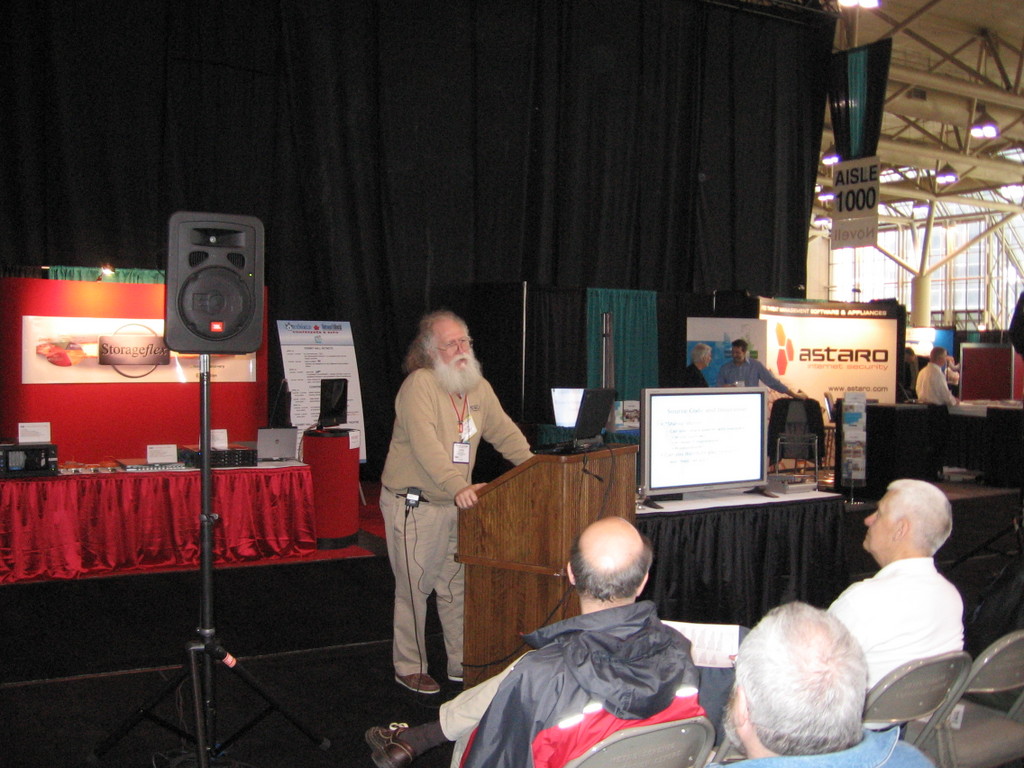
Jon "maddog" Hall of Linux International
Kevin Shockey, editor of Linux Journal's sister publication TUX was at the show, and he was often found at the Linux Journal booth. In the past, I have written an article for Kevin Shockey, but before meeting and talking him with him I had no idea that he lives in Puerto Rico.
During the Tuesday lunch hour IBM ran a press briefing, and among the speakers, the most interesting was Patrick Lor of istockphoto.com. The istockphoto.com Web site offers very inexpensive stock photography. So people who want stock images for their Web sites or other publications and don't want to worry about copyright concerns, simply pay anything from $1 to $40 per image. With typical stock photography vendors, you are paying $100 and up, so the istockphoto.com people are determined to change the market by making it so easy and cheap to use stock photography, there will be no excuse not to. Further, istockphoto.com is offering an easy way for people to get money for the images they have taken. Some 25,000 new images are submitted to istockphoto.com each week, of which the staff consider about 12,000 images to be usable. The istockphoto.com Web site is powered by IBM servers.
In the afternoon, Bdale Garbee of Hewlett-Packard spoke about reaping the benefits of open-source development. HP is currently the largest single vendor of Linux-based servers. An internal HP study has turned up some 15,000+ Linux-based devices. Also, there are some 120,000 registered HP Jabber instant messaging users, something that is all run under Linux. In the community, HP is a Jabber Foundation member (www.jabber.org) and behind the Linux Common Operating Environment (linuxcoe.sourceforge.net).
Tuesday evening, the NewTLUG (the Toronto Linux User Group new user) meeting occurred at the show, with the topic being a distribution comparison. Four other local "power" users and I made the case for seven different distributions. I spoke in favor of Knoppix (www.knoppix.org) and Debian (www.debian.org). My Debian comments were a rehash of what I noted in my April 2006 TUX (www.tuxmagazine.com) article. In my talk, I got in a small plug for Coyote Linux (www.coyotelinux.com), a Linux distribution that makes for brilliant firewalls/routers and is unapologetically awful at everything else. Other speakers made cases for Mandriva (www.new.mandriva.com), Fedora Core (fedora.redhat.com), Ubuntu (www.ubuntu.com), PCLinuxOS (www.pclinuxos.com) and MEPIS (www.mepis.org). Paul Mora, whose day job is with IBM Canada, had set up his laptop with VMware and basic installs of most of the distributions discussed so they could be easily shown on the video projector. As well, in David Patrick's Ubuntu talk, he offered some real-world examples of using Ubuntu to run his small business, Linuxcaffe (linuxcaffe.com).
Wednesday, with my talk done, the show was more relaxing, and I could enjoy starting with the morning keynote speech by Bob Park of Samsung. Bob Park's focus was on his firm's products as a business value, but it could have used more reference to Linux.

Bob Park of Samsung
I interviewed Max Haroon of the Society of Internet Professionals (www.sipgroup.org) regarding his organization's certification programs, which include Search Engine Optimization, Web Technology, Web Design, Web Management, Web Development, Internet Privacy, e-Business and e-Learning. The current big project for this small organization is a one-day Identity Theft Summit on September 12, 2006 in Toronto, Ontario.
Ross Chevalier of Novell spoke at the Wednesday afternoon keynote about Novell's efforts to bring Linux to the desktop via its SUSE subsidiary. There are several new efforts on that score. Novell is running a Web site, www.betterdesktop.org, that offers GNOME and KDE developers insights from Novell's usability studies. Novell has set up usability labs in Utah and in Boston, Massachusetts, and it has a portable lab. In the labs Novell asks ordinary computer users to perform a task, such as open and edit a document, then video tape what happens.
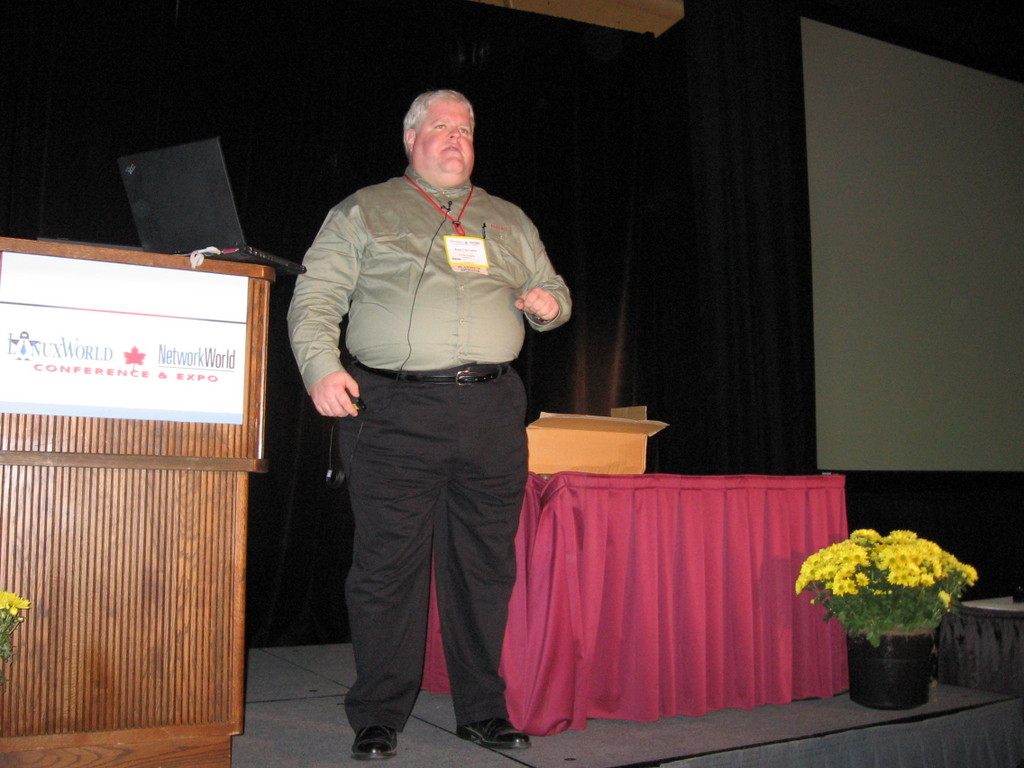
Ross Chevalier of Novell
With this Ross Chevalier noted the value of eye candy, commenting that he would not have believed people would travel across the show floor to see a spinning cube, but that is what happened. People love attractive-looking screen displays, so it is important to look good. With the XGL screen software, which requires 3D accelerator video cards, you get such goodies as being able to flip between screens the way you have with many window managers such as KDE and GNOME, but it treats the screens as a cube, rotating between screens. Further, with XGL, you can rotate between screens partially, allowing you to see two screens at once. The XGL software is being made available under the GNU Public License, so all Linux distributors will have the option of including XGL for free. This is in part driven by the fact that we know Microsoft's upcoming Vista software and Apple's next OS X software will raise the appearance bar, so that is what users will expect, and Novell wants to meet that challenge.
It was somewhat surprising to see the Toronto Windows Server User Group at the show, a group that was telling people that thanks to virtualization software, Microsoft now supports Linux. In the short time I was by the Toronto Windows Server User Group booth, they seemed to be getting a polite but hardly convinced reception.
Allied Telesyn had a small booth at the show. I am one of the old timers who remembers Allied Telesyn as makers of AUI-to-Ethernet transceivers, which looked like small bricks and in service were rock-solid reliable and tough as bricks. Now, Allied Telesyn has joined the Voice over IP crowd with a number of products aimed at supporting the issues of supporting voice over the Internet.
Other VoIP players at the show included the Toronto Asterisk Users Group (taug.ca). The Asterisk people are operating-system indifferent as this program is available for Linux, Mac OS X and Windows. Still, it was cute to see a Linux-based Linksys wireless router running Asterisk set up to act as a basic private branch exchange phone system, all for less than $100. Further, as the Asterisk booth was close to the GTALUG booth, an extension phone was set up between the two booths, allowing people at one booth to phone the other booth.
The most notable firm missing from last year's show was Apple Computer, who last year talked about its FreeBSD-based servers. As well, Toronto-area Linux Journal columnist Marcel Gagn�did not make this year's show due to a scheduling conflict with another Linux-related show in California.
The most interesting choice of outfits for the show came from XPMsoftware (www.xpmsoftware.com) where all the booth staff was wearing the same Hawaiian-style shirts--something that implied a different origin than Brampton, Ontario, just outside Toronto. XPMsoftware's focus is antispam software, an element that although clearly present at the show this year, was not the overwhelming presence it seemed to be at last year's show.
Near the end of the show, Novell held a drawing for a number of goodies for people who had spoken to at least three of its sales people. In years past I had entered the drawings, never winning. This year, I came away with a nice piece of Novell-logo-decorated luggage.
Among the more interesting freebies at the show was a purple flashing rubber ball from Netdirect.ca and a small rubber blue-jacket-wearing Tux doll from IBM.
I was interested in the benefits of having a press badge at a show like this. A Red Hat staff member noted that as a member of the press the normal $1,199 registration fee for the Red Hat Summit May 30 - June 2 in Nashville, Tennessee would be waived, something that were my day job a bit better I would find tempting. There was a press lounge that always had coffee and orange juice available. The IBM press briefing, besides some interesting speakers, also offered some sandwiches, cakes, coffee and soft drinks.
At the end of the show, I found I had been almost run off my feet. Lessons learned included the fact that I took on too many tasks for the show this year, that four hats--journalist, presenter, coordinator for one booth and set-up/tear-down supervisor for two booths--was too much. For next year's show, I plan to drop at least one (presenter) hat. For the Greater Toronto Area Linux User Group, financially we did not make as much money as last year in membership sales, and the crowds seemed to be somewhat lighter than last year. Still, between the money that did come in and the contacts that were made, we considered the event to be a success overall. I'm already looking forward to next year's show!
Colin McGregor works for a Toronto-area charity, does consulting on the side and has served as President of the Toronto Free-Net. He also is secretary for and occasional guest speaker at the Greater Toronto Area Linux User Group meetings.
