Economics Researchers Meet OpenDocument
Some weeks ago I wrote
"Everybody's Guide
to OpenDocument" to explain, in non-technical
terms, how the adoption of open file formats benefits the lives of
all citizens, not only computer techies. A few days later, I received
a request to introduce the problems of file formats to an unexpected
audience, one that is highly skilled but not in the software field. The
Sant'Anna
School of Advanced Studies is a prestigious public university in
Pisa,
which is located in wonderful Tuscany. Sant'Anna is specialized in both
social sciences (economics, jurisprudence and politics) and experimental
ones (agriculture, medicine, industrial and computer engineering). It also hosts the
Group of Italian TeX Users
and its annual TeX and LaTeX meeting. Outside of this group and the engineering
department, the rest of the school does not commonly use Linux. The
school administration recently has started to receive OpenOffice.org
files, however, but Microsoft proprietary formats still lead the game there.
My invitation to speak came from the school's
Laboratory of Economics and
Management (LEM).
Giulio Bottazzi, Associate Professor
of Economics, works in CAFIM, the
Research Center of Analysis of
Financial Markets, which is part of LEM. Giulio always has worked in a scientific environment and, to use his own
words, "grew up with UNIX". He almost exclusively uses free software,
such as Emacs, gnuplot and TeX, in his work. Giulio had read my article
on OpenDocument and wanted me to come to the school to talk about the
need to keep industry standards truly open.
In particular, Giulio wanted me to talk about OpenDocument. He was
interested in both the future--that is, the cultural and monetary costs
of keeping digital data available--and in the short-term market impacts
caused by barriers to transparent communication among users of different
computer platforms. Giulio explained to me that this kind of problem is being analyzed
with growing interest by economics researchers. However, to evaluate
date properly, they need practical overviews, minus software
engineering jargon. My task then was to make clear why and how
something like OpenDocument could be relevant to people studying
"management and corporate strategies, public choice and public policy,
innovation and industrial history".
That's why, on November 10th, I took the train to Pisa, by way of Florence,
and arrived at the school. Following Giulio's request, I had with me some
45 slides, of which only two or three actually dealt specifically with XML
and OpenDocument internals.
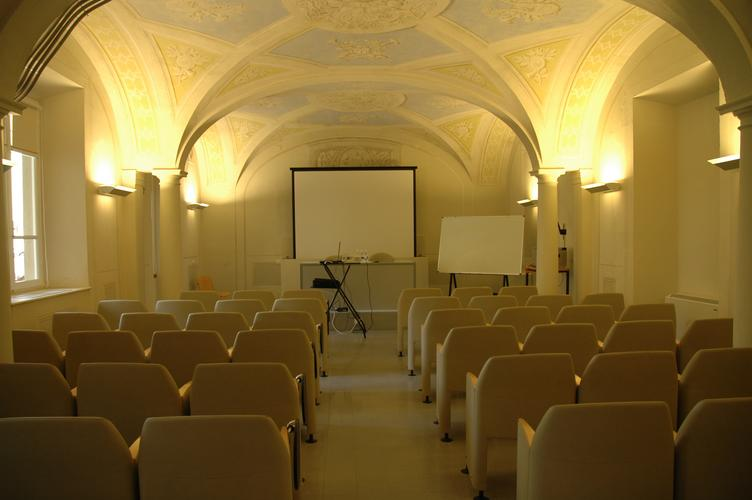
Once settled in a very nice hall, I began to demonstrate for the
audience how important open formats were right there in Pisa, more than four centuries ago. I was assisted in
this by nobody less than one of the most famous Pisans,
physicist Galileo Galilei. As the story goes, at the end of the 16th
century, Galileo climbed to the top of the famous Leaning Tower of Pisa and dropped
two balls of different weights in order to measure how fast each
fell. Starting with this experiment, Galileo built the
theories later exposed in his
"Dialogue
Over the Two Chief World Systems", which proved Aristotle wrong and was the beginning of classical
cinematics and dynamics. The Leaning Tower experiment, as told in the
folklore, is probably a legend. However, I pointed out to Giulio and
his students--who has started wondering if they'd invited the
right guy--that the truthfulness of the tale doesn't matter. What
matters is we still can learn physics from the original version of Galileo's 1632 book. Even
if it never had been republished, the first edition remains readable (if
you know Italian, of course), because the data format--the alphabet--is
completely open. This, I continued, is true with every book, from the Bible to Euclide's
Elements. And the cultural and economical benefits
of such openness are enormous.
Next, I explained what made this miracle of perpetual accessibility
possible: a well-structured information architecture that humankind
has had since the beginning of recorded history and risks losing today. We
create, access and preserve information through the simultaneous use
of three different things that should remain as separate as possible:
- Physical Support: the material object containing
the information - Data Format: the rules by which the information
is encoded on the support - User Interface: the tools used to write and read
the data according to the format
Some millennia ago, the distinction was quite clear. To demonstrate
this point, I showed a picture of the Rosetta Stone. In the second
century BC, someone used a chisel (the user interface) to save on a slab of rock
(the support) some information in hieroglyphs (the format). The
information equally could have been written on papyrus or clay tablets with a quill pen
or stylus. Eighteen centuries later, as anybody who's been left with
Betamax tapes in a VHS world knows, the analog electronic era
mixed things up terribly. This happened partly because of profit but also
because almost nobody realized what was at stake early enough. One of
the best examples of this point is the 1976 Viking records, previously
discussed in my OpenDocument Guide article. In short, due to format
incompatibilities, many extant documents had to be retyped manually
from printouts in order to be restored, simply because the old and new
formats couldn't communicate.
The digital era, I continued, finally has the potential to set things
straight again and make them a million times better. We have hard drives,
floppies, CD-ROMs, DVDs, compact flash drives and so on. These supports
all are pluggable directly, within reasonable limits, into different kinds
of hardware. They merely act as containers of the same bits, which are arranged
in different formats to store any kind of information: text, images,
audio and more. Above all, any software program (user interface), regardless of its license
and the hardware it runs on, could read and write the same format.
Keep the Records Straight, Please!
The central part of the seminar centered on the fact that almost all
software programs are worthless if they don't have information to process, store
and display. Locking up that information is the easiest way a
manufacturer has to keep selling copies of a program, without really improving it,
but it can be terribly costly for users. Adobe, for example, can maintain the same pricing
strategy of
FrameMaker, even if
its development has been completely out-sourced to India, because
of the product's proprietary format.
I also brought up some examples of how closed formats make a huge
impact on private and public digital archives. One example is the
Virginia State
Laws declaring, due to a lack of hardware and software standards,
that electronic records are not acceptable yet for permanent storage.
Microfilm and alkaline paper are allowed, but they are much more
expensive, not searchable with a computer and unaccessible from the Internet.
Another example is a
report
published in 2000 that discovered most organizations hadn't even realized
they had a data preservation problem. Those who were aware of the
problem also knew the total cost per year to fix the problem would range
from $10,000 to $2.6 million.
Here Come the Governments
Open formats, or lack thereof, definitely should be
on any economics researcher's radar, because they will move huge piles
of government money in the coming years. Massachusetts state government may
have received the most press in the US for its desire to move to open
formats, but other governments are not sleeping on this matter:
- The Norwegian Minister of Modernization recently
announced his intention
to stop using proprietary software and accept only open formats by
2009. - The policy of the British Education Communication Technology
Agency
states
that only software that saves files in open formats (including OpenDocument, but not Microsoft .doc)
can be used in a big project to modernize all secondary
schools in the UK. - A 2003 directive
in Italy requires that public administrations privilege
IT solutions that, among other things, can export data in at least one
open format. - The regions of
Emilia Romagna
and
Toscana,
where Pisa is located, have local laws that promote non-proprietary file formats "in order to
guarantee to all citizens the greatest freedom to access public
information".
Not Some Visionary Dream
During my talk at Sant'Anna, I also showed that OpenDocument already is
being used and that any information stored in this way is available
completely and easily to its owner. The
slideshow
I presented ran in
OpenOffice.org 2.0,
which uses OpenDocument as a default format. When I announced what
I've found to be OO.o's best selling point for non-techies--its
built-in ability to save in PDF format--one participant brought up
all the trouble he had experienced when trying to do the same thing
with proprietary software. At that point, I stopped the slideshow, opened the
presentation file with WinZip and loaded the content.xml file in
Notepad to show the audience the same text that was filling the
screen only seconds earlier in the slideshow. The text was buried
in a ton of XML markup, so I reassured everybody that while few people
edit XML by hand, it's essential that the option remains possible.
Final Results and Plans for the Future
According to Giulio, the seminar I participated in met all his
expectations. It illustrated clearly both the real costs of using proprietary formats
to archive or exchange information and the potential an open solution
such as OpenDocument offers. When I asked him his professional opinion on the
whole issue, he said:
The usage of customer lock-in techniques as barriers to reduce competition
is well known. Its extension to Information Technology doesn't change the
nature of the problem, which has already been widely studied and documented
by economists. On the other hand, keeping digital documents fully accessible
for long periods of time is indeed a huge problem and expense, whose true
magnitude is still barely understood. I don't know of any economic
model [taking] this issue into account. It would be interesting to
develop it.
Giulio concluded by confirming his belief that these issues are extremely
relevant to our future. The unstoppable conversion of all services to
digital technology makes information management and archival more and
more important in every budget, from families to nations. Private
companies operate for profit, and there is nothing wrong with that.
However, Giulio said, "when we choose these technologies, we can't afford to put the
interests of private, sometimes foreign, parties before the guarantees
of freedom, equality and legality that a fair and liberal society must
offer to all its citizens". In the future, he hopes to contribute to
other initiatives and studies on open formats, so all researchers and
FOSS users are encouraged to contact him at
bottazzi@sssup.it. If you do, please let me know too.
Marco Fioretti is a hardware systems engineer interested in free
software both as an EDA platform and, as the current leader of the RULE
Project, as an efficient desktop. Marco lives with his family in Rome,
Italy.