
Building Image Galleries with Konqueror
I have had a digital camera for a several years now. I take a lot of photos with it, but most of them seem to end up stored on CDs that sit on the shelf. This happens because it seems to take too long to build photo galleries with my desktop.
Many photo gallery programs are available, but they always seem to be inconvenient. First, they aren't included with most Linux distributions. Second, they have complicated setups and/or they require a lot of command-line work to build the galleries. Recently, I was looking in the menus of Konqueror, KDE's file manager and Web browser, and saw an entry in the Tools menu called "Create Image Gallery". One of the reasons I probably missed this entry earlier is it appears in the Tools menu only if you start Konqueror from the little house icon. If you open Konqueror from the K menu or from the globe icon on the bottom toolbar, once it opens, click the house icon on the Konqueror toolbar. When the new screen opens, you can find the "Create Image Gallery" on the Tools menu (see Figure 1). Alternatively, if you open Konqueror from the command line, the "Create Image Gallery" immediately is available on the Tools menu.
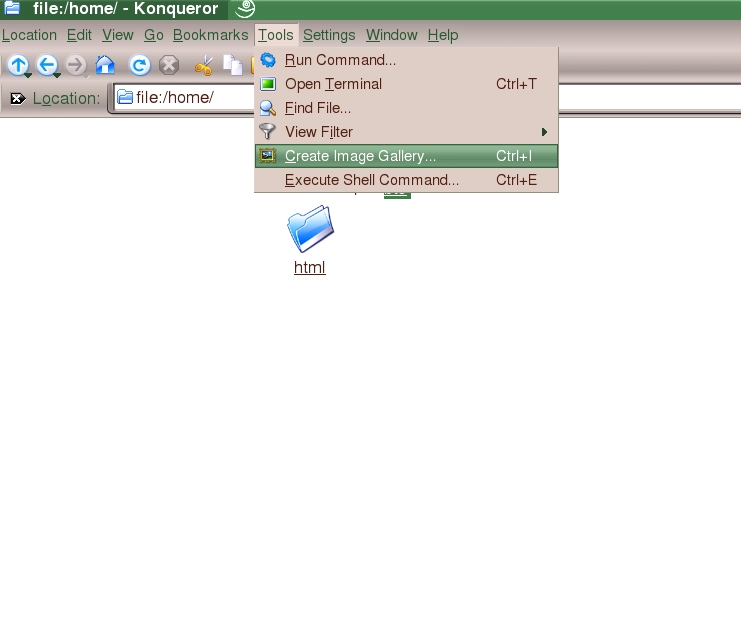
In order to see what this magic tool might do, I created a new directory and copied some pictures to it. You can do this however you want. Working totally within Konqueror, for example, you can select the New Directory item on the Edit menu, name and create the directory folder and then drag the desired files to this directory. This usually is accomplished easier if you open two Konqueror windows. If you are a command-line user, mkdir and cp can be used to create the directory and copy the images.
Once you have all the pictures you want in the directory, click on Create Image Gallery in the Tools menu. There, you should see a box of options that let you set the style of your gallery. Included are options for images per line, font, colors and what descriptive information is to be included. You can specify a page title, for example, "Trip to New York". By clicking the Directories icon, you can specify the output file name--the default is images.html--whether to recurse any subdirectories, if the files are to be copied and if a comment file is to be used (see Figure 2).
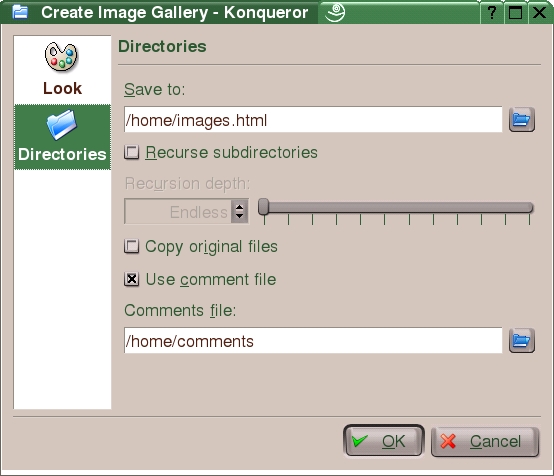
I like the idea of the comment file but had some trouble finding documentation for it. The KDE.org site, though, explains how to use it. Create a text file with the name you're going to use in the "Comments File" field. Each thumbnail should have the comment underneath the file name:
FILE1: comment1 FILE2: comment2 FILE3: comment3
The order of the filenames is not important, but make sure you spell them correctly. The comment can be any length, the page will stretch or shrink the line to fit it. Each time you change the file, you have to re-run the Create Image Gallery command, remembering to check the Use Comment File box that appears when you click on the Directories icon.
Once you have selected the options you want, simply click the OK button, and your gallery will be created and displayed. It is as easy as that. If you aren't happy with the results, modify the options and click OK again.
Copyright (c) 2004, Hal Stanton. Originally published in Linux Gazette issue 98. Copyright (c) 2004, Specialized Systems Consultants, Inc.
Hal Stanton was a Windows user for too many years. Now he honestly can say that Linux is a lot more fun.
Realizing the promise of Apache® Hadoop® requires the effective deployment of compute, memory, storage and networking to achieve optimal results. With its flexibility and multitude of options, it is easy to over or under provision the server infrastructure, resulting in poor performance and high TCO. Join us for an in depth, technical discussion with industry experts from leading Hadoop and server companies who will provide insights into the key considerations for designing and deploying an optimal Hadoop cluster.
Sponsored by AMD
Built-in forensics, incident response, and security with Red Hat Enterprise Linux 6
Every security policy provides guidance and requirements for ensuring adequate protection of information and data, as well as high-level technical and administrative security requirements for a system in a given environment. Traditionally, providing security for a system focuses on the confidentiality of the information on it. However, protecting the data integrity and system and data availability is just as important. For example, when processing United States intelligence information, there are three attributes that require protection: confidentiality, integrity, and availability.
Learn more about catching the bad guy in this free white paper.
Sponsored by DLT Solutions
| Designing Electronics with Linux | May 22, 2013 |
| Dynamic DNS—an Object Lesson in Problem Solving | May 21, 2013 |
| Using Salt Stack and Vagrant for Drupal Development | May 20, 2013 |
| Making Linux and Android Get Along (It's Not as Hard as It Sounds) | May 16, 2013 |
| Drupal Is a Framework: Why Everyone Needs to Understand This | May 15, 2013 |
| Home, My Backup Data Center | May 13, 2013 |
- Linux Systems Administrator
- New Products
- Senior Perl Developer
- Technical Support Rep
- UX Designer
- Web & UI Developer (JavaScript & j Query)
- Designing Electronics with Linux
- Dynamic DNS—an Object Lesson in Problem Solving
- Using Salt Stack and Vagrant for Drupal Development
- Making Linux and Android Get Along (It's Not as Hard as It Sounds)
- Have you tried Boxen? It's a
2 hours 10 min ago - seo services in india
6 hours 41 min ago - For KDE install kio-mtp
6 hours 42 min ago - Evernote is much more...
8 hours 42 min ago - Reply to comment | Linux Journal
17 hours 27 min ago - Dynamic DNS
18 hours 2 min ago - Reply to comment | Linux Journal
19 hours 33 sec ago - Reply to comment | Linux Journal
19 hours 50 min ago - Not free anymore
23 hours 52 min ago - Great
1 day 3 hours ago
Enter to Win an Adafruit Pi Cobbler Breakout Kit for Raspberry Pi

It's Raspberry Pi month at Linux Journal. Each week in May, Adafruit will be giving away a Pi-related prize to a lucky, randomly drawn LJ reader. Winners will be announced weekly.
Fill out the fields below to enter to win this week's prize-- a Pi Cobbler Breakout Kit for Raspberry Pi.
Congratulations to our winners so far:
- 5-8-13, Pi Starter Pack: Jack Davis
- 5-15-13, Pi Model B 512MB RAM: Patrick Dunn
- 5-21-13, Prototyping Pi Plate Kit: Philip Kirby
- Next winner announced on 5-27-13!
Featured Jobs
| Linux Systems Administrator | Houston and Austin, Texas | Host Gator |
| Senior Perl Developer | Austin, Texas | Host Gator |
| Technical Support Rep | Houston and Austin, Texas | Host Gator |
| UX Designer | Austin, Texas | Host Gator |
| Web & UI Developer (JavaScript & j Query) | Austin, Texas | Host Gator |
Free Webinar: Hadoop
How to Build an Optimal Hadoop Cluster to Store and Maintain Unlimited Amounts of Data Using Microservers
Realizing the promise of Apache® Hadoop® requires the effective deployment of compute, memory, storage and networking to achieve optimal results. With its flexibility and multitude of options, it is easy to over or under provision the server infrastructure, resulting in poor performance and high TCO. Join us for an in depth, technical discussion with industry experts from leading Hadoop and server companies who will provide insights into the key considerations for designing and deploying an optimal Hadoop cluster.
Some of key questions to be discussed are:
- What is the “typical” Hadoop cluster and what should be installed on the different machine types?
- Why should you consider the typical workload patterns when making your hardware decisions?
- Are all microservers created equal for Hadoop deployments?
- How do I plan for expansion if I require more compute, memory, storage or networking?


Comments
Update to comments file format
I have been experimenting with the Image Gallery tool, and found the comments file to be a great addition. In trying to get it work, I found that you need to put a blank line between the comment and the next file name:
FILE1:
comment1
FILE2:
comment2
FILE3:
comment3
Hope that helps somebody.
Image Gallery
Many do not know about existence of such function.
It really simplifies creation Image Gallery.
Thanks Hall.
JAlbum
Howdy! Thanks for sharing this tip. However, a simple cross-platform tool you can use that does an awesome job--including templates for photo albums--is JAlbum. You can get it online at www.jalbum.net
Best wishes,
Miguel Guhlin
http://www.mguhlin.net/blog
nicee
Verrrry nice !
Btw, can you tell me the name of your Green Kde theme ? It's very lovely !
that's the SUSE theme, as
that's the SUSE theme, as you can recognize from the "Geeko"