
Linux Quick Fix Notebook by Peter Harrison
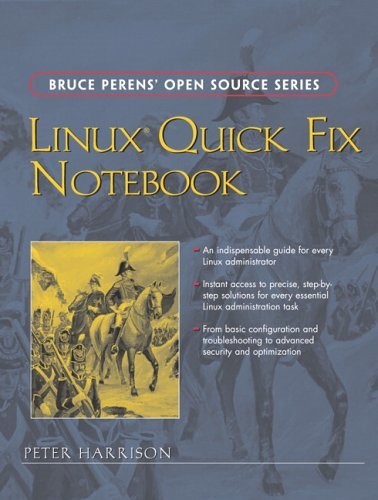
The book covers topics ranging from configuring the boot process to building DHCP servers.

Prentice Hall PTR, 2005

ISBN: 0131861506

$39.99 US

Peter Harrison's new Linux Quick Fix Notebook is the kind of book that all Linux professionals should have handy for times when they need immediate results. Harrison doesn't waste time explaining theory or concepts. Instead, he works off the assumption that if you need to build a DNS server, you already know what DNS is and how it operates.

The book covers topics ranging from configuring the boot process to building DHCP servers. Within each topic, Harrison jumps directly to what you need to do to get the application running right away. Although the directions and configurations are not always sophisticated, they are fully functional and technically correct. This approach of providing a starting point for a service and leaving the rest to the reader to configure is probably for the best, as each user has individual requirements.

The layout of the book is almost that of a FAQ. Each topic is covered within a few pages. Of all the computer books I own, this is the most direct and to the point when it comes to Linux configurations.

Harrison's writing style is clear and easy to understand. He manages to provide adequate detail on each step of a procedure without going overboard on details. Linux Quick Fix Notebook is suitable for all levels of Linux users. Novice Linux users will appreciate the ability to dive right in and begin setting up services. On the other hand, this book makes an excellent quick reference for the experienced Linux administrator who needs a little help remembering the proper steps to configure a particular service.

All in all, Linux Quick Fix Notebook has become one of my new favorite books on Linux administration. I've used it on several occasions at work, and it has yet to let me down.

______________________

White Paper
Fabric-Based Computing Enables Optimized Hyperscale Data Centers

Today’s modular x86 servers are compute-centric, designed as a least common denominator to support a wide range of IT workloads. Those generic, virtualized IT workloads have much different resource optimization requirements than hyperscale and cloud applications. They have resulted in a “one size fits all” enterprise IT architecture that is not optimized for a specific set of IT workloads, and especially not emerging hyperscale workloads, such as web applications, big data, and object storage. In this report, you will learn how shifting the focus from traditional compute-centric IT architectures to an innovative disaggregated fabric-based architecture can optimize and scale your data center.

Learn More

Sponsored by AMD

White Paper
Red Hat White Paper: Using an Open Source Framework to Catch the Bad Guy

Built-in forensics, incident response, and security with Red Hat Enterprise Linux 6

Every security policy provides guidance and requirements for ensuring adequate protection of information and data, as well as high-level technical and administrative security requirements for a system in a given environment. Traditionally, providing security for a system focuses on the confidentiality of the information on it. However, protecting the data integrity and system and data availability is just as important. For example, when processing United States intelligence information, there are three attributes that require protection: confidentiality, integrity, and availability.

Learn more about catching the bad guy in this free white paper.

Learn More

Sponsored by DLT Solutions