
LinuxFest Northwest 2005: Wrap-Up Report
LinuxFest Northwest is a non-commercial one-day conference and exhibition of open-source technology with an emphasis on Linux. It is held in the city of Bellingham, Washington, which is about 90 miles north of Seattle and about 20 miles south of the Canadian border. It is run by the Bellingham Linux Users Group (BLUG) with the help of other users groups. Admission is free and open to all.
LinuxFest Northwest 2005 was held on April 30, 2005, at the Bellingham Technical College (BTC). Helping BLUG were the Tacoma LUG (TACLUG), Kitsap Peninsula LUG (KPLUG), Greater Seattle LUG (GSLUG), Victoria LUG (VLUG), Vancouver LUG (VanLUG) and Seattle BSD Users Group (SeaBUG). An estimated 1,000 people attended.
BTC is a great place to hold a conference such as this. The presentations were held in classrooms, so there was ample seating and it was easy to hear the presenters talking. The BTC Chefs Club prepared a grilled salmon lunch outdoors on a barbecue and indoors served espresso drinks from an espresso bar.
Over 40 presentations were on the schedule, and it was an impressive lineup for a users' group conference.
I started off my day by attending Carl B. Constantine's presentation "Programming with Anjuta". He did a great job of showing exactly how slick Anjuta is, and he really made me want to try it out.
While I was attending the Anjuta presentation, George Dyson was giving a presentation titled "Von Neumann's Universe". A friend of mine attended and told me later how much he enjoyed it. It was a fascinating discussion of the history of how Von Neumann and his group invented stored program digital computers. The presentation was peppered with many cool tidbits of history--for example, the very first computer hackers also consumed large quantities of coffee and tea. I performed a Web search and found that a streamed recording of this lecture, recorded at the O'Reilly Emerging Technology Conference in March 2005, is available. There even is a PDF available of all the slides that accompany the presentation. It's definitely worth your time to download the recording and the PDF.
After Constantine's presentation ended, I checked out the exhibits area and bought some raffle tickets. The exhibits area included several server hosting services and ISPs, several users groups and representatives from several free software projects. Google had a booth with recruiters, as did Volt Technical Resources. Pogo Linux was showing off some amazing computers. There was plenty to see, but time was short and I had another presentation to attend.
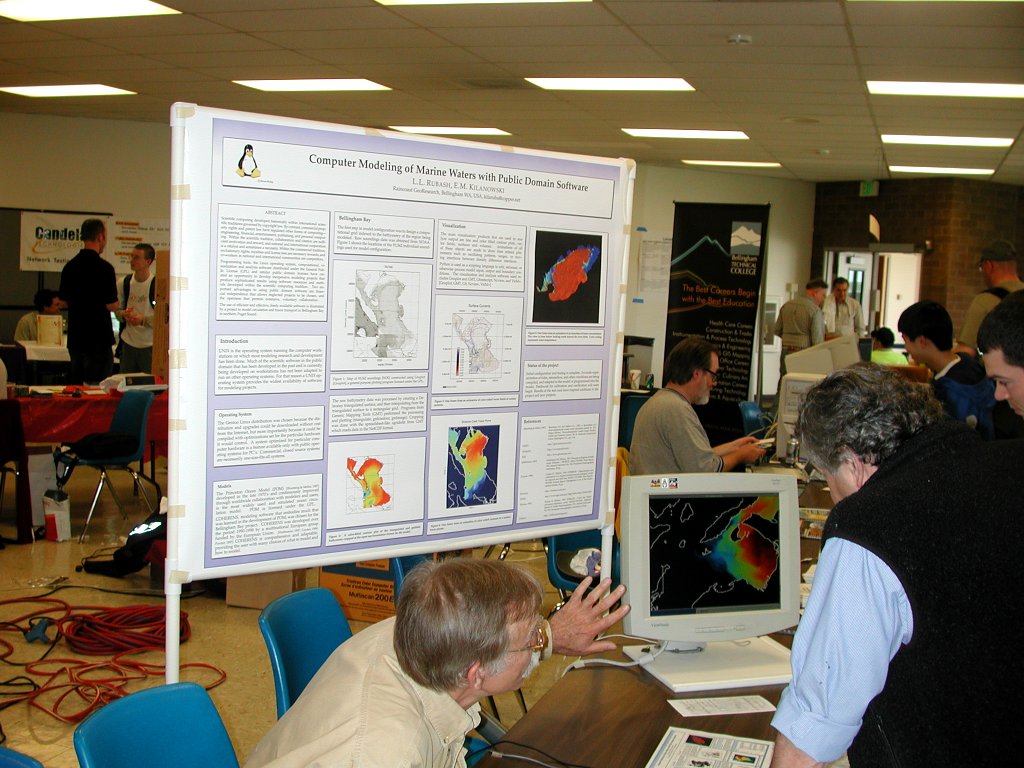
Figure 1. The Exhibits Hall
Next, I was off to Chuck Gray's presentation "Impact of Linux". Chuck Gray works for IBM and has given similar presentations to companies considering adopting Linux. IBM, he told us, has invested over $6 billion in open-source software already and is continuing to invest more. He discussed the history of Linux and explained why Linux is ready for enterprise use despite its nontraditional development model. The estimated value of all the code contributed to the Linux kernel is $2 billion, while a proprietary software company is unlikely to spend more than $100 million per year. Proprietary software, therefore, will have to fight to keep up with open-source software, not the other way around. And the Linux kernel is well-written; he showed metrics demonstrating that Linux has fewer errors per line of code than the industry norm.
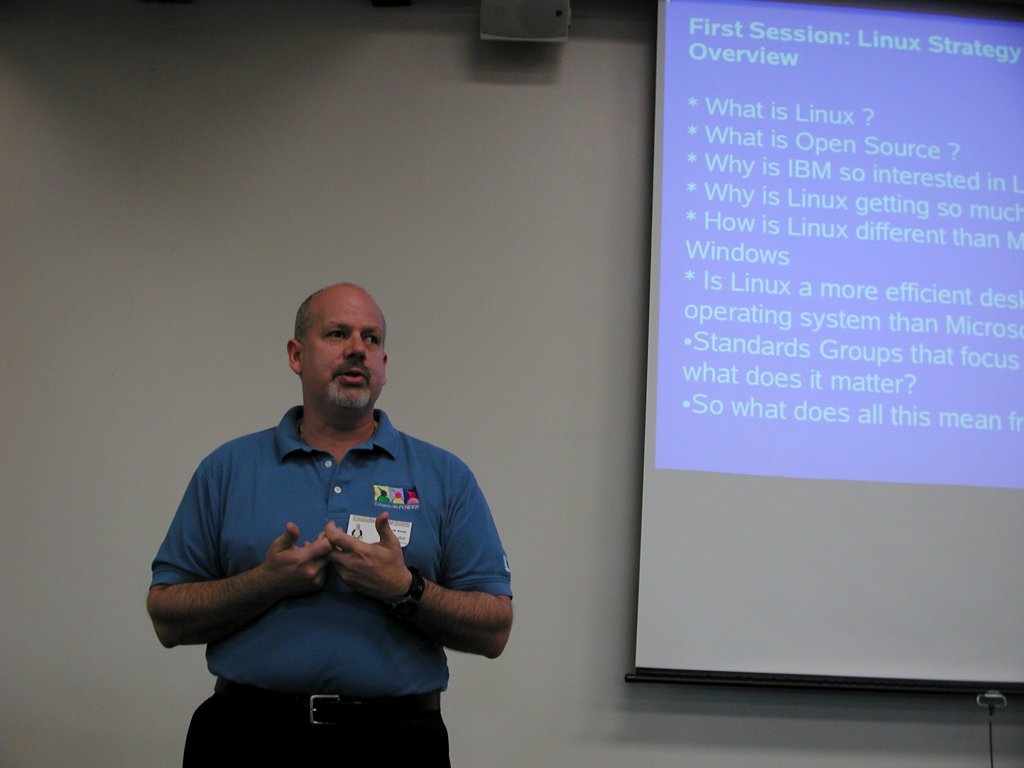
Figure 2. Chuck Grey from IBM
After lunch I attended Chris DiBona's presentation "Google Open Source Update". Chris DiBona, formerly a Slashdot editor, now is the Open Source Program Manager at Google. He started out apologizing for having brought a Windows laptop--it wasn't his fault--then noted that one isn't supposed to start a presentation with an apology and apologized for doing so. His lecture was full of funny moments such as this, which made it even more entertaining, but the substance of his talk also was extremely interesting. He explained the history of Google, how it grew from a handful of workstations at Stanford to the powerhouse it is now. He also explained how Google relates to the Free Software community. He gently deflected questions about how PageRank works: "I don't know that, and if I did know I wouldn't be allowed to tell you." He also explained why some Google technology simply is not worth releasing. For example, some of their software is simply too Google-specific to be useful to anyone else; how many organizations have 10,000 servers? If I ever get another chance to hear Chris DiBona speak--on any topic--I'm going.
After his presentation, Chris DiBona spared a few minutes for a quick interview. "I really enjoy LUG shows", he told me. "I used to be the president of SVLUG. I think that shows like this are great examples of what groups can do when they put their minds to it."

Figure 3. Chris DiBona from Google
At 2:30 PM I had to choose between attending the Real Networks presentation on Helix, Jarod Wilson's presentation on MythTV, Novell's presentation on Novell Linux and so on. In fact, I was interested in every one of the 11 presentations scheduled for that time.
The one I actually attended was Chuck Wolber's Alpha Geek contest. Acting as the emcee, Chuck Wolber quizzed the contestants on computer and sci-fi trivia, gradually eliminating them until only one contestant was left. The questions covered Star Trek, Star Wars, The Matrix, Snow Crash and computer technology. As promised, the audience really did get into the show, shouting out joke answers:
Q: In the first few seasons of Star Trek: Voyager, who were the main enemies?
A: (from Chris DiBona) The writers?
In case you were wondering, the correct answer is the Kazon.
At 4:00 I went back to the Exhibits area for the raffle. Thousands of dollars worth of prizes were raffled off; alas, none of my tickets was a winner. Most of the prizes were technical books, but there also was clothing, computer accessories, some vouchers good for computer classes and prizes for free Web hosting services for periods of up to a year.

Figure 4. The Raffle
Afterwards, several parties were held, but I was unable to attend them.
I had a great time attending LinuxFest Northwest 2005. Kudos to all the volunteers who worked hard to make it happen.
BLUG already has started to plan next year's LinuxFest. If you want to volunteer to help out, send email to lfnw@blug.org.
I look forward to attending LinuxFest Northwest 2006! And, I'll be bringing my laptop next year, too, as all around LinuxFest I saw posters advertising a Wi-Fi network on-site.
Steve R. Hastings first used UNIX on actual paper teletypes. He enjoys bicycling with his wife, listening to music, petting his cat and making his Linux computers do new things.

