
EOF - Inside the Ultimate Linux Box 2005

The RME sound card uses this handy Multiface box to offer standard connections for digital and analog audio, along with MIDI. Because RME uses the same interface for its PCMCIA cards, you can take the same Multiface along to use with your laptop for remote sessions (photo: Don Cameron).

The Ultimate Linux Box has three separate cooling loops: one for the power supply and two that each handle two CPUs. We carefully monitored CPU temperatures with lm_sensors. CPU temperature rises a little before the water in the “up” tube warms up enough to start convection (photo: Don Cameron).
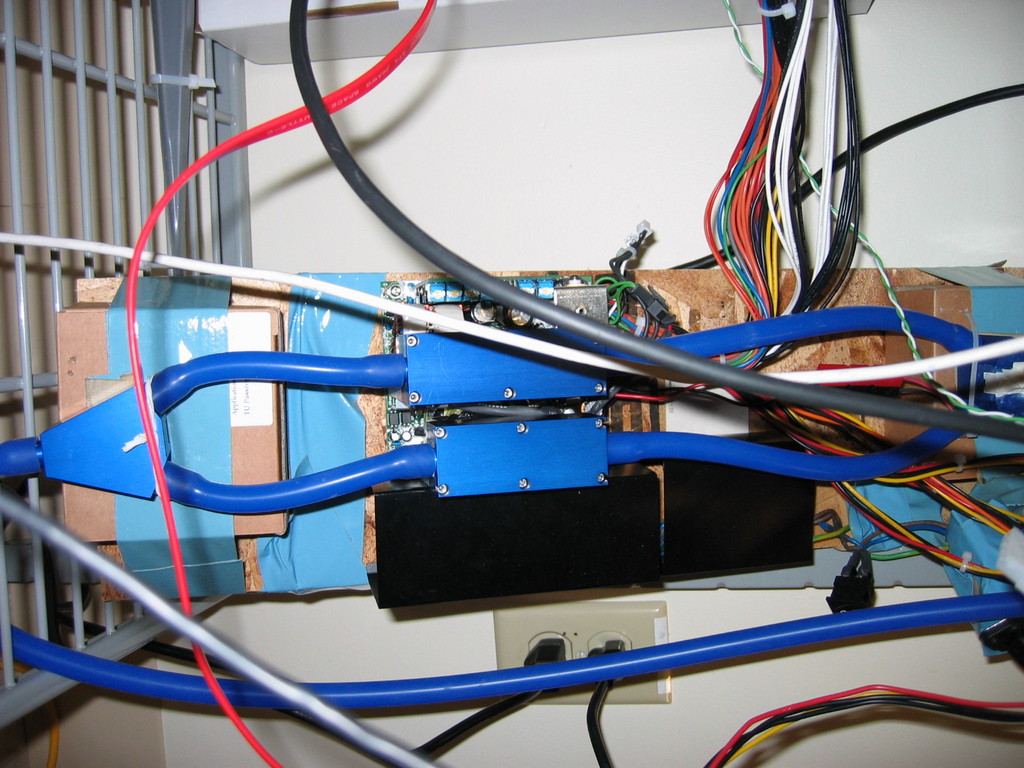
With the heatsink fins milled flat, we were able to attach custom waterblocks for fanless cooling of the modified power supply, shown here mounted on a temporary rack for testing. The waterblocks and the custom Y-connectors are anodized blue to match the Zalman parts (photo: Don Marti).

The Ultimate Linux Box boots from a CompactFlash card with an ATA adapter. Pull the card out to make an easy backup. 256MB is plenty of space for /boot, and the rest of the storage is at the other end of a long fiber optic cable. Going back to a noisy PC after using this machine was sure hard on the ears (photo: Don Cameron).
Don Marti is editor in chief of Linux Journal.
Today’s modular x86 servers are compute-centric, designed as a least common denominator to support a wide range of IT workloads. Those generic, virtualized IT workloads have much different resource optimization requirements than hyperscale and cloud applications. They have resulted in a “one size fits all” enterprise IT architecture that is not optimized for a specific set of IT workloads, and especially not emerging hyperscale workloads, such as web applications, big data, and object storage. In this report, you will learn how shifting the focus from traditional compute-centric IT architectures to an innovative disaggregated fabric-based architecture can optimize and scale your data center.
Sponsored by AMD
Built-in forensics, incident response, and security with Red Hat Enterprise Linux 6
Every security policy provides guidance and requirements for ensuring adequate protection of information and data, as well as high-level technical and administrative security requirements for a system in a given environment. Traditionally, providing security for a system focuses on the confidentiality of the information on it. However, protecting the data integrity and system and data availability is just as important. For example, when processing United States intelligence information, there are three attributes that require protection: confidentiality, integrity, and availability.
Learn more about catching the bad guy in this free white paper.
Sponsored by DLT Solutions
| Making Linux and Android Get Along (It's Not as Hard as It Sounds) | May 16, 2013 |
| Drupal Is a Framework: Why Everyone Needs to Understand This | May 15, 2013 |
| Home, My Backup Data Center | May 13, 2013 |
| Non-Linux FOSS: Seashore | May 10, 2013 |
| Trying to Tame the Tablet | May 08, 2013 |
| Dart: a New Web Programming Experience | May 07, 2013 |
- RSS Feeds
- New Products
- Making Linux and Android Get Along (It's Not as Hard as It Sounds)
- A Topic for Discussion - Open Source Feature-Richness?
- Drupal Is a Framework: Why Everyone Needs to Understand This
- Home, My Backup Data Center
- New Products
- Paranoid Penguin - Building a Secure Squid Web Proxy, Part IV
- Developer Poll
- Trying to Tame the Tablet
Enter to Win an Adafruit Prototyping Pi Plate Kit for Raspberry Pi

It's Raspberry Pi month at Linux Journal. Each week in May, Adafruit will be giving away a Pi-related prize to a lucky, randomly drawn LJ reader. Winners will be announced weekly.
Fill out the fields below to enter to win this week's prize-- a Prototyping Pi Plate Kit for Raspberry Pi.
Congratulations to our winners so far:
- 5-8-13, Pi Starter Pack: Jack Davis
- 5-15-13, Pi Model B 512MB RAM: Patrick Dunn
- Next winner announced on 5-21-13!
Free Webinar: Linux Backup and Recovery
Most companies incorporate backup procedures for critical data, which can be restored quickly if a loss occurs. However, fewer companies are prepared for catastrophic system failures, in which they lose all data, the entire operating system, applications, settings, patches and more, reducing their system(s) to “bare metal.” After all, before data can be restored to a system, there must be a system to restore it to.
In this one hour webinar, learn how to enhance your existing backup strategies for better disaster recovery preparedness using Storix System Backup Administrator (SBAdmin), a highly flexible bare-metal recovery solution for UNIX and Linux systems.


13 min 55 sec ago
4 hours 27 min ago
7 hours 10 sec ago
11 hours 39 min ago
14 hours 1 min ago
1 day 6 hours ago
1 day 9 hours ago
1 day 10 hours ago
1 day 11 hours ago
1 day 11 hours ago