
Product of the Day: QuickSilver 3.0 Cluster Software
E-Mail: sales@infinicon.com
URL: sales@infinicon.com
High performance computing has taken great leaps in the past few months. Through the use of commodity hardware and Linux, companies can now create their own supercomputer in weeks. The Linux cluster as a model for a HPC framework is gaining popularity as a low cost/high performance solution.
InfiniCon has become one of the leading companies in the Linux cluster market. Their technology powers some of the world's largest clusters--including the world's largest Linux cluster at RIKEN. InfiniCon provides end-to-end networking for high performance business computing. Their products include Host Channel Adapters, InfiniBand Switches, Virtual I/O and their QuickSilver software for data transport. They provide a complete set of proven, production-ready offerings for high performance Linux, Mac OS, and Windows environments. They have released v3.0 of its QuickSilver software suite--an end-to-end data transport and management solution.
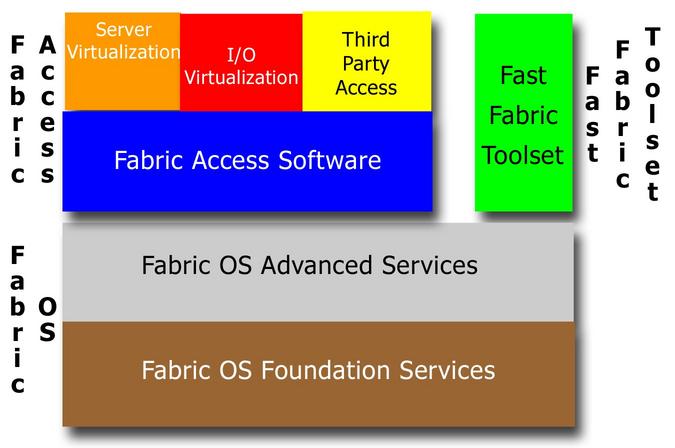
QuickSilver software is designed to be used in conjunction with InfiniCon's switching and Virtual I/O products for InfiniBand networks. This is a new architectural approach for the company's InfiniBand-based switch platforms, QuickSilver release 3.0 includes all host software, switch embedded software, and InfiniCon's unique FastFabric tools, providing greater flexibility to customers and opening the architecture to enable the use of 3rd party tools and applications. Release 3.0 introduces a number of additional significant new enhancements including support for Linux 2.6, scalability to over 1000 node fabrics, Oracle certification, certification of additional commercial MPI packages, additional fabric reliability features, performance enhancements for InfiniBand and Ethernet protocols, and significant additions to FastFabric tools for ease of management.
QuickSilver has built-in intelligence to enable rapid, error-free installation and provisioning of small to extremely large (1000s of nodes) server clusters, providing the most optimized fabric possible to support today's cluster aware applications. The QuickSilver architecture is modular to provide maximum flexibility and extensibility to commercial customers, including large cluster scaling, enterprise-class reliability, Virtual I/O, and server virtualization. One key enhancement is the incorporation of the 3.0 software into next generation server architectures that embed InfiniBand on the motherboard - either on servers or on blade platforms - eliminating the need for a Host Channel Adapter (HCA) to access the InfiniBand network. InfiniCon's Virtual I/O capabilities offer additional capabilities to large cluster implementations, seamless integration of I/O into a single high-speed, low latency link during cluster scale-out simplifies networks, and reduces cost by eliminating the need for server NICs and redundant SAN and LAN switches.
InfiniCon's technology is used in computationally intensive problems in diverse fields including oil and gas exploration, automotive and aerospace design, financial analysis, and many others. The Institute Français du Pétrole (IFP), which provides R&D solutions to the oil, natural gas and automotive industries, has one of the first InfiniBand-interconnected Linux clusters in its market--a 200 processor (AMD Opteron, Intel Xeon and Itanium) cluster with approximately 300 users and 50 internal codes. "The ability to share the traffic for MPI-based applications, Ethernet, and Fibre Channel with InfiniCon's network infrastructure has dramatically increased the performance and reliability of our HPC Linux cluster, delivering 30GBs of bandwidth with low latency access," said Stephane Requena, IFP High Performance Computing Architect. "Just as impressive as the performance is the ease of management--we have experienced far less administrative complexity with the InfiniCon solution."
Building your own High Performance Linux cluster is getting easier and easier all the time and InfiniCon is a company that is helping this process in the marketplace. The Linux Cluster supercomputer model is here to stay as who would want to pay all those license fees for all the servers for a proprietary operating system.

