
The Official Blender 2.3 Guide: Free 3D Creation Suite for Modeling, Animation, and Rendering, Edited by Ton Roosendaal and Stefano Selleri
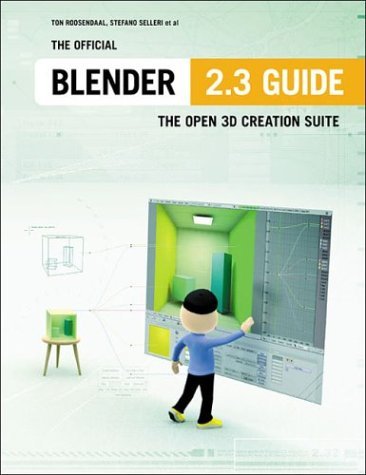
If you are neither an artist nor an animator but have an interest in trying 3-D design and animation software on your workstation, then Blender 3D is the application for you. As complex as this type of application is, Blender 3D is quite approachable due to the extraordinary support, including documentation, tutorials and demonstrations, produced by the Blender 3D community.
The Official Blender 2.3 Guide is a published compilation of on-line resources produced by the Blender 3D community. As would be expected from an official guide, the contents are authoritative. This book also is comprehensive, targeting the full range of Blender 3D users—this is not a simple command reference.
My only issue with the book's text is the English in some passages is grammatically incorrect to the point that the reader's progress is disrupted, forcing a re-read of a sentence or two. This is to be expected, given that many of the authors do not speak English as a first language and the Blender Documentation Board decided to grant each author stylistic latitude. These occasional lapses are forgiven, though, because the overall quality of the book is so high.
Due to the many supporting images provided throughout the book, readers can learn how to use Blender 3D without a workstation as easily as with one. In fact, I would not hesitate to recommend teaching directly from this text.
Different types of users are going to approach this book from various perspectives. A novice, for example, should start at the beginning and work methodically through the text in order to learn general design concepts and terminology while also learning Blender 3D. An artist already skilled with another 3-D application should start at the beginning as well, if only to cover the Blender 3D interface. However, an experienced Blender 3D artist probably could use the book for its reference sections, to explore little-used techniques and parts of the program.
Because it is a cross-platform application, the authors present important information about running Blender 3D on each platform, including sections about installation and supported graphics cards.
The book comes with a CD that contains Blender 3D 2.32 source code, binaries for several platforms, documentation and representative example work. The book also offers a glossary, but in my opinion, it does not rise to the level of rest of the book. Overall, I highly recommend this book to anybody interested in learning about 3-D design and animation.
