
Letters to the Editor
Letters
Throne Reading
This is in response to the “Hey! You Kids! Get Out!” letter in the September 2004 issue. Geeks have kids, and we are as proud of them as any snippet of code. My kids love Linux from Tux Racer to GCompris to screensavers. They have their own Linux box in the works and have never been exposed to anything else. Heck—we even use Linux during potty training! Here is a pic to prove kids and Linux match up quite nicely, and that LJ is a great potty-training tool.

—
Mark
More Ham Please
Just a quick note to congratulate you for your LJ September 2004 issue. Yesterday, I went to my favorite newsstand and was immediately drawn by the great article written about PSK by Dr Volker Schroer. This article was the main reason I decided to buy the magazine. It is an excellent article and has inspired me to go back and experiment with PSK under Linux. I'm an amateur radio operator and was a former subscriber to LJ. I would love to see more Linux Ham radio articles!
Vy 73
—
Luis Delgadillo
XE2AC - W2GO
Achtung! SuSE Cat!
Serena is guarding my Linux distro archive.

—
Leigh
Another Penguin Beer
I was recently in Brazil, and thought you might be interested to see what beer they drink in the land of Conectiva.

—
Robert Rust
Tracking Down a Network Problem
I just purchased a Toshiba M30 laptop and installed Debian on it. It took three days to get it all up and running, but everything works perfectly, excluding the Winmodem. Shortly after everything was running smoothly, I ran into problems. Right after I had upgraded my Wi-Fi drivers, KDE applications started locking up randomly. They never crashed, but they would freeze for up to five minutes before performing a function. KDE would take ten minutes to load, but for some reason, this only would happen after the machine was running for a while. Naturally, I rolled back the drivers to no avail, then I assumed it was temperature, but the rest of the system seemed very stable and the machine wasn't that warm.
I really didn't know what to do but I recalled the
“Ten Handy Commands Every Linux Developer Should Know”
article from the September 2004 issue of LJ and decided to
apt-get install strace and try to figure out was
causing my problems. I couldn't figure out the
problem in KDE's startup sequence, but Konqueror
gave away the problem when I saw it hanging on an
attempt to connect to 127.0.0.1. I took a peek at my
/etc/network/interfaces file to discover that I,
or some script, inadvertently had removed the iface
lo inet loopback entry that provides the network
loopback device. I added it back in and brought up
the interface. Everything is back to normal.
Thanks LJ.
—
Pete Osborne
Support for Laptop Hardware
I just finished reading Lincoln Durey's article “Dear Laptop Vendor” [LJ, October 2004], and I'm forced to ask “How does selling me (or Lincoln) a laptop without an OS on it help Linux run on it better?” Don't get me wrong, I'm one frugal guy, so I'll gladly take the $100 discount, but how does that help (except my wallet)? Wouldn't it be better to ask for Linux drivers for their hardware or documented specs so that open-source developers could write drivers for the hardware? Perhaps I don't understand why Linux can't do all those laptop things, but isn't that how Apple's OS X can be UNIX and still be a fully functional laptop? Apple owns the hardware specs, and they write good drivers right? If not, how do they do it? Their laptops suspend, hibernate, wakeup, do back flips and make me breakfast.
My letter would be to the hardware vendor that's the
closest to going out of business (more desperate and
therefore hopefully more willing to take a chance),
and it would say, “Want to boost sales? Write Linux drivers for your
laptop so that all the bells and whistles of your
platform will work. Oh, and if it's not too much
trouble, dump the pre-installed OS and reduce the
price accordingly!”
—
Anonymous
Where drivers are concerned, the biggest thing a laptop vendor can do is to require GPL drivers or unrestricted documentation from the chipset suppliers. Watch for a review of HP's first Linux laptop next issue. —Ed.
Help! A Penguin Ate My Quarters!
I called this photo “Subliminal invasion”. They don't know what it is, but now, they know that it exists.

—
Francisco Ruiz
That's the new Tux Racer arcade game from roxorgames.com. Why not bug your local arcade manager to install one? —Ed.
Hurricane-Proof?
My house got demolished by hurricane Frances, but my Linux box booted and ran fine, and my Linux Journal arrived two days later. Why wasn't the car damaged? I believe the Tux logo chases away bad mojo.

—
Tom Maier
Which Desktop?
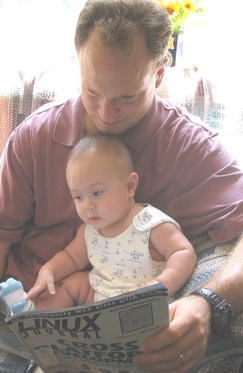
My 4.5-month-old son, Zach, and I arguing over GNOME and KDE for his first desktop.
—
Brian Cashman
Photo of the Month: a Ten-Year Collection
My fidelity to Linux Journal lasts nine years, and next month I'll start my tenth uninterruptible yearly subscription! From time to time, I revolve the magazines looking for that article I need. My wife captured that moment. The drink is a mate, a kind of wild tea of Argentina, Paraguay and southern Brazil. Hope to send the same picture when I am a 20-year LJ subscriber. Keep doing everything the same way. Good work—especially for us, south of the Tropic of Cancer, where Open Source is the right (only?) choice.

—
Guillermo Giménez de Castro
Photo of the month gets you a one-year extension to your subscription. Photos to ljeditor@linuxjournal.com. —Ed.
Why DIY?
I've just read Phil Hollenback's article on building a Linux-based
WAN router. I was wondering if there was a reason why he didn't
use ImageStream's Rebel Router, which was reviewed by Linux Journal several years ago [August 2002].
Keep up the good work.
—
N. Huggins
Phil's reply: that's a good question, which I probably should have addressed more directly in the article. We did examine the ImageStream routers. However, we didn't go with them for a couple of reasons. 1) Most important, their drivers are proprietary and closed. Plus, they make extensive modifications to the Linux kernel to make their drivers work. We didn't want to use proprietary software. 2) I'm a little hazy on this because it has been a few months; however, I believe the ImageStream hardware that will support a T3 plus four T1s all in the same router gets to be quite expensive—their basic Rebel Router can't handle that much bandwidth. You have to move up to their carrier-grade solution.
The bottom line is we customize the heck out of our infrastructure, and we wanted the software and hardware with the most flexibility. That's why we built our own. However, if you are looking for a basic router and don't have the admittedly esoteric requirements that we did, the ImageStream Rebel seems like a good choice. Thanks for reading the article!
Revealing Hidden Commands
Thanks for the article “Ten Handy Commands Every
Linux Developer Should Know” [LJ, September
2004]. I'm not a developer,
but a now-retired longtime UNIX administrator.
I'm familiar with most of those commands but have been
missing my favorite ofiles, and now I see fuser
is a command with the same purpose. And, I was
unfamiliar with objdump.
Another program I used to use a lot—I've forgotten
the name at the moment—took a dump of a running
program without disturbing the program that was
running.
All of this points out that
Linux has a lot of neat stuff that people may be unaware of.
I know when I install a Linux distribution, I see
stuff getting installed that I don't know what it is,
and I have never used it.
—
jhhaynes
LJ for Kids?
I am delighted how many people send their children's
pictures to be published. Think about your readers'
demography. Don't you think that it would be a great
idea to have an issue dedicated to kids and young
teenagers?
Please, let me know if you read this and I will
send you a picture of my one-year-old son in front of
the computer.
—
Diego Betancor
We'll keep it in mind. You and your kids can have fun with Kino (page XX.)—Ed.
Maybe We Should Rename This Section...
Here is our two-month-old daughter Avery being very happy with Tux. I've been inching into using Linux at work and have started documenting our progress. Our most popular page (by visits) is www.flmnh.ufl.edu/linux/fc1_intel_video_fix.htm.

—
Dan Stoner
...to “Babies and Penguins”
Here is a picture of my little girl, Madeleine. As you can see, she is well on her way to creating open source software. Well after lunch that is.

—
Christopher Graham
Market Opportunity?
Let's face it, Linux is not a user-friendly,
ready-for-the-masses system.
I'm thoroughly convinced that Linux must get on the
desktop for the masses. The longer it isn't, the more
time Microsoft has to wheedle into the server market
and hijack the Internet.
Today, Linux hasn't made a strong enough push on the
desktop. Microsoft is so confident on the desktop that
their cheapest offering now retails for $200! A lot
of boats are being missed by Linux these days.
Much has been made of the network or appliance
computer, a cheap, minimalist home machine that
would do Web, e-mail, digital photography management
and word processing (all 90% of home users really
want/need from a computer). It's wide open for Linux,
but Linux seems to not care.
—
Olwe
Why not start the next great home computer company yourself? Twenty percent of Linux is “U”. —Ed.
Laptops, Security and Thin Clients
Lincoln Durey's “Dear Laptop Vendor” [LJ, October 2004] was not very useful. It would have been a far better use of space, and his expertise, to explain how his staff sorts out and solves the problems with getting Linux to work properly on the laptops his company sells, and what sorts of changes need to be made. Software is an add-on option with ChemBook laptops. Durey already has a solution to his problem if he wants it.
As a beginner/intermediate user I found Mick Bauer's clear and complete explanations enjoyable to read as well as helpful. I look forward to part two of Linux Filesystem Security [page XX]. I appreciate very much that Mick Bauer neither assumes I know something, nor talks down to me, nor dumbs down his article.
Please do a thorough article on how to create thin
clients and serve them with a Linux server. Linux is
inherently a server OS. This huge advantage over the
popular proprietary OSes is not being exploited to its
full advantage for desktop use. There is no reason
for a home or small office to buy all new computers
every couple of years. All that is necessary is to
buy one good computer and use the old computers as
thin clients. I've seen it done, and now I want to
know how to do it.
—
Eric Skalwold
Watch for coverage of thin clients and other desktop management topics in our February 2005 issue. —Ed.
Mention the US Army Connection
I'm really astonished by the little article by Gary
Glasscock on the game America's Army for Linux.
I'm a peace activist here in Italy. Just to be
clear, I've found no problem at all if Linux and
free software are used for military purposes, and
I've found LJ very equal on these subjects, writing
about “Tux at war”, but also writing about
“maddog”
Hall on Brazil or the digital divide and Africa.
So, I'm astonished because a single thing is not stated
in this article: that the site www.americasarmy.com
is an initiative of the US Army, I think primarily
for recruiting troops.
I think this is a real mistake; please, preserve the
LJ impartiality that I like so much.
Many thanks.
—
Marco Gaiarin
