
HEC Montréal: Follow-up on the Large-Scale Mail Installation
The May 2004 issue of Linux Journal features an article that discusses the large-scale mail installation we did at HEC Montréal at the end of 2003. The present article describes how the system handled the recent e-mail worm explosion. It provides relevant information and statistics about the efficiency of unsolicited bulk email (UBE) prevention and virus protection policies now in place at HEC Montréal.
HEC Montréal is Canada's first management school, founded in 1907. Over 11,000 students and 220 career professors are active every year. Furthermore, each student that graduates from HEC Montréal is provided with a lifelong e-mail account; over 35,500 accounts are active to date. As with many organizations, the e-mail infrastructure at HEC Montréal is a critical component that cannot perform at anything less than optimal functionality.
As this article explains, the new infrastructure not only excels in performance and stability, but it also allows HEC Montréal to save money. Thus, it benefits from an accelerated return on investment (ROI). Emmanuel Vigne, Information Director at HEC Montréal, put it this way:"Without the new mail infrastructure, we likely wouldn't have survived the recent e-mail worms crisis. We probably would have closed all servers in order to limit the damage. With the new infrastructure, we went through this crisis without issues or outages. Our network analysts can now focus on developing tools to manage more efficiently the infrastructure, as they are no longer always fixing issues with regard to the mail servers."
The implemented solution was based mostly on open-source components. A total of 11 servers, mostly IBM xSeries, and storage array networks (SAN) are used in the new infrastructure. Figure 1 depicts the architecture of the implemented solution.
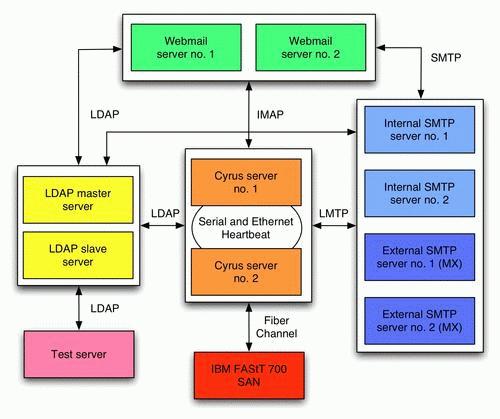
Figure 1. Architecture of the Solution
The core of the new mail infrastructure is based on components with industry proven track records. The components are:
Postfix: A fast, easy to administer, secure and scalable mail transport agent.
Cyrus IMAP Server: IMAP, POP3, Sieve services and message storage management.
SquirrelMail: Complete Web mail system, slightly adapted for the specific needs of HEC Montréal.
OpenLDAP: Directory services for user management, authentication and more.
Furthermore, in order to limit the delivery of UBEs and viruses, a number of policies were adopted and deployed on the four SMTP servers. Among them, we have:
Header and MIME header checks that use up-to-date maps
Carefully chosen real-time blackhole lists (RBL)
Content filtering using SpamAssassin (with some network checks enabled, including Vipul Razor)
Virus scanning using NAI VirusScan
To get a full description of the implemented solution, please refer to the May 2004 edition of Linux Journal.
Although UBEs continued to grow at an alarming rate, at the beginning of 2004, we also have seen of e-mail worms. Those worms spread themselves over the Internet as attachments to infected mail. The attached files are all Windows portable executable (PE) EXE files affecting various versions of Microsoft Windows. Table 1 describes some of the most popular e-mail worms we have seen in the first three months of 2004.
Table 1. Recent Internet Worms
| Worm | Description |
|---|---|
| MyDoom.A | MyDoom.A, also known as Novarg, had the most impact at the beginning of 2004. Once it has infected a computer, the worm uses its own SMTP engine to send files (while harvesting the addresses found in those files) with the following extensions: asp, dbx, tbb, htm, sht, php, adb, pl, wab and txt. The worm also contained a backdoor function programmed to launch a Denial of Service (DoS) attack on www.sco.com on February 1st, 2004, by sending HTTP GET requests every millisecond to port 80 of the attacked site. MyDoom.A also has two well-known modifications, MyDoom.B and MyDoom.E. The first one is similar to MyDoom.A, but it also carries out a DoS attack on www.microsoft.com and replaces the standard Windows host file with its own to prevent access to domains of anti-virus software companies. Finally, MyDoom.E (also called MyDoom.F) is similar to MyDoom.A; it also is programmed to carry out a DoS attack on www.microsoft.com and www.riaa.com. In addition, it searches for more file extensions in order to send copies of itself and randomly deletes files with avi, bmp, doc, jpg, mdb, sav and xls extensions. |
| Bagle.A | Beside replicating itself with its own SMTP engine (with harvested e-mail addresses from various files), Bagle.A also opens a backdoor on port 6777 to listen for commands (allows an attacker to download files and execute commands on the infected computer). Similar to its predecessor, Bagle.B opens a backdoor on port 8866. Bagle.C, Bagle.D and Bagle.E are mostly identical: they all open a backdoor on port 2745 and block anti-virus database updates by terminating update processes from a list of well-known vendors. Finally, Bagle.F is similar to Bagle.C, but it also propagates to P2P networks. |
| NetSky.C | Like the first two worms, NetSky.C searches for files with many extensions and harvests e-mail addresses from them. It then sends a copy of itself to these addresses--using its own SMTP engine--directly to the message's recipient server. If it fails, it uses a list of predefined SMTP servers. NetSky.D, also known as SomeFool, is similar to NetSky.C but is programmed to delete MyDoom from the infected machine. |
As you can expect, those viruses make a huge economical impact, calculated in terms of help desk support, overtime payments, false positives, bandwidth clogging, transient storage consumption, productivity erosion, management time reallocation and cost of recovery. Various industry estimates speculate that global businesses lost $55 billion in 2003 due to viruses, up from $30 billion in 2002 and $13 billion in 2001. Other research papers show that a typical user spends 4.4 seconds taking action against an e-mail. As an example, if we take the 25 most-spammed employees at HEC Montréal and set the average annual salary at $46,618 CAN, we can proceed with an estimate of productivity cost for the first three months of 2004. Table 2 shows the cost worksheet.
Table 2. Cost Worksheet
| Criteria | Value |
|---|---|
| Number of employees | 25 |
| Average annual salary | $46,618 CAN |
| Number of UBEs that would have been delivered to them for the first three months of 2004 | 172,887 |
| Time to identify and discard each UBE | 4.4 seconds |
| Total amount of time lost in the first two months of 2004 for those employees | 33 days |
| Total cost for the first two months | $6,157 CAN |
Some analysts quantified the annual cost of spam at $8.9 billion for US corporations and $2.5 billion for European businesses in 2002. In 2003, the numbers increased and reached $10 billion for the US and over a $1 billion for Canada. This tendency most likely will continue, and some estimate that over 8.8 billion UBEs will be sent daily in 2004, compared to 7.3 billion in 2003 and 5.6 billion in 2002.
"Our library director can now efficiently use his e-mail account. Before the new system was put in place, he was receiving hundreds of spam every week. Going through his e-mail during the day in order to respond to student requests was relatively painful and the associated productivity erosion was high", said Emmanuel Vigne. Nevertheless, although tallying the true cost of spams and viruses is relatively hard, HEC Montréal certainly saved money by reducing the loss of productivity of its employees due to UBEs and e-mail worms.
In order to produce valuable statistics, two tools were used: Spamity and pflogsumm. The former is a complete solution for extracting information from log files of a mail infrastructure based on Postfix and AMaViS. Spamity extracts all the relevant information and stores it in a database. A Web frontend is offered so users simply can log in to the Web application to see the mail rejected by the filtering policies. The nature of Spamity makes it a valuable tool to examine the spam and virus tendencies in order to tune the infrastructure over time to limit the delivery of UBEs and viruses. Spamity efficiently gathers the information related to the rejected messages and classifies it with regard to the following policies:
RBL: Message rejected by a real-time blackhole list.
RHSBL Client: Message rejected by a right-hand side block list.
Header Date: Message has a date from the distant past or future.
Header Subject: Message rejected by suspicious subject.
Header X-Mailer: Message rejected by suspicious mail user agent.
Header Content-Disposition: Message rejected by suspicious attachment.
Header Content-Type: Message rejected by suspicious attached file. The filter method specifies the file extension.
Body: Message rejected by suspicious body content.
Access Username: Message rejected by access username.
Virus: Message rejected by AMaViS together with the anti-virus solution used.
Spam: Message rejected by AMaViS together with SpamAssassin.
On the other hand, pflogsumm is a useful tool for providing a quick overview of Postfix activity. This allows an administrator to identify rapidly potential problems in a Postfix installation. Among the information reported by pflogsumm, we have:
Total number of received, delivered, forwarded, deferred, bounced and rejected messages
Per-day and per-hour message traffic and connection summaries
Various other summaries (warnings, fatal errors, panics) and more.
Using those two tools and some custom Perl scripts, we produced the different figures found in this article.
Figure 2 shows the weekly total number of mail considered to be UBE or containing viruses that were blocked since the beginning of 2004. The rules' efficiency also is shown in this figure.
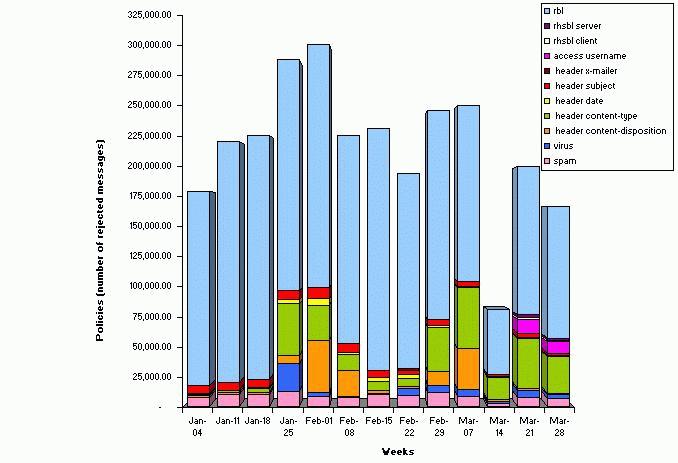
Figure 2. Policies' Efficiency
As shown in Figure 2, the RBL policy is definitively the most effective one, followed by content analysis using SpamAssassin and message Subject header analysis. You also can note that the virus policy numbers are not as high as expected. This is easily understandable as the detection of viruses often is moved from AMaViS to Postfix's header checks (Content-Disposition, for example). This requires considerably less system resources, because we avoid both detailed analysis in SpamAssassin and a process fork, for each received message, for virus scanning using NAI VirusScan. The network analysts proceeded with such modifications after the 01-25 week for the MyDoom e-mail worm.
Furthermore, Figure 3 shows the usage of services offered by the mailstore, during the busiest week of the first three months (March 21-27).
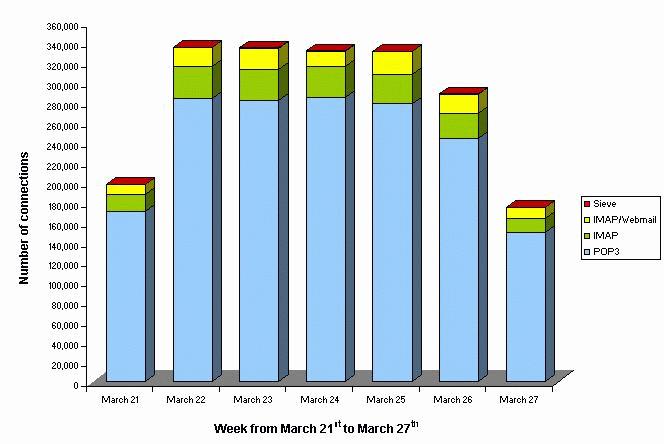
Figure 3. Services Usage
As shown in Figure 3, POP3 is the most solicited service, followed by IMAP and the Web mail system, which also uses IMAP but was separated in the figure. During this week, peeks of 52 POP3 and 338 IMAP concurrent connections were observed coming from a total of 11,000 different users. The mailstore also is responsible for message deliveries in the user's mailboxes using the Local Mail Transfer Protocol (LMTP). Peaks of 75 concurrent delivery processes often were seen.
On the other hand, Figure 4 shows the amount of mail exchanged using the four SMTP servers for the entire month of March 2004.
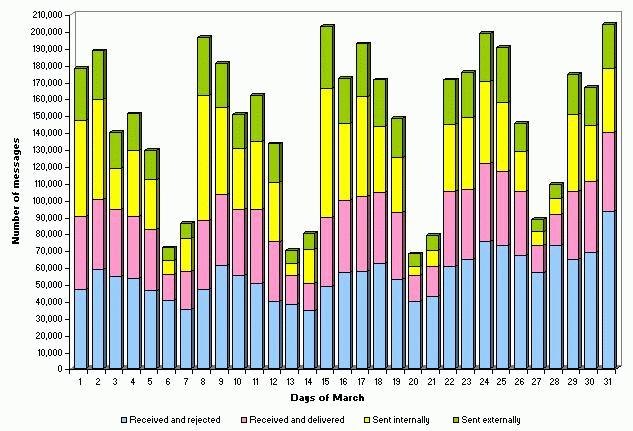
Figure 4. SMTP Activity
As shown in Figure 4, 40 to 60% (55,000 messages per day, on average) of all received mail was rejected by various UBE and virus filtering techniques. This number actually is down from 80% in December 2003. At that time, HEC Montréal was receiving more than 125,000 spams per day. Currently, the average number of messages sent per day is 57,000, while the average number of received (from external servers) and delivered email per day is 35,000.
As you have seen from the different figures, the mail infrastructure certainly is a key component at HEC Montréal, as it is highly solicited. Overall, the mail infrastructure has been very fast and stable since it was deployed. Minor updates were performed by network analysts, mainly to keep up with the new e-mail worms.
The new mail infrastructure helped HEC Montréal manage the e-mail worm crisis we all went through at the beginning of 2004. It also continues to efficiently limit the delivery of UBEs. According to the Call Center Team, "We have noticed an important decrease in calls regarding problems with the mail infrastructure, spams or viruses. This is especially true for computer viruses, as we are offering first level support if they get infected. On the other hand, some are actually calling to be sure we haven't blocked legitimate e-mail. Pushing forward the use of Spamity to users likely will help us in reducing the number of calls. Finally, some users also called to praise the speed, the stability and the efficiency of the new infrastructure."
I would like to give special thanks to Dominique Duc for helping me with the various charts in this article and Chris B. Vetter for reviewing the content.
Ludovic Marcotte (ludovic@inverse.ca) holds a Bachelor degree in Computer Science from the University of Montréal. He currently is a software architect for Inverse Inc., an IT consulting company located in downtown Montréal.

