Hunting Penguins in the Desert: The CES Report
This year's CES (Consumer Electronics Show) ran in Las Vegas from January 8-12, following Macworld in San Francisco. My report on Macworld was called "New Economy Hack: Turning Consumers into Producers". This is my report on CES. Coming up, reports on LinuxWorld Expo in New York, which ran from January 21-23, and the O'Reilly Emerging Technology Conference, which ran from February 9-12.
--Doc Searls
One year ago, Kunitake Ando, president and CEO of Sony, gave a keynote speech at CES explaining how his company would lead the rest of the industry's giants into an "always on" and "interactive" future built largely on a co-developed embedded Linux distribution. Six months later, in July, the CE Linux Forum (CELF) was formed by Sony, Matshushita, NEC, Philips, Samsung, Sharp and Toshiba. Today, the membership roster also includes IBM, Mitsubishi, Metrowerks, Motorola, Nokia, LSI Logic, HP, Fujitsu, Hitachi, Phoenix, Samsung, Sanyo and Montavista.
So, as CES approached, I looked for signs of World Domination at work. Sure enough, Montavista had lined up a hundred or more consumer electronics partners, and the Embedded Linux Consortium had five programs in one session track. So I expected to see plenty of braggage about Linux out on the show floor--at least among CELF members.
What I discovered was something else. The narrative that follows is an account of that discovery. (Many of the links below point to my photo gallery from the trip.)
After picking up my badge and my rolling Toshiba backpack (one of thousands handed out to badgeholders in the press room), I looked at the four show guides and wondered how I could begin to cover even a fraction of the Linux surely on display at the show.
img src="images/showguides.jpg" alt="figure"
Here's the rundown:
Sourcebook: 530 pages
Show Guide: 160 pages
Addendum: 70 pages
Visitor's Guide: 104 pages
Total: 804 pages
I was one of 4,000 press badgeholders among 129,000 attendees spread across 1.1 million square feet or more of floor space in seven exhibition halls. I say "or more" because reports of the floor size vary. The new South Hall, which has 1.3 million square feet all by itself, brings the whole Las Vegas Convention Center to a total of 3.2 million square feet. That still would be south of CES' total square footage, since the whole LVC was packed wall-to-wall with CES exhibits, including two floors of exhibit space in the South Hall and more across town at the Alexis Park Hotel.
No exaggeration, the central aisles in the South Hall are so long that they feature green road signs like the ones on interstate highways.
Although the CES Web site was helpful as far as convention sites go (as a breed, they're usually brochures), it didn't provide a way to search through all the show guides for the word "Linux". Fortunately, the CES people did provide touchscreen kiosks in the hallways; thankfully, those got me straight to the information I needed.
So here's a question. Out of 2,300+ exhibitors, how many do you think mentioned "Linux" in their descriptions of what they were up to at the show? A couple hundred? Fifty?
Try eleven.
The only brand name among them was Real Networks, which had a huge booth but nobody to talk to about Linux. No Sony. No Toshiba. No Philips. No IBM or HP or Dell. And no CELF members other than Softier, whose booth I couldn't find.
Not even Transmeta, famous for years as the employer of Linus Himself (who is officially on a leave of absence from the company). Transmeta had a good-size booth in the South Hall and a lot to talk about. In fact, I ran into a couple of Linux hackers there: Karim Yaghmour and Greg Ungerer. Yet nothing in Transmeta's promotional poop at the booth mentioned Linux (that I noticed, anyway). John Heinlein, the Director of System Marketing at Transmeta, said plenty of Linux was running on Transmeta chips, old and new--RLX blade servers, for example. I saw racks of those when I visited DolphinSearch in Ventura last year. There's also nothing, Heinlein said, to stop anybody from putting Linux on Transmeta-based hardware. He showed me one Linux-ready tablet device that was, indeed, cool. Still, it was running Windows.
Another chip company, VIXS, which makes chipsets and software for distributing video by Wi-Fi, took a similar stance. The company mentioned nothing about Linux in its booth or its literature, but said it could support Linux as a primary system platform choice made by OEM customers, which include Toshiba and other major brands. In fact, the company said they had to do so, because so many OEMs were building set-top boxes and similar devices that run on Linux.
When I walked into Netgear's booth, again I saw nothing about Linux. Yet, when I asked if they were using Linux, they said "Sure. Come over here and look at our Layer 3 switch".
DLink had a similar story: Sure, they have Linux in their stuff. It was like, Why even bring it up? You'd think I was asking if their gear came with power cords or Ethernet jacks.
So, it's clear that Linux is fast becoming a pure infrastructural commodity – like the air we breathe. Why promote what's best taken for granted? Thus, take Linux's decreasing visibility as the inverse of its ubiquity.
Fortunately, Linux still has promotional advantages for some companies; especially those competing against closed-box makers who value all of Linux' virtues other than its hackability.
Take TiVo boxes. As we all know, TiVos run on Linux. But, as with so many other embedded Linux cases, TiVo as a company defaults to silence on the subject of its operating system. So it was a welcome relief to find a company at CES (one of the Eleven) that not only builds TiVo-like boxes on Linux but decorates its logo with a penguin:
img src="images/head_nav_r2_c2_f2.gif" alt="figure"
The company is Interact-TV and its "Telly:" boxes are designed to be much more than DVRs (digital video recorders--the category TiVo created). Interact-TV boxes are, in the Linux tradition, all-purpose devices. Home entertainment servers, they call them. Telly boxes feature TiVo-like PVR functions, but they also provide an interactive storage and content management system for all your video, audio and photo archives. Interact-TV CEO (and Linux Journal subscriber) Bob Fuhrmann explains:
We want to make these things as open as possible, so you can record and store files any way you please, through any connection you choose. You can rip audio CDs into any format you want: MP3, Ogg Vorbis, WAV, uncompressed--whatever. You can burn audio or MP3 CDs. We have USB and FireWire connections for whatever outside devices you want to plug in. Our video library supports MPEG2, MPEG4, MPEG1, OGV or OGM files. Again, whatever you like.
And because it's all in a network-mounted drive, you can do a lot with it: Internet radio, CDDB database lookup.
There's a built-in Web server, so you can access it from any Web-enabled device on your home network. It has SAMBA. There's a Wi-Fi option. We support most CAT-5 and USB wireless adapters.
Again, it's all open. You may want to replace the hard drive or add a second one. You may want to upgrade from CD-RW to DVD-RW. We let you do that without breaking the warranty.
A lot of our customers are Linux savvy. So we give them root access. Please, go hack away. We're already seeing a lot of community development. In fact, some of the features we're introducing at the show came from the community.
We have support for two-screen interactive applications, coordinated with either a live or recorded program, which wouldn't be possible if the unit wasn't also connected over the Net.
We also have program guides that you can download for satellite, cable and terrestrial TV reception. But we also support content that isn't mainstream, communities of artists, for example. Our goal is to allow any kind of content to be easily downloadable to the box. And to make it accessible to PCs because it's a network-mounted drive.
We're also open to future developments. HDTV is coming along this quarter. It'll be a swap-out of parts for registered users.
I asked him if the company might do a DVR for Internet radio, something I'd love to see. He replied:
We've had some requests for a DVR for radio, NPR listeners, for example. And we've been talking with RealNetworks about its Helix platform. They've bent over backwards with reasonable licensing programs for companies like ours. Their developers have been very helpful and open. So we're planning on moving forward with that. Our current offering is still a little bit spotty. Pure MP3 stuff is straightforward, but there's less and less of that. Some of the sources are switching to Windows Media 9 or Real and dropping MP3. Helix has a good architecture for switching between codecs in an agnostic way. We'll also probably enable some of the additional video codecs as well.
"What about DRM?" I asked.
We don't want to get directly involved with DRM, but we do want to give customers access to protected content. Working with RealNetworks is helping with that. We also may have to license Windows Media 9 directly. We've been sort of avoiding that, but the customers may give us no choice about it.
Fuhrmann said the company sells both directly (you can buy on-line) and through resellers. Because the products still appeal mostly to early adopters, we can expect them to appear first at boutique retailers and later at "big box" stores. Meanwhile, they're selling as value-adds for home entertainment systems. Best Buy, for example, offers a home networking service at some of its locations, and media servers are a natural fit for those installations. Interact-TV also has an OEM strategy in which they sell only the software. EOS is the "entertainment media development platform".
Over in one of the international halls, I met with three energetic Asian companies, Movain, Unication and MagicEyes, all of which not only use Linux extensively but are eager to talk about it. They were three among the Gang of Eleven.
Movain has multimedia content filtration systems, a cool color deficiency engine that corrects for partially color-blind people, and data management products for high speed PC backup over networks.
MagicEyes runs Linux on its multimedia SoC (system on a chip), MMSP (multimedia application processor) chip and vRender3D graphics application processor offerings--all targeted to the "convergence" space where TV, radio, telephony, PDAs and computing intersect. Yong Ho On, Sales and Marketing Group VP for MagicEyes, told me the company is looking for Linux experts. In fact, executives at all three companies told me there currently is a very competitive market for Linux talent all over the Far East.
Unication was showing a pile of products: a wireless set-top box, a wireless gateway and one item I want bad, a PDA that transmits at any frequency on the FM band. There's no shortage of little PDA-attachable FM transmitters that are switchable between four channels at the bottom end of the band (88.1, .3, .5 and .7) or that offer "seven selectable channels", but I haven't seen anything that can go on any FM channel other than the unit Belkin showed (the TuneCast II) at both Macworld and CES. At both shows, Belkin promised to start delivering the things "next month" (they're still not here). The Unication PDA is tunable up and down the dial, even among the even numbers to the right of the decimal point, which often are used outside the US.
Sometimes I call myself an "old radio engineer", but that's a stretch. Although it's true that the only code I know is Morse and that I once tended transmitters and other heavy hardware at radio stations, my interest in radio technology has been avocational since Linus was in grade school. Still, I always hold hope that broadcast engineering and consumer electronics eventually will pull their clues together and renew the golden age when AM was king and FM was challenging its empire.
Fat chance, right?
At CES, the residue of that golden age took the form of two small adjacent booths: one for C.Crane and one for Sangean. C.Crane is the best radio store in the world, while Sangean makes some of the world's best radios--I have two of them. I enjoyed talking deep radio trash with the people at both booths; Kevin Wang, the President of Sangean, was actually manning his company's booth at the time, all by himself. But, it was hard not to see the companies and their businesses as relics. All the action was at the Automotive expo in the North Hall, where the space was dominated by satellite radio and booming media systems in sharp-looking cars (the '63 Caddy convertible was my fave, but the one I want is the boxy Scion).
XM Satellite radio had the biggest booth, with Sirius close behind. Gear-wise, the two and only vendors in the space seemed to be pushing their offerings in the same two directions. One is localized data, for example, XM's "instant" traffic and weather offering for 16 major metros. The other direction is expanding from dashboards to living rooms, kitchens and the great outdoors. For that, XM and Delphi were showing off the SkiFi, a $99 receiver that's essentially a plug-in face plate for a car radio, a home stereo or a boom box. Sirius was showing off a cool Tivoli tabletop satellite radio that plays Sirius stations with all the handy digital readouts, as well as AM and FM. It was designed by Henry Kloss and resembles the excellent old KLH Model 8 radio.
img src="images/playboygirls.jpg" alt="figure"
Nobody at either booth knew if Linux was involved in their systems; but at trade shows like this one, what sells isn't tech. It's girls. XM drew a long line of fans looking for autographs from Juli and Tiffany, the "seductive hosts" of Playboy's Night Calls show. Over at Swiss Audio, the biggest draw was the same miss featured in its huge booth displays. I didn't catch her name, but she patiently paused for photos with ogglers-by. I guess the she (or her agency) answered this ad.
Digital radio won't be coming at us only from the sky. Both the FCC and the consumer electronics industry want to see the terrestrial radio industry convert to digital as well. Ibiquity is the company behind the conditionally approved IBOC (in band, on channel) "HD radio" digital transmission system that eventually will be used on both the AM and FM bands. Licensing isn't cheap on the transmit side, and it's totally proprietary, having been developed (and, no doubt, patented) by a fleet of broadcasting's big boys. I knew at least one Ibiquity engineer had posted a question to the Linux Kernel mailing list, so I assumed some kind of penguin business was going on there; but nobody at the booth had a clue about Linux' involvement with the company's tech. They were able, however, to demonstrate AM and FM in both analog and digital form. The sonic difference on FM was apparent but far less dramatic than the difference on AM, where mass-market high-fidelity receivers haven't been manufactured for decades--but could be, if anybody still is interested.
The people over at Delphi (formerly GM's Delco division) went much deeper into the technologies they're developing, showing me the prototype chipsets and boards that will go into car radios in 2005-2006.
I really like the car radios Delphi makes and wanted to thank them for taking the trouble. Many of the radios they supply to GM cars, for example, actually have knobs with nice little click-detents for each channel on the dial, making them much easier to tune than any of the push-button alternatives in the aftermarket. It also was fun to listen to HD radio on the AM band, thanks to KNXT/840 in Las Vegas. HD radio has the capacity to display call letters and much more information on receivers. (So does RDS, but not as elegantly.)
There's plenty happening on the supply side. Harris and other transmission equipment suppliers already have HD gear on the market. Tim Posar, a Linux and open-source geek of high standing, as well as a veteran broadcast engineer, recently told me he'd fired up some HD gear at the transmitter of a public FM station near where I live in Santa Barbara. But there still are no production receivers out there, and the future offerings showcased at CES were mighty thin. Kenwood showed a few "HD ready" car receivers, which they announced one year earlier. But that was about it, not much mojo there.
When I asked around about how manufacturers might improve the quality of FM and AM chipsets, it was like I was asking Dell about about improving the quality of its floppy drives. I was told that chipsets had long since become ubiquitous standard parts and cost only pennies for the receiver manufacturers. So it's hard to imagine the Ibiquity chipsets getting cheap quickly, especially in the absence of awareness--much less volume demand. Meanwhile, the lo-fi qualities of AM radio chipsets have forced the whole band to do almost nothing but talk.
At this point in history, most of us who care about music are no longer getting it from radio anyway. We're getting it from one another or from on-line sources. The most popular portable entertainment systems today are MP3 players, as all those iPod billboards are glad to tell you. One big reason for their popularity is regulation. There's a lot of it around old-fashioned radio and nearly none of it around computers and MP3 players.
Here in the US, about 14,000 signals are wedged onto 95 FM and 116 AM channels, using modulation methods developed early in the last century. The capital costs of setting up and running stations are high. Ownership and content are regulated, though not as highly as elsewhere in the world. And approximately nobody outside the business thinks it's better than it was in its golden years, now long gone.
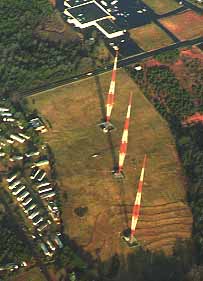
When I was a kid, I used to ride my bicycle down to the New Jersey Meadowlands and hang out with the old guys who ran the transmitters for New York's big AM radio stations. All but four of New York's AM stations still radiate from New Jersey, taking advantage of the high ground conductivity provided by the salty tidewater there. The old guys were true antenna gurus who worked where the rubber met the road. The patient ones taught me interesting stuff about phased array radiation patterns (produced by two or more towers), with lobes for maximizing coverage and nulls for protecting other stations. They compared the virtues of guyed and self-supporting towers, spoke reverentially of the great Blaw-Knox tower designs (like WOV/WADO's diamond-shaped landmark, which came down a few years ago) and lamented technical compromises, such as capacitive "hats", including the ones worn by WNEW's old towers. (From a plane I once got a nice picture of WBT's three diamond-shaped Blaw-Knox's before a hurricane damaged them a few years later. Thankfully, the replacements are just as pretty, if you're into this kind of thing.)
Back in those days, being a broadcast engineer was a worthy calling, full of black art and deep knowledge. Now it's antique. These days, the same kinds of kids hack their own computers, not somebody else's transmitters. Today, all those transmitters I used to visit are solid-state and run by computers anyway.
Meanwhile, the media environment continues to become increasingly infertile as Congress salts the land with content regulations. As I write this, the House of Representatives has passed the Broadcast Decency Enforcement Act, by a vote of 391-22. One of its unintended consequences is sure to be an acceleration in the shift of technology innovation away from broadcasting and over to the relatively free and unregulated Internet. (Like it hasn't happened already.)
I missed a lot at CES, unavoidably. For example, it was hard to find Booth 22200 when the banners on the ceiling pointed to 22100-22175 on one side of the hall and 22300-22350 on the other. But there were fun places to pause between here and there. One was Nisus, which makes a little camera that shoots 4-megapixel still pictures, records and stores MP3s, shoots digital movies (even at VGA resolution) and costs just $199. They were doing brisk business at the booth when they weren't busy goofing around. The same went for the folks at NeuTrino Technologies, who have a complex and useful Windows-based desktop software product. I tried to convince them to re-deploy their stuff for Linux but didn't get my hopes up, even though it was clear they take Linux seriously.
It also was fun to see all the LCD and plasma TV screens, which generally looked impressive but continue to be priced way too high for most of the market--but not so high that the haven't made the market for conventional TVs, even "HDTV-ready" ones, terminal. That's why prices for old-fashioned picture-tube TVs are falling toward zero. If you're still into TV, now might be a good time to buy one. I saw in a recent Consumer Reports that the top-rated TV of any type, including plasma and LCD, was a Sony WEGA tube model. (The KV-34XBR910, to be exact.)
As you might guess from the photo galleries I publish along with articles like this one (see also, Linux Lunacy Geek Cruises (2001, 2002 and 2003); OSCon; Apachecon; and Digital ID World), photography is one of my preoccupations. In fact, I began my journalism career 33 years ago as a newspaper photographer and reporter. Since then my specialty has become candid photography, although I enjoy a nice sunset a much as the next lens wrangler.
But I've avoided getting a good digital camera; partly because they're still too expensive and partly because my practical needs are outside the scope of just about everything I've seen from the digital camera makers. For one thing, I shoot a lot of presentations at trade shows and other events (such as Linus' talk on the last Geek Cruise), and I need a long zoom lens to get tight shots of presenters and presentations (an enormous help for note-taking). I also shoot a lot of candids that take advantage of the flip-out viewers that are standard on camcorders and increasingly rare in digital cameras.
My base requirements are simple: 1) long zoom, 8x optical at the minimum; 2) flip & pivot display; 3) small size, so it's easy to carry in a laptop bag or a large pocket; and 4) ability to shoot good pictures in low light. High resolution is nice to have, but not it's not a prime necessity.
So far, the only cameras that do all four of those things have been camcorders that also shoot stills. That's what you see in the archive links above. Most of those were shot with my Sony DCR-PC120BT or its stolen predecessor, the DCR-PC110 (nearly identical, except for the 120BT's BlueTooth, which, in the Sony tradition of hideous UIs, is unusable). The resolution is only 1.55 megapixels, but most of the time that's good enough for the Web. Its built-in processing has a lot of compression artifacts and the color is far from the best. But the Zeiss optics are excellent, and on the whole it does a good-enough job.
At both Macworld and CES I stopped by the Olympus, Canon and Nikon booths to see what they had this time around. The only camera that came close to meeting my needs was the Nikon Coolpix 5700. I loved the way it felt and the size, which is smaller than it appears--it's almost pocketable. But it's still a lot of money I don't have, so I think I'll wait.
It seems like every time I go to Las Vegas, Bill Gates and Carly Fiorina give keynote addresses. There's still nothing that overlaps in the Microsoft/Linux Venn diagram, so I saw no point in joining the vast herd that always turns out for Bill. But Carly runs a company that's one of the leading lights on the supply side of the Linux product market. The last time I saw her speak was at Comdex 2002, when she minimized her mentions of Linux (just three times in a long talk), most likely because Steve Ballmer sat in the front row and one of her missions was showing off HP's new tablet PCs. I hoped she'd give Linux a longer shrift this time around, but I wasn't holding my breath.
As it happened I missed her talk anyway, for scheduling reasons. It was just as well. She only mentioned Linux once--and gave the most pro-DRM speech I've ever heard from a computer industry CEO. Here's the relevant excerpt from the transcript:
Today, HP is stepping up its commitment to building, acquiring or licensing the best content protection technologies for our devices that will set secure copyrights without sacrificing great consumer experiences. In recent years, we've canceled planned products because we weren't comfortable with the level of protection. We've been active through the Business Software Alliance to educate consumers and businesses that digital piracy is a threat to economic growth. We've worked in cross-industry efforts like the Secure Digital Music Initiative to develop a solution to digital piracy. And in partnership with Microsoft, our Media Center PC responds to a copy control flag embedded in current generation TV signals.
Starting this year, HP will strive to build every one of our consumer devices to respect digital rights. In fact, we are already implementing this commitment in products such as our DVD Movie Writer, which protects digital rights today. If a consumer for example, tries to copy protected VHS tapes, the DVD Movie Writer has HP-developed technology that won't copy it — instead, it displays a message that states, "The source content is copyrighted material. Copying is not permitted." And soon, that same kind of technology will be in every one of our products. HP will also work constructively with technology and content industries to implement Broadcast Flag into some of our products this year.
Later this year, we'll also introduce a new protection technology that encrypts recorded content. Going forward, we will actively promote the interoperability of content protection technologies to ensure that content protection becomes the enabler it was intended to be — not the obstacle to compelling content that many fear. And we will also step up our efforts to work with anti-piracy industry advocates and consumer advocates.
No doubt HP will be running a lot of that DRM on Linux that you won't see and that the company won't promote.
Every technology trade show has its moral geeks, pushing a cause. I saw the EFF at Macworld. Maybe they were at CES, too; I don't know. What I did see, in the press room hallway, was an ancient top-loading Betamax VCR, with piles of literature from the Home Recording Rights Coalition (HRRC). The old box celebrated the 20th anniversary of the Betamax case, which gave viewers the right to record TV transmissions, regardless of content. It was a defeat for the movie industry, which wanted to outlaw VCRs because they allegedly infringed on protected copyrights. The Supreme Court called Hollywood's case an "unprecedented attempt to impose copyright liability upon the distributors of copying equipment". It also would have prevented most of the future business for Hollywood that the VCR opened up.
Since then, Hollywood has waged a vicious battle to burn supply-controlled DRM software and firmware into everything that might conceivably circumvent their copyright: audio and video playback, Internet radio stations, MP3 players, DTV receivers and personal computers. Chief among its successes is the Digital Millennium Copyright Act, which serves to legitimize, among other things, strangling the infant Internet radio business while it was still in the cradle (and where today its damaged form still gasps for air).
The HRRC supports HR 107, which would counteract the anti-circumvention clauses in the DMCA, among other things.
Another group is siding with the computer industry (that's us) against those who would protect copyright at all other costs. Surprise: it's the Consumer Electronics Association, which puts on CES. Here's what the CES says about home recording rights:
First Amendment and fair use rights must be safeguarded to preserve consumers' freedoms, the creative spirit and advancement in the digital age. Consumer electronics products are a vital link allowing the world's citizens access to information, education and entertainment. Increased access to this technology will shrink the digital divide and produce a renaissance in arts, science, music, academics and creativity across the entire world. Copyright owners must resist the temptation to restrict technology. If successful, restrictions will deprive the public of equal and fair access to information, entertainment and education.
They also add,
On the regulatory front, SEA sent comments the FCC on broadcast flag proceeding urging for the protection of home recording rights. In the 108th Congress, we will actively support the introduction of the legislation that reaffirms consumers' home recording rights and actively oppose legislation that threatens such rights and impose burdensome technology mandates.
This is consistent with the same creative energies that brought Linux into the world and spread it everywhere. If SEA members are what they eat, it should be good news that they're eating a lot of Linux.
Even if we can't see it.
Doc Searls is Senior Editor of Linux Journal. His monthly print column is "Linux for Suits" and his bi-weekly newsletter is SuitWatch.