
New Products
SGI's Altix 350 server scales from one to 16 64-bit Itanium 2 processors (regular as well as low voltage) and up to 192GB of global shared memory in a single system. The 350 also uses the 6.4GB/sec SGI NUMAlink interconnect. It is capable of independently scaling across processors, shared memory and/or I/O on a single, standard chassis with different expansion modules, making it suitable for demanding technical applications. Along with the 350, SGI offers ProPack software, which includes tools, libraries and performance improvements that build on system, data and resource management features in the standard Linux distribution.
Silicon Graphics, Inc., 1500 Crittenden Lane, Mountain View, California 94043, 650-960-1980, www.sgi.com.

The IVR100B is a rackmountable telecom application server for interactive voice response (IVR) applications, based on the GNU/Linux OS and Bayonne. It ships standard with a four-port Pike Inline GT voice resource card that is expandable to 24 ports. The IVR100B features a Pentium-class SBC with at least 32MB of RAM, an onboard USB and 10/100 Ethernet and a Quantum Fireball LM IDE hard drive. A standard set of IVR applications capable of interfacing with database, Web and mail servers are included with the IVR100B.
Open Source Telecom Corporation, 278 Hope Street Suite E, Mountain View, California 94041, 866-688-6423, www.ostel.com.
Lycoris announced the Desktop/LX Pocket PC Edition of its Linux OS customized for handheld devices. Based entirely on open standards, this edition supports wired, USB, infrared and 802.11b networking. It also provides a full-service PIM suite, supports full HTML and CSS 4 protocols and POP3 e-mail and enables playback of audio, video and streaming-media formats. Device input support includes gesture-based handwriting recognition, onscreen keyboard, built-in touchscreen, pickboard and a physical keyboard. Desktop/LX Pocket PC Edition also offers support for select StrongARM- and XScale-based processors and chipsets.
Lycoris, 26828 Maple Valley Highway #259, Maple Valley, Washington 98038, 425-738-6604, www.lycoris.com.

SSV Embedded Systems releases the ADNP/ESC1, an FPGA-based DIL/NetPC built specifically for embedded softcore computing (ESC). An Altera EP1C6F256 Cyclone FPGA is used in the ADNP/ESC1 instead of an MCU. The ADNP/ESC1 offers a 32-bit NIOS-Softcore processor with two UARTs, 20-bit PIO, SPI, JTAG, an IDE CompactFlash interface and a 16-bit expansion bus with chip select outputs and interrupt inputs. The module includes 12MB of SDRAM, 8MB of Flash and a 10/100 Ethernet controller. A starter kit is available for system integration. It includes a networking prototyping board, sample applications and the uClinux OS, based on the 2.4 kernel.
SSV Embedded Systems, Heisterbergallee 72, D-30453 Hannover, Germany, www.ssv-embedded.de.

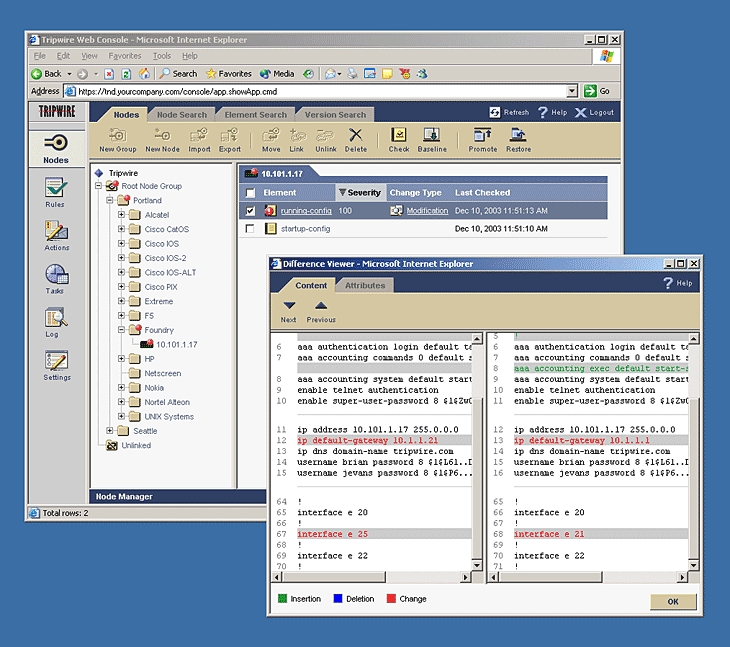
Tripwire for Network Devices 3.0 is multivendor network configuration management software that centrally manages, monitors and reports changes made to network components. In addition to heterogeneous device support, Tripwire offers version control, in which an archive of configurations for every device is maintained and updated automatically whenever change is detected. Tripwire for Network Devices can scale to tens of thousands of nodes that can be organized in logical groups. It integrates with user authentication, access and accounting applications to manage passwords and user access rights. Tripwire also offers baseline restorations, real-time integrity scans and proof of conformance.
Tripwire, Inc., 326 SW Broadway, 3rd Floor, Portland, Oregon 97205, 800-874-7947, www.tripwire.com.
REALbasic 5.5 is a development tool for creating cross-platform software for Linux, Windows and Mac. REALbasic includes the VB Project Converter tool to migrate tables, forms and code to REALbasic to get applications ported to Linux or Macintosh. REALbasic 5.5 supports Linux for x86 Intel platforms running Red Hat Enterprise or SuSE, as well as other distributions with the GTK+ 2.0 and CUPS libraries. Remote debugging is included so Linux applications can be tested and debugged from either Windows or Mac environments. Other additions and upgrades for version 5.5 include improved user interfaces, improved MS Office compatability, extended Mac OS X support, better database support and support for SOAP, XML and APIs.
REAL Software, 1705 South Capital of Texas Highway, Suite 310, Austin, Texas 78746, 512-328-7325, www.realsoftware.com.

