
From the Publisher - Ten Years of <citetitle>Linux Journal</citetitle>
With this issue, Linux Journal turns ten. I hadn't really thought about how LJ had been my job for ten years until Don suggested I write this editorial. To me, that's a good thing; I have been publishing rather than counting days. What has happened in these last ten years is amazing. Ten years ago I don't think anyone would have expected to see the L-word in ads by HP, IBM, Oracle and many other big players.
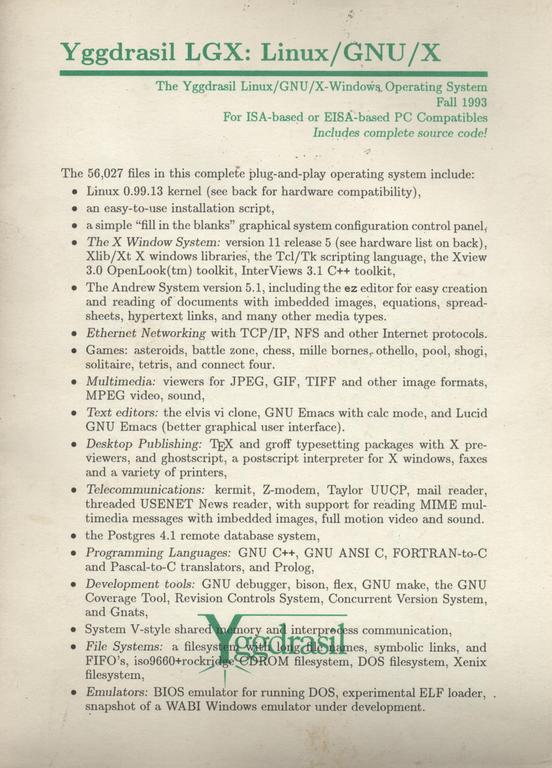
In looking around to see what I had from ten years ago that might have something to do with this editorial, I found two interesting things. The first was my copy of Yggdrasil LGX: Linux/GNU/X. This is the Fall 1993 distribution. The second was a picture of Phaedra, the daughter of Joanne Wagner, our first ad rep. The two go together because Phaedra (now 15) used to play the text game Mille Bornes, from the BSD games collection, on this version of Linux.
 Linux Journal" src="/files/linuxjournal.com/linuxjournal/articles/073/7308/7308f1.inline.jpg">
Who came up with the name?
 Linux Journal" src="/files/linuxjournal.com/linuxjournal/articles/073/7308/7308f2.inline.jpg">
Is she still a Linux gamer?
The distribution came in the form of a 64-page book and had a description of what it included and what it would run on on the covers. Inside you found a CD, a regular 5 1/4" boot floppy and one of those new-fangled 3.5" boot floppies. The system requirements were 4MB of RAM and from 2 to 680MB of disk space. Inside the book were installation information and a list of where to get support—12 places. One of these 12 is Russ Nelson at Crynwr Software, who still is very much an active member of what we were all calling the free software community back then.
We publish a magazine, so let me look at what I predicted back in the beginning. My editorial in issue two was a piece of fiction describing what Linux would be like in the year 2000—six years into the future. The first sentence says, “In the past 7 years we have seen Linux go from an idea for a small UNIX-like system into a movement to bring affordable, reliable multi-tasking software to anyone who could buy a rather minimal computer.” I don't think there is any argument there.
After some rambling about a program loader called MS-DOS, I went on to say, “With the advent of ISDN in the early 1990s and personal satellite stations in the late 1990s, connectivity became the big issue.” Personal satellite certainly did happen. I was wrong about ISDN (I guess I forgot it stands for It Still Does Nothing), but DSL and cable clearly filled that gap. So, I am still on track.
And that's where the track went astray. For example, I predicted that 90% of LJ subscribers would be receiving the magazine on-line. It still sounds like a great goal, but a combination of people wanting to have something to carry on the bus with them and the way subscription audits work—that is, only paper magazines count toward the official circulation—has slowed progress there. Of course, to my credit, Microsoft founder Bill Gates previously had predicted that Xenix on an Intel 80286 chip was the future of computing, so at least I was a little closer.
All my other predictions had to do with getting everyone on the Internet. In January 2001, I moved to Costa Rica. In the 1994 editorial I claimed that in 2000, I was in Yaak, Montana. So, I did move but I picked a place with a lot better weather. This move also helped me adjust my perspective about Internet connectivity. While many countries, Korea being a good example, are delivering broadband Internet service to a large percentage of their population, many other places are still without.
About nine years ago we decided we needed a Web presence. Linux and Apache sounded like the right approach, so we set up a 486DX100 with 16MB of RAM to test the waters. We agreed to evaluate what we really wanted to do when we got to 10,000 hits per month. LJ was growing and we were busy with other projects. When we finally looked at the Web site again we were at 100,000 hits per month. The system was handling it just fine. Today, we receive over 10,000 hits per hour on our Web sites.
Early on in the life of Linux, ISPs considered it to be an alternative to proprietary UNIX platforms. This was an era where dial-up was almost always the answer. Unfortunately, no intelligent serial communications boards were available with Linux drivers. I started talking to vendors and they all thought I was crazy to think there was any commercial future in Linux for them.
One company kept talking to me, though. They thought I was crazy mind you, but they did keep talking. That company was Cyclades, and I finally managed to get them to give Randy Bentson one of their boards so he could write a Linux driver. Six months later, Doris Li, their marketing manager, admitted that 50% of their domestic sales of that board were going to Linux users. Much like Russ Nelson, Cyclades is still here.
When Irene Pasternack and I started SSC about 20 years ago, we knew we would be doing computer-related documentation and training, but we needed to focus better than that. After discussing this, we decided the important thing that would make us different from everyone else was we would create only products we wanted for ourselves.
We weren't perfect, and every now and then we would get a brilliant idea and forget to check it against this criteria. For example, we did three MS-DOS Reference Cards. Bottom line: we sold about 5,000 of them, while we sold more like 500,000 vi Reference Cards.
Starting LJ was one of those things we wanted for ourselves. We had been running UNIX, but it looked like Linux was what we needed. We started the magazine and made the switch pretty much at the same time and have never looked back. We still do layout using Quark XPress on a non-Linux system, but Scribus is looking pretty good now, so we could be an all-Linux shop in the near future.
Once we started doing LJ, things have fallen into place a lot better than ever before. Here are a few of those magic happenings:
I knew Doc Searls' wife before they were married, in fact, before he knew her. Doc became part of LJ because Joyce convinced him that I seemed to be on to something.
Right after Doc wrote the Cluetrain Manifesto, he got e-mail from Dawn Smith. She told him she really liked the book and if he was ever in Costa Rica....He wrote back telling her that his publisher at LJ had just been to Costa Rica. Dawn told him that her husband recently had been working with Linux. Today, Willy Smith, Dawn's husband, works for us.
Back when I was starting SSC I worked for a company that did point-of-sale systems for gas stations. That's where I met Dan Wilder, who has been our head geek for the last few years.
I could go on and on here, but the important point I am trying to make is that with LJ, connections have just happened. Or, more accurately, when we let things happen in the Linux racket we seem to get the desired results.
Linux made me believe in community. I have worked in computers since 1968 and had a few other technical jobs when I was going to college. They were just that, jobs. I worked for a company that produced something it wanted to sell. You always had “the company” and “the customer”. With Linux, that paradigm changed.
At first there was no company. The latest Linux distribution was a box of home-brew floppies that were passed around at the Seattle Linux Users' Group meetings. We knew Linux was growing fast when we had two sets to loan out. I remember sending e-mail to Ted Ts'o about a problem I was having with the serial driver. I was somewhat timid, but his response included a new driver to test. It fixed the bug, and I realized that Linux was moving forward because we worked together.
The first time I met Linus Torvalds I saw what was behind that whole sense of community. It was at a party in Washington, DC. When Michael K. Johnson and I arrived, Linus was there along with a few other people who had contributed code to Linux. They were in a technical discussion about how something new should be implemented. What I saw was Linus treating these people as peers rather than trying to be the boss. To me, Linus is the ultimate manager. I mean, who else has been able to get thousands of employees, many of whom he has never even met, to work for free?
With Linux and Linux Journal, that community continued. We have authors who write because they want to write, readers who tell us that our ads are very useful to them and advertisers who ask us what we think our readers want to see. Sure, there is money changing hands (I haven't yet figured out how to get my staff to work for free), but much of that money is recycled within the Linux community.
Linus coined the idea of World Domination after we had started Linux Journal. At first it sounded like a joke, but today, it sounds like a goal we will reach before LJ turns 20. But, again, looking at the world scene we see a much different picture than if we solely focus on the United States.
Initially, I thought it was a third-world issue that drove Linux penetration. That is, people here don't have the same amount of disposable income as those in the US, and therefore, they are more willing to listen to a solution than follow the marketing hype. But, Linux penetration in Europe is very significant; the same is true in Asia. Although I don't understand why, I think the United States will be the last country to take Linux seriously.
There are two ways we can move Linux forward in the marketplace. One is to continue to show the shortcomings of proprietary alternatives. The problem with this approach is you get into a “which is better” contest, and the people on the anti-Linux side have a lot more money than we do. Thus, it isn't an issue of being right but of getting everyone else to see you are right.
The other method is to just do it. That is, run Linux. Help others run Linux. When a business needs a solution, offer Linux. And, most important of all, when Linux doesn't do something that is needed, address it. We have an amazing base available and some amazing talent in the Linux community. It is time to run with what we have and reach that World Domination goal.
First, I have some questions that need answers. Actually, we probably will never get the answers, but I find them interesting to think about:
At what point did Microsoft spend more on bad-mouthing Linux than all Linux vendors combined spend on marketing?
When will the number of installed copies of Linux exceed the number of legally installed copies of Microsoft OSes?
When will the number of installed copies of Linux exceed the number of total installed copies of Microsoft OSes?
Notice that I say when, not if. This will happen. It may happen last in the United States, but the combination of Linux maturing and the world economy dictates that this will happen. All of us have an opportunity to make this happen faster.
By the time you read this, I probably will be in Nicaragua helping get some Linux classes started. These are not classes for systems administrators or even computer users. The average person will have never used a computer before and currently makes about $3/day working in a cigar factory. This is not the profile of people that Microsoft is interested in marketing to, but they are typical future new computer users. This is my current path; you don't have to pick this same path. You simply can use Linux and set an example.
Another good approach is to help someone convert to Linux. For example, my neighbor does computer consulting. All his customers run Microsoft software, but they are getting pretty irritated by worms and viruses. Most of them run typical office software, including word processor, spreadsheet and e-mail, so it is the perfect time to offer them an alternative.
Although Linux certainly has become mainstream, it still has a great distance to go before we can claim a World Domination success story. If you are a Linux Journal reader, you are likely ahead of the crowd. Put a little effort into getting that crowd moving in the right direction, and we can reach World Domination long before Linux Journal is 20.
Looking beyond Linux, we also need to look at how what has happened with Linux is a template for what can happen in other areas. In mid-2003, we started our WorldWatch site as an experiment (worldwatch.linuxgazette.com). We saw the need for a worldview of what was happening with Linux and open-source software from a social, political and economic point of view. What happened made WorldWatch Editor Willy Smith realize that we needed to tie together free, libre and open-source software (FLOSS) with similar efforts in other areas. One of the best examples is what we called Open Source seeds. That is, seeds that actually can reproduce rather than the genetically engineered ones that have to be purchased from the patent holder.
This revelation resulted in our creation of a new Web site, A42 (www.a42.com). The Linux-related technical side of what WorldWatch was will be appearing on Linux Gazette (www.linuxgazette.com). A42 is going to be where we try to tie together the whole open-source revolution—whether it applies to computers or not. In order to remain sane, A42 will take a light-hearted approach.
So, let's just say Linux moving toward World Domination is well on the way, and I feel comfortable enough it will happen that I am going to go further out on a limb this time and say that Open Everything is the real goal. Hasta pronto.
Phil Hughes is publisher of Linux Journal.

