
Hacking the Xbox by Andrew “bunnie” Huang
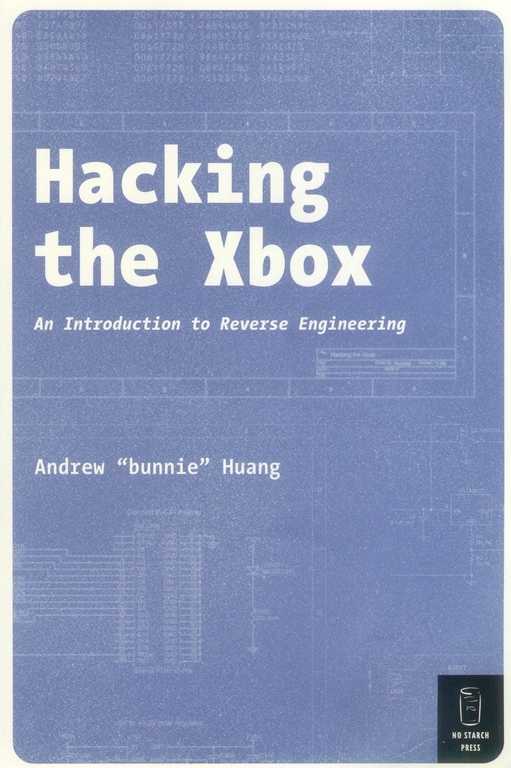
Structured around a series of hardware hacking projects that range in complexity from installing an alternate LED and making cables to eavesdropping on the motherboard with a custom tap board, Hacking the Xbox explores the hardware internals of Microsoft's game console first by opening the case, then by voiding the warranty and, finally, by taking a look around. Doing so is a legal minefield under the controversial Digital Millennium Copyright Act (DMCA), and discussion of the DMCA is featured frequently throughout the text. Although primarily of interest to the North American reader, the book provides insight into the problems that can be created by well-intentioned but often ill-informed legislators. Hackers living in other countries may not worry too much about the DMCA, but that's not to say there is not an equivalent local legislation waiting in the wings.
Readers looking to learn about hacking the Xbox from a software perspective will be intrigued but disappointed. Although it describes some important Xbox software projects, Hacking the Xbox focuses on reverse engineering from the point of view of the hardware engineer, not the software engineer. Detailed instructions on getting GNU/Linux up and running on your Xbox are not here, but they are provided elsewhere, and Andrew Huang includes the required pointers. If you are the kind of person who is at home with a screwdriver, a soldering iron, electronic components and PCBs, then this is the book for you. Of course, it helps if you can stomach potentially destroying your Xbox in the process. Not to worry, though, as Huang provides detailed instructions on replacing damaged mass-storage devices, memory and power supplies should anything go wrong.
Subtitled An Introduction to Reverse Engineering, Huang's Hacking the Xbox is much more. It is an introduction to cryptography and its use in hardware design. It is a warning on the threat to scientific pursuit that is the DMCA. It is a primer on intellectual property law and its implications for hackers. It is a profile of the key players in the Xbox Hacking community and it highlights their motivations, intent and contributions. It's also a darned good read. What is astounding is that Huang manages to do all this in under 270 pages.
Obviously, Hacking the Xbox describes the current Xbox and, now that the book has been published (another story all in itself), it is likely that the next-generation Xbox will change, invalidating the bulk of the book's content. That said, the general hardware hacking techniques described in Hacking the Xbox can be re-applied to the new Xbox, albeit without the step-by-step instructions. Of course, with millions of original Xbox consoles shipped worldwide, there will always be old, replaced or upgraded Xboxes to play with, so the book will have worth for some time to come.
Realizing the promise of Apache® Hadoop® requires the effective deployment of compute, memory, storage and networking to achieve optimal results. With its flexibility and multitude of options, it is easy to over or under provision the server infrastructure, resulting in poor performance and high TCO. Join us for an in depth, technical discussion with industry experts from leading Hadoop and server companies who will provide insights into the key considerations for designing and deploying an optimal Hadoop cluster.
Sponsored by AMD
Built-in forensics, incident response, and security with Red Hat Enterprise Linux 6
Every security policy provides guidance and requirements for ensuring adequate protection of information and data, as well as high-level technical and administrative security requirements for a system in a given environment. Traditionally, providing security for a system focuses on the confidentiality of the information on it. However, protecting the data integrity and system and data availability is just as important. For example, when processing United States intelligence information, there are three attributes that require protection: confidentiality, integrity, and availability.
Learn more about catching the bad guy in this free white paper.
Sponsored by DLT Solutions
| Designing Electronics with Linux | May 22, 2013 |
| Dynamic DNS—an Object Lesson in Problem Solving | May 21, 2013 |
| Using Salt Stack and Vagrant for Drupal Development | May 20, 2013 |
| Making Linux and Android Get Along (It's Not as Hard as It Sounds) | May 16, 2013 |
| Drupal Is a Framework: Why Everyone Needs to Understand This | May 15, 2013 |
| Home, My Backup Data Center | May 13, 2013 |
- RSS Feeds
- Dynamic DNS—an Object Lesson in Problem Solving
- Making Linux and Android Get Along (It's Not as Hard as It Sounds)
- Designing Electronics with Linux
- Using Salt Stack and Vagrant for Drupal Development
- New Products
- A Topic for Discussion - Open Source Feature-Richness?
- Drupal Is a Framework: Why Everyone Needs to Understand This
- Validate an E-Mail Address with PHP, the Right Way
- What's the tweeting protocol?
Enter to Win an Adafruit Pi Cobbler Breakout Kit for Raspberry Pi

It's Raspberry Pi month at Linux Journal. Each week in May, Adafruit will be giving away a Pi-related prize to a lucky, randomly drawn LJ reader. Winners will be announced weekly.
Fill out the fields below to enter to win this week's prize-- a Pi Cobbler Breakout Kit for Raspberry Pi.
Congratulations to our winners so far:
- 5-8-13, Pi Starter Pack: Jack Davis
- 5-15-13, Pi Model B 512MB RAM: Patrick Dunn
- 5-21-13, Prototyping Pi Plate Kit: Philip Kirby
- Next winner announced on 5-27-13!
Free Webinar: Hadoop
How to Build an Optimal Hadoop Cluster to Store and Maintain Unlimited Amounts of Data Using Microservers
Realizing the promise of Apache® Hadoop® requires the effective deployment of compute, memory, storage and networking to achieve optimal results. With its flexibility and multitude of options, it is easy to over or under provision the server infrastructure, resulting in poor performance and high TCO. Join us for an in depth, technical discussion with industry experts from leading Hadoop and server companies who will provide insights into the key considerations for designing and deploying an optimal Hadoop cluster.
Some of key questions to be discussed are:
- What is the “typical” Hadoop cluster and what should be installed on the different machine types?
- Why should you consider the typical workload patterns when making your hardware decisions?
- Are all microservers created equal for Hadoop deployments?
- How do I plan for expansion if I require more compute, memory, storage or networking?


9 hours 15 min ago
13 hours 42 min ago
17 hours 18 min ago
17 hours 50 min ago
20 hours 14 min ago
20 hours 17 min ago
20 hours 18 min ago
1 day 43 min ago
1 day 2 hours ago
1 day 7 hours ago