
Linux for Suits - Practical Penguin Progress
Here at Linux Journal we've been deeply involved in the Linux community ever since Phil Hughes started the magazine back in 1994 when Linux was turning 1.0. Through that whole time, we've served two different overlapping communities of interest—one political, the other practical. The political community cares about issues and the characters who drive them. The practical community cares about the nuts-and-bolts challenges of putting Linux to work.
During the past year, we've seen a growing split between the two, because the practical penguin population has been snowballing. And, on the whole, newborn practical penguins are joining the species for practical purposes. They don't care much about licensing, software patents or threatening legislation. To them, free software means free-as-in-beer. The free-as-in-speech stuff is fine, but it's not their issue.
What practical penguins care about is getting stuff done. If they're shucking off Microsoft, it's mostly because other stuff is cheaper, does a better job or is a smaller pain in the butt. The fact that it's free, and seems to grow wild in nature, makes Linux, along with the free stuff that runs on it, highly appealing. The fact that programmers get to keep and share their improvements to code is another bonus.
Of course, many practical penguins are political ones, too. But the political penguin percentage is getting smaller, even though their absolute numbers are getting larger.
Sound familiar? This is very much like what happened to the Internet in the mid-90s. Prior to that time, the Net was the province of academics and hackers working for organizations privileged to have Net connections. Politics and utility were closely connected. What made the Net important was also what made it handy. At a certain point, however, the appeal got turned around. What made it handy made it important. And as it became handier for more and more people, the percentage of people who continued to care about its founding virtues grew smaller. Today a noisy minority still exists that loves the Net's founding virtues and inveighs tirelessly on its behalf. That's why I wrote “World of Ends” (worldofends.com) with David Weinberger, for example. But most people who use the Net really don't care. They only like what the Net does.
That's where we're going with Linux. It's the somewhat unexpected yet entirely predictable consequence of World Domination. When Linux becomes the default operating system—ubiquitous, or close enough—it still will be important for some of us to care about why it got that way and why its founding virtues remain as operative as ever. But as a percentage of the whole community, that “some” will be a progressively smaller group, even if they grow in absolute numbers. The only problem is the practical majority still is mostly a silent one, while the political minority still is widely heard. This creates distortions in the press, which often treats Linux as a political cause rather than a market effect. It also denies the political voices much of the validation they deserve. Unfortunately, the silence is likely to persist for a while. Linux is long past the Not Going Away stage, but still a long way from World Domination.
So, I've been making it my job to watch what the practical penguins have been up to and to talk to as many as I can. I outlined my first findings last month in “How Linux Makes Smart Companies Smarter”. Since then I've condensed my conclusions to a few key points:
Linux is a project, not a product. So are the other members of the LAMP suite: Apache, MySQL, Perl, Python, PHP and PostgreSQL.
Free software and open source are ways that the demand side supplies itself. Call this DIY-IT, or Do It Yourself Information Technology. In some cases, DIY-IT is so well developed that customers hardly need vendors at all.
DIY-IT is causing a shift in market power from supply to demand.
Clueless vendors fight this shift. Smart vendors learn from smart customers, often by working on the same development projects.
IBM and Oracle are two standout examples of suppliers who are hip to the smart stuff happening on the demand sides of their markets—largely because it's happening inside their companies as well.
This shift in power, and in the way clues are passed among practitioners, is turning the software industry into something very much like the construction industry, which also has architects, designers, builders, tools, platforms, frameworks, a hearty DIY tradition, project-based work and open-source know-how.
Figure 1 presents the old view of the software marketplace. Vendors had a controlling position, because they supplied the goods—and the expertise to go with them. This is what made 90% gross profit margins not only possible, but standard.
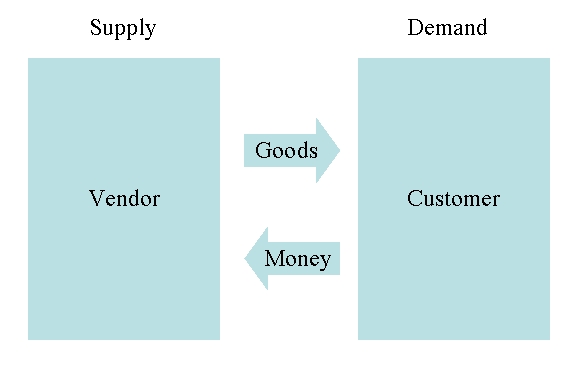
Figure 1. The Old View of the Software Marketplace
Figure 2 shows how the new marketplace looks. Here the demand side—the customer—is in a position to supply itself. It still buys goods from vendors. In fact, smart vendors' goods are improved by participation in the same development community as their customers.
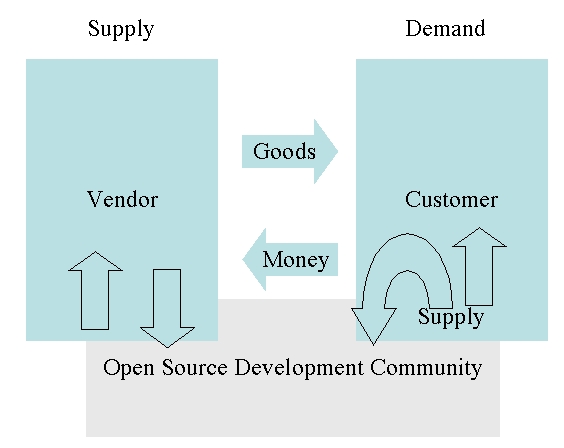
Figure 2. The New Marketplace
As the market continues to mature, the open-source development community will come to be understood as a collection of know-how. In a mature industry like construction, this community includes everyone who participates expertly in the industry. When that happens in the software industry, topics like patents and licensing will acquire more confined meanings than they have today. We won't need patents on “business methods”, and most of us won't need licenses to tell us it's good to share what we know. We'll do what comes naturally, which is what free software and open-source licenses predicted in the first place.
Meanwhile, the political remains as important as it ever was. Let's remember, if it weren't for the political penguins who got the snowball rolling, the practical penguin movement never would have picked up its mass and momentum.
Doc Searls is senior editor of Linux Journal.

