
AMD64 Opteron Released Today
As far as most Linux users are concerned, Opteron is the most significant new hardware introduction so far this decade. Pick up the July issue of Linux Journal for a closer look. LJ also will be publishing more articles about 64-bit Linux on Opteron in the months to come. At release time, important partners, including distributions, ISVs and systems integrators, are offering Opteron support.
In advance of the release of the AMD64 Opteron processor, we had the opportunity to test a dual-processor SMP system with a 64-bit Linux distribution.
The Opteron is a new device family based on a new 64-bit architecture that is compatible with the pre-existing x86 32-bit architecture. AMD's choice to preserve compatibility has positive implications for transmigrating 32-bit workloads.
The code name for the processor core is "Sledgehammer", and the device ships in a 940-pin ceramic micro PGA package. The current Opterons use nearly 106 million transistors in a 130nm Silicon on Insulator (SOI) process. The devices were fabricated at AMD's Fab30 in Dresden, Germany. The L1 cache has 128KB capacity, split into a 64KB instruction cache and a 64KB data cache. An on-chip L2 cache has a 1MB capacity.
AMD has a three-digit part numbering scheme for the Opterons. The first digit indicates the intended SMP scalability, which is two-way in the 1.8GHz Opteron Model 244 and the 1.6GHz Opteron Model 242 reviewed in this article. The second digit indicates relative performance within the scalability family. AMD also will manufacture a one-way Opteron for high-performance, lower-cost systems. Models 240, 242 and 244 are available at the time of this writing. The eight-way capable models 840, 842 and 844 are scheduled for May 2003, and model 144 is scheduled for Q3 of 2003.
The reference platform is called the 2100 and was realized by Newisys, Inc., a technology provider that presently has two years of experience with Opteron.
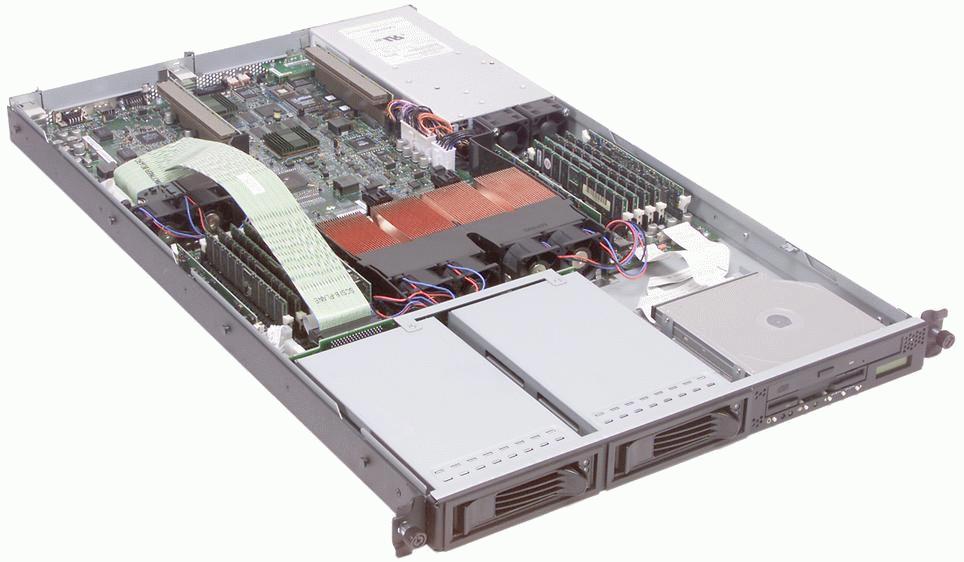
Figure 1: The Newisys 2100 puts two Opteron processors in a 1U enclosure.
The 2100, a 1U, two-processor, rackmountable system, is superbly engineered. The mechanical and electrical design offers reliability in a dense package, which can be seen in Figure 1. The evaluation system came with 6GB of PC2700 memory, but the server will support 16GB.
The two copper heatsinks in Figure 1 are the processors. Two speed grades are supported, the 1.6GHz Opteron Model 242 or the 1.8GHz Opteron Model 244. The Opterons link to each other and to the chipset using HyperTransport. The CPU-to-CPU bandwidth is 3.2GB/sec--in each direction (that is, full-duplex). The Opterons each have an internal memory controller that supports ECC DDR SDRAM at a bandwidth of 5.33GB/sec. There are two banks of memory, one next to each processor.
The AMD-8000 HyperTransport chipset includes an AMD-8131 HyperTransport PCI-X chip, as well as an AMD-8111 I/O hub chip. The AMD-8131 is configured to drive a full slot PCI-X 64-bit/133MHz at a 1GB/sec data rate, as well as a half slot PCI-X 64-bit/66MHz with a 0.51GB/sec data rate. The AMD-8131 also provides a pair of triple-mode NICs (10M/100M/1GB) and a dual Ultra SCSI RAID controller. The AMD-8111 chip provides a VGA port, IDE CD-ROM and a USB port. Separately, a SuperI/O chip provides floppy, keyboard, mouse and a conventional serial port.
The system also contains a separate embedded server management processor, a PowerPC running Linux. We'll have more on the capabilities of the management processor in the July issue.
Newisys partners include some well-known names in IT: Angstrom Microsystems, Appro, RackSaver, M&A Technology, Microway, New Technology Solutions, Inc. and Promicro.
SuSE will offer Opteron support from day one. "We've been working with AMD for a couple years on this", said product manager Jay Migliaccio. SuSE Enterprise Server 8 builds from a common code base for all architectures, including IA-32 and AMD64, Migliaccio said. "Seamless migration is really the story here."
The main GUI environment supported on SuSE Linux Enterprise Server 8 is KDE 3.0, and the system comes with all the regular tools and applications usually expected from a SuSE distribution. One of the first things you notice when working with this system is that Emacs starts immediately, faster than you can blink.
We performed one test with the Icarus Verilog compiler. Icarus Verilog is a GPLed Verilog HDL compiler for electronic design automation (EDA), especially HDL simulation and synthesis. Linux Journal has interviewed Steve Williams, the author of Icarus, two times now. Over time, we have documented the steadily increasing advances this compiler has made as a serious industrial-strength EDA tool for logic and FPGA design. Because Steve has been building Icarus as 64-bit clean code for the last five years under Linux for Alpha, compiling the compiler was relative easy. What was of interest was learning how fast Icarus is on the Opteron, how well it responds to large workloads and many more cycles of operation in terms of runtime it completes.
We tested a large multiplier logic model and testbench from the Icarus test suite, and it was almost twice as fast as a 1.5GHz Athlon processor running the same binary. For the large workload test, a Verilog model consisting of 1,720,648 lines of HDL code was compiled. This process also was breathtaking. In 61 minutes, the machine compiled a model with a memory footprint larger than the largest user space in 32-bit Linux--3.6GB. Opteron clearly is well-suited to be an excellent server technology for engineering work.
One major proprietary EDA vendor, Cadence Design Systems, already has announced that it has ported its design for test (DFT) software, which had been used in designing Opteron, to Opteron.
The last major test we compiled was for the Linux Test Project (LTP). The LTP is a GPLed test environment for Linux, available for download at SourceForge. The version tested was ltp-full-20030404, from early April 2003. It compiled and ran the default tests.
64-bit SuSE Enterprise Linux is squeaky clean. Although the LTP is well geared to testing Linux, some other more quantitative data about Opteron is necessary to understand it's capabilities. We turn now to some preliminary benchmarks.
Some pre-release industry standard benchmarks available at press time are listed in Tables 1 and 2. These are for a dual-processor SMP Opteron 244 with PC2700 memory configuration, for 32-bit applications.
In the near future, the upside for 64-bit "long mode" applications running on Linux seems very high indeed, because eight-way SMP processors are coming. Linux Journal will be covering this emergent technology with additional articles in the future.
email: mab@cruzio.com
email: mab@cruzio.com
