Buffer Overflow Attacks and Their Countermeasures
Buffer overflow problems always have been
associated with security vulnerabilities. In the past, lots of
security breaches have occurred due to buffer overflow. This
article attempts to explain what buffer overflow is, how it can be
exploited and what countermeasures can be taken to avoid it.Knowledge of C or any other high level language is essential
to this discussion. Basic knowledge of process memory layout is
useful, but not necessary. Also, all the discussions are based on
Linux running on x86 platform. The basic concepts of buffer
overflow, however, are the same no matter what platform and
operating system is used.Buffer Overflow: the BasicsA buffer is a contiguous allocated chunk of memory, such as
an array or a pointer in C. In C and C++, there are no automatic
bounds checking on the buffer, which means a user can write past a
buffer. For example:
int main () {
int buffer[10];
buffer[20] = 10;
}
The above C program is a valid program, and every compiler
can compile it without any errors. However, the program attempts to
write beyond the allocated memory for the buffer, which might
result in unexpected behavior. Over the years, some bright people
have used only this concept to create havoc in the computer
industry. Before we understand how they did it, let's first see
what a process looks like in memory.A process is a program in execution. An executable program on
a disk contains a set of binary instructions to be executed by the
processor; some read-only data, such as printf format strings;
global and static data that lasts throughout the program execution;
and a brk pointer that keeps track of the malloced memory. Function
local variables are automatic variables created on the stack
whenever functions execute, and they are cleaned up as the function
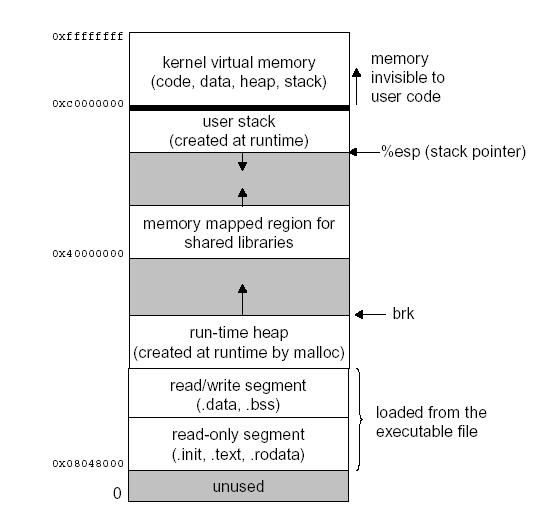
terminates.The figure above shows the memory layout of a Linux process.
A process image starts with the program's code and data. Code and
data consists of the program's instructions and the initialized and
uninitialized static and global data, respectively. After that is
the run-time heap (created using malloc/calloc), and then at the
top is the users stack. This stack is used whenever a function call
is made.The Stack RegionA stack is a contiguous block of memory containing data. A
stack pointer (SP) points to the top of the stack. Whenever a
function call is made, the function parameters are pushed onto the
stack from right to left. Then the return address (address to be
executed after the function returns), followed by a frame pointer
(FP), is pushed on the stack. A frame pointer is used to reference
the local variables and the function parameters, because they are
at a constant distance from the FP. Local automatic variables are
pushed after the FP. In most implementations, stacks grow from
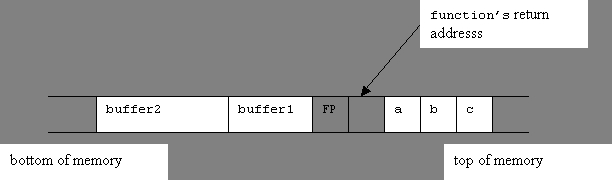
higher memory addresses to the lower ones.This figure depicts a typical stack region as it looks when a
function call is being executed. Notice the FP between the local
and the return addresses. For this C example,
void function (int a, int b, int c) {
char buffer1[5];
char buffer2[10];
}
int main() {
function(1,2,3);
}
the function stack looks like:As you can see, buffer1 takes eight bytes and buffer2 takes
12 bytes, as memory can be addressed only in multiples of word size
(four bytes). In addition, an FP is needed to access a, b, c,
buffer1 and buffer2 variables. All these variables are cleaned up
from the stack as the function terminates. These variables take no
space in the executable disk copy.Buffer Overflow: the DetailsConsider another C example:
void function (char *str) {
char buffer[16];
strcpy (buffer, str);
}
int main () {
char *str = "I am greater than 16 bytes"; // length of str = 27 bytes
function (str);
}
This program is guaranteed to cause unexpected behavior,
because a string (str) of 27 bytes has been copied to a location
(buffer) that has been allocated for only 16 bytes. The extra bytes
run past the buffer and overwrites the space allocated for the FP,
return address and so on. This, in turn, corrupts the process
stack. The function used to copy the string is strcpy, which
completes no checking of bounds. Using strncpy would have prevented
this corruption of the stack. However, this classic example shows
that a buffer overflow can overwrite a function's return address,
which in turn can alter the program's execution path. Recall that a
function's return address is the address of the next instruction in
memory, which is executed immediately after the function
returns.Overwriting Function's Return AddressesBecause we know it is easy to overwrite a function's return
address, an intelligent hacker might want to spawn a shell (with
root permissions) by jumping the execution path to such code. But,
what if there is no such code in the program to be exploited? The
answer is to place the code we are trying to execute in the
buffer's overflowing area. We then overwrite the return address so
it points back to the buffer and executes the intended code. Such
code can be inserted into the program using environment variables
or program input parameters. An example code that spawns a root
shell can be found in a classic paper written by Aleph One for
Phrack Magazine (see Resources).Buffer Overflow CountermeasuresThe solutions proposed for buffer overflow problems mainly
target the prevention of large-scale system attacks through the
loopholes described above. None of the methods described below can
claim to prevent all possible attacks. These methods, however, can
make it more difficult to access buffer overflows and, hence,
destroy the consistency of stacks.
- Write secure code: Buffer overflows are the result
of stuffing more code into a buffer than it is meant to hold. C
library functions such as strcpy (), strcat (), sprintf () and
vsprintf () operate on null terminated strings and perform no
bounds checking. gets () is another function that reads user input
(into a buffer) from stdin until a terminating newline or EOF is
found. The scanf () family of functions also may result in buffer
overflows. Hence, the best way to deal with buffer overflow
problems is to not allow them to occur in the first place.
Developers should be educated about how to minimize the use of
these vulnerable functions. - Stack execute invalidation: Because malicious code
(for example, assembly instructions to spawn a root shell) is an
input argument to the program, it resides in the stack and not in
the code segment. Therefore, the simplest solution is to invalidate
the stack to execute any instructions. Any code that attempts to
execute any other code residing in the stack will cause a
segmentation violation. However, the solution is not easy to
implement. Although possible in Linux, some compilers (including
GCC) use trampoline functions (see Resources) to implement taking
the address of a nested function that works on the system stack
being executable. A trampoline is a small piece of code created at
run-time when the address of a nested function is taken. It
normally resides in the stack, in the stack frame of the containing
function and thus requires the stack to be executable. However, a
version of the Linux kernel that enforces the non executable stack
is freely available (see Resources). - Compiler tools: Over the years, compilers have
become more and more aggressive in optimizations and the checks
they perform. Various compiler tools already offer warnings on the
use of unsafe constructs such as gets (), strcpy () and the like.
For example, this code
int main () {
char *str = (char *)malloc(10);// allocate 10 bytes for str
gets (str); // reads input from stdin and store into str
}
when compiled with GCC, returns the following warning:
/tmp/cc203ViF.o: In function "main": /tmp/cc203ViF.o(.text+0x1f): the "gets" function is dangerous and should not be used.
Apart from offering warnings, modern compiler tools change
the way a program is compiled, allowing bounds checking to go into
compiled code automatically, without changing the source code.
These compilers generate the code with built-in safeguards that try
to prevent the use of illegal addresses. Any code that tries to
access an illegal address is not allowed to execute.These kind of tools, however, require the source code to be
recompiled with a newer compiler. This requirement may be a problem
if the application is not open source. Furthermore, it may affect
the application's performance to a great extent. In some case,
executable size and execution time may increase two-fold.A patch for GCC that does bounds checking can be found
here.
Recently, however, most of the tools have concentrated on
preventing the return address from being overwritten, as most
attacks occur this way.
StackShield
is a freely available tool that copies the return address of a
function to a safe place (usually to the start of the data segment)
at the start of the function. When the function terminates, it
compares the two function return address, the one in the stack and
the one stored in data segment. In the case of a mismatch, the
function aborts immediately.Because a function also can call another function, it needs
to maintain a stack kind of structure for storing return addresses.
Another tool available is
StackGuard,
which detects and defeats smash stacking attacks by protecting the
return address on the stack from being altered. It places a canary
word next to the return address whenever a function is called. If
the canary word has been altered when the function returns, then
some attempt has been made on the overflow buffers. It responds by
emitting an alert and halting.
application has restricted access in order to prevent attacks. This
method primarily relies on the safety code being preloaded before
an application is executed. This preloaded component can either
provide safer versions of the standard unsafe functions, or it can
ensure that return addresses are not overwritten. One example of
such a tool is
libsafe.
The libsafe library provides a way to secure calls to these
functions, even if the function is not available. It makes use of
the fact that stack frames are linked together by frame pointers.
When a buffer is passed as an argument to any of the unsafe
functions, libsafe follows the frame pointers to the correct stack
frame. It then checks the distance to the nearest return address,
and when the function executes, it makes sure that address is not
overwritten.
ConclusionsAll the methods/tools described above are limited in one
manner or another. No tool can solve completely the problem of
buffer overflow, but they surely can decrease the probability of
stack smashing attacks. However, code scrutiny (writing secure
code) is still the best possible solution to these attacks.
Programmers should be educated to prevent/minimize the use of
standard unsafe functions. In addition, no warning given by the
compiler should be taken lightly. With time and increasing
awareness among developers, buffer overflow problems are predicted
to decrease in importance and frequency. Security-related issues
are still expected to be around, though, by various other
means.Resources"Smashing
the Stack for Fun and Profit", by Aleph One.Trampoline
Functions and
GCCOpenwall
Project, Linux patch with non-executable stack
version.Bounds
Checking Patch for GCCVendicator,
StackShieldStackGuardlibsafe
Project from Avaya LabsSandeep Grover works as a
Software Engineer with
Quicklogic, India.
He holds a Bachelor's Degree in Computer Science from the Institute
of Technology, BHU, India. His research interests lie in compilers,
EDA and computer architecture.
email: sgrover@quicklogic.com


This week 5 lucky Members will receive a copy of The Official Ubuntu Server Book by Benjamin Mako Hill and Linux Journal's very own Kyle Rankin. No entry necessary. Check back here early next week to find out who the lucky Online Members are.


Comments
need for diagrams
thi site is very gud. but we need some diagrams for well known about buffer. thank you
Remote launching of buffer overflows
Hi sandeep,
Thanks a lot for the fantastic effort. I was wondering how a hacker can launch the buffer overflow atack remotely.
It was quite clear from your article how the buffer overfloe happens on a local system. In fact I was reading the following pdf ""A Bu®er Over°ow Study
Attacks & Defenses
Pierre-Alain FAYOLLE, Vincent GLAUME
ENSEIRB
Networks and Distributed Systems
2002"
which talks about the same and mostly shows ways and tools to protect against buffer overflow attacks.
But I wan to know how the attack is actually launched.
Say a user is sitting on a machine A and a hacker is sitting on machine B. They are in different cities. In such a case how will the hacker make its malicious code run on the user's machine, i mean to say how will a hacker sitting in a different geographical location overflow the memory buffer on the user's local system over the network/internet...
it seems that the last response on your article was more than 40 weeks ago... so if you reply I would be very grateful.
Using string libraries to mitigate buffer overflows
> Write secure code: Buffer overflows are the result
> of stuffing more code into a buffer than it is meant
> to hold. C library functions such as strcpy (),
> strcat (), sprintf () and vsprintf () operate on null
> terminated strings and perform no bounds checking.
> gets () is another function that reads user input
> (into a buffer) from stdin until a terminating
> newline or EOF is found. The scanf () family of
> functions also may result in buffer overflows. Hence,
> the best way to deal with buffer overflow problems is
> to not allow them to occur in the first place.
> Developers should be educated about how to minimize
> the use of these vulnerable functions.
Ok, but one clear way to avoid problems with these functions is to absolutely ban their use in the first place. That may seem heavy handed or impractical, but its not if you have an alternative that is ready to use to substitue for the functionality of all those functions. That is to say you simply need a comprehensive string library that performs automatic buffer management and delivers sufficient functionality and simply switch to it.
I think the two main alternatives that I would recommend for C programmers is either James Antil's "Vstr":
http://www.and.org/vstr/
or my own library, "The Better String Library":
http://bstring.sf.net/
They attack the problem with different philosophical mindsets (as James says, his is a buffer manager for struct iovect *, while mine is a buffer manager for char *), but either one is sufficient significantly reduce the occurrence of buffer overflows, while delivering all sorts of side features which you can read about at their respective home pages.
For C++, you can also use my library, however either STL's std::string or Microsoft's MFC based CString class are also good alternatives for automatically buffer managed strings.
The problem with using functions like snprintf/strncat/strlcpy, etc, is that they don't remove the problem of buffer overflow, they simply change them. Remember that buffer overflows, fundamentally come program programmer errors. Just because you've reformulated that problem doesn't mean programmers are going to stop making errors. The advantage of a dynamic string library is that the problem of buffer management for strings (and/or other kinds of memory buffers) is completely solved for you. So these kinds of buffer overflow errors basically cannot happen.
Re: Buffer Overflow Attacks and Their Countermeasures
Purdue University has a nice website about buffer overflow attacks and prevention methods including their hardware based approach called SmashGuard. Check out www.smashguard.org
Spot the difference
Half of this article has just been ripped and paraphrased from Aleph1's original. It would have been easier just to paste the url to Phrack, or create a .diff for 'Smashing the stack for fun and profit'. Apart from that, it's good
"The standard C library provides a number of functions for copying or appending strings, that perform no boundary checking. They include: strcat(), strcpy(), sprintf(), and vsprintf(). These functions operate on null-terminated strings, and do not check for overflow of the receiving string. gets() is a function that reads a line from stdin into a buffer until either a terminating newline or EOF. It performs no checks for buffer overflows. The scanf() family of functions can also be a problem"
"C library functions such as strcpy (), strcat (), sprintf () and vsprintf () operate on null terminated strings and perform no bounds checking. gets () is another function that reads user input (into a buffer) from stdin until a terminating newline or EOF is found. The scanf () family of functions also may result in buffer overflows"
Read
Read
Smashing The Stack For Fun And Profit
and
w00w00 on Heap Overflows
Re: Buffer Overflow Attacks and Their Countermeasures
very good articles...
but there is a thing that leave me very surprised: why we can execute instructions in the data segment?? since now i have believed the memory paging system marks the memory pages with 3 bits: r,w,x ... so if program counter points to something in a data page (r or r,w) a page fault should occour... where's the trick???
Re: Buffer Overflow Attacks and Their Countermeasures
I was thinking the same thing. The author says that gcc places "trampoline code" in the stack (segment) making it executable "(in order) to implement taking the address of a nested function that works on the system stack being executable." huh? That would be a big mistake. Makes me wonder if Linux is any better than Windows.
Local C functions are non-standard --I know gcc allows them and I've used them, very nice-- but they are still "static". Only their names are hidden inside the enclosing function.
You don't need any code in the stack to follow C++ exception handling, so what are you talking about Sandeep????
Re: Buffer Overflow Attacks and Their Countermeasures
>No tool can solve completely the problem of buffer overflow
Huh? You seem to be saying that keeping track of the size of the destination buffer doesn't work. Barring an error at the hardware level (or incorrect function implementation), how can a properly used *sn* function lead to an overflow?
Failure to use a tool properly does not make the tool faulty.
Re: Buffer Overflow Attacks and Their Countermeasures
Making strcpy() safe is easy, but it's use is slightly different. Here's my own source code to a safer strcpy:
#include // for printf()
#include // for memset()
char *sstrcpy(char *dest, const char *src);
int main(int argc, char *argv[])
{
char buffer[20];
memset(&buffer,1,19) //set buffer -1 with 1's
sstrcpy(buffer,argv[1]);
printf("buffer is : %s (%d)
",buffer,strlen(buffer));
return 0;
}
char * sstrcpy(char *dest, const char *src)
{
char *temp = dest;
while (*dest != '') {
if (*src == '')
{
*dest++ = '';
return temp;
}
*dest++ = *src++;
}
*dest++ = '';
return temp;
}
Let me know what you think.
Re: Buffer Overflow Attacks and Their Countermeasures
// these are not valid C comments, and will not be recognized by a C compiler such as gcc, but are recognized by a C++ compiler such as g++
/* these are valid C comments */
Re: Buffer Overflow Attacks and Their Countermeasures
Oops, forgot a bit of code:
between memset() and sstrcpy()
add
buffer[20] = '';
That should make it work fine.
Example output:
$ ./test AAAAAAAAAAAAAAAAAAAAAAAAAAAAAAAAAAAAAAAAA
buffer is : AAAAAAAAAAAAAAAAAAAA (20)
$
Re: Buffer Overflow Attacks and Their Countermeasures
Try adding the line below (defining badthing) and then see what happens when you pass 20 chars. You end up with a non-terminated string, which when printed, appends the string immediately following in memory. Woops.
char badthing[20]="what the hell happened...";
char buffer[20];
memset(&buffer,1,19) //set buffer -1 with 1's
sstrcpy(buffer,argv[1]);
Re: Buffer Overflow Attacks and Their Countermeasures
but it's a deliberate overflow by the code author, not the user
Re: Buffer Overflow Attacks and Their Countermeasures
I would just like to thank Linux Journal for updating the article to correct errors mentioned in the discussion. This is especially interesting, as they didn't feel justified to mention that they updated the article. Thank you for the shining exampling of journalism you present to the world.
Re: Buffer Overflow Attacks and Their Countermeasures
Wonderful article and context !
I feel I am sitting in a newsgroup !
More articles like this please. I think this can be a good forum for
people to discuss technical ideas.
Re: Buffer Overflow Attacks and Their Countermeasures
You forgot to mention runtime-checking tools like valgrind and purify.
Other than that, looks pretty unprofessional
Re: Buffer Overflow Attacks and Their Countermeasures
Did u mean professional??? Since I thought the other way round....
What about LIDS?
Buffer overflows would not be nearly the security nightmare they are if the root account were not all-powerful and if network and system daemons like apache were not run from the root account. Fixing this turns out to be simpler than you might think with the LIDS kernel patch.
LIDS stands for Linux Intrusion Detection System. I think of it as a firewall that sits between a process and the kernel when system calls are made. With it, priviledges can be granted to and taken away from individual programs (based on the inode of the executable program file) instead of to user accounts.
If the only root priviledge the apache program possesed was the ability to bind to port 80, and someone found a buffer overflow in apache and exploited it, and they managed to get a remote root shell from it, it would buy them little if the normal powers of the root account had been stripped away.
See www.lids.org for more information.
Although you have to spend some time configuring the permissions table for the applications you want to run, it is quite manageable and only has to be done once. I think this is the ultimate answer to bufferflows: make it so that even when a buffer overflow is found, the attacker can't do anything with it.
Chris Marshall
Re: Buffer Overflow Attacks and Their Countermeasures
Well one solution to this problem could be the new Openbsd 3.2 kernel policy, that most of the stack programming is removed. You can also config systrace and config it but it takes alot of time if you want it to work good.
Those are my best answers to how sysadmins could protect themselfs against Buffer overflow attack. And also one more thing, PROGRAMMERS DONT write shitty code!!! buffer overflow is really easy to avoid, in the programming state.
Re: Buffer Overflow Attacks and Their Countermeasures
Well presented Article!!
Re: Buffer Overflow Attacks and Their Countermeasures
well one solution to this problem could be the new Openbsd 3.2 kernel policy, that most of the stack programming is removed. You can also config systrace and config it but it takes alot of time.
Those are my best answers to how sysadmins could protect themselfs against Buffer overflow attack. And also one more thing, PROGRAMMERS DONT write shitty code!!! buffer overflow is really easy to avoid, in the programming state.
Re: Buffer Overflow Attacks and Their Countermeasures
Consider some very simple program whose main() calls a function, passing it a couple of parameters. Then compile with the -S switch (upper case) e.g.
gcc -S simple.c
producing simple.s. This file then shows the assembly language translation with the explicit stack behavior revealed.
Re: Buffer Overflow Attacks and Their Countermeasures
well one solution to this problem could be like the new Openbsd 3.2 kernel, that most of the stack programming is removed. You can also config systrace and config it.
Those are my best answers two how sysadmins should protect against Buffer overflow attack. end also one point. PROGRAMMERS DONT write shitty code!!! buffer overflow is really easy to avoid, in the programming state.
/mr.J
Re: Buffer Overflow Attacks and Their Countermeasures
>No tool can solve completely the problem of buffer overflow
Probably true, if C is the only language you know.
Seriously, the choice of language for implementing any
system should consider the tradeoffs involved, and the
risk (and expense of finding and fixing) buffer-overflow
problems is one of the BIG tradeoffs. The article would
be stronger if it started with a mention of this issue.
There are places where a low-level language such as C
must be used, but far too often a high-level language
would be the choice of a responsible engineer.
"Performance" is seldom important enough to require
accepting the risks of low-level errors such as buffer
overflows (or wild pointers, or any of the C "Traps
and Pitfalls"). Yes, there's even a book, a very good
book by that title.
Bill Sconce
In Spec, Inc.
New Hampshire
Re: Buffer Overflow Attacks and Their Countermeasures
Performance is seldom important enough to require
accepting the risks of low-level errors such as buffer
overflows
Yes it is, in almost every application.
I despise the attitude that performance doesn't matter because memory and cpu is cheap, well it ain't cheap enough to warrant that attitude, which leads to software getting evermore bloated.
Re: Buffer Overflow Attacks and Their Countermeasures
No tool can solve completely the problem of buffer overflow
Probably true, if C is the only language you know.
Amen, brother!
COBOL, Ada, Pascal, BASIC & Python pop instantly into my head as languages where such bugs will never occur.
Programmers that have such a bias towards C should get a real clue. It is a poor tool for many problems.
Re: Buffer Overflow Attacks and Their Countermeasures
"COBOL, Ada, Pascal, BASIC & Python pop instantly into my head as languages where such bugs will never occur. Programmers that have such a bias towards C should get a real clue"
This is FUD. It is biased and untrue.
Pascal and BASIC got the same problems. I don't know if COBOL and Python do, so I refrain from arguing on this issue.
Ada, C# and Java are usually compiled into managed environments which solve the problem. Naturally, at the expense of complete bound checking at every buffer access (which I agree on is often acceptable).
It is not REALLY an issue on the side of the language as the poster seem to believe, it is an issue of
- is code running "live" or "managed" ?
- if not managed, are every API and possible way to express yourself within the language bound checked?
I do not give much for the argument of Pascal syntax making code better than C. It's an old and biased argument which I do not believe is based on good statistics.
Of course, Pascal programmers code C badly. But what of experienced C programmers vs experienced Pascal programmers in their native language? Do Pascal programmer really produce better code? I doubt it.
Bad statistics are based on bad comparisions like what unexperienced programmers yield in different langauges. Additionally, since most code is written in C, it is also a _lot_ of inexperienced programmers coding in C.
Pascal has _never_ been mainstreamed enough to been tested with the "30% of the programmers cannot code, what do they produce" test C is experiencing every day. Pascal, Ada, Fortran etc programmers tend to be better educated because they are mostly used by researchers or people will univerisity or college experience.
//P
Re: Buffer Overflow Attacks and Their Countermeasures
I have been out of touch with technology since the last 4years but still could understand the article extremely well.
Very good read.
Re: Buffer Overflow Attacks and Their Countermeasures
>No tool can solve completely the problem of buffer overflow
IBM iSeries AS/400 has firmware/hardware based protection against buffer overflow and several other potential vulnerabilities.
Problems currently plaguing the PC world have long been solved or never existed in the kingdom of large iron.
Re: Buffer Overflow Attacks and Their Countermeasures
As does most SUN's. You have to enable it though.... You'd think that something like that that is implented in hardware should be on by default if only to catch buggy software.
Re: Buffer Overflow Attacks and Their Countermeasures
Nice, easy to understand article, but for the strncpy blunder !!
Dont mind, keep it up !!
Re: Buffer Overflow Attacks and Their Countermeasures
Sandeep, nice article; I'd like to offer the following papers for further reading for interested readers:
http://wirex.com/~crispin/opensource_security_survey.pdf
(published in IEEE's new Security & Privacy Magazine)
"Buffer Overflows: Attacks and Defenses for the Vulnerability of
the Decade". Crispin Cowan, Perry Wagle, Calton Pu, Steve Beattie, and
Jonathan Walpole. DARPA
Information Survivability Conference and Expo (DISCEX), Hilton Head
Island SC, January 2000. Also presented as an invited talk at SANS 2000, Orlando FL,
March 2000. PDF.
Seth Arnold, WireX Communications
Re: Buffer Overflow Attacks and Their Countermeasures
for more relevant projects unfortunately left out from Dr. Cowan's aforementioned article the interested readers are invited to check out the following sites as well:
http://www.rsbac.org/
http://www.grsecurity.net/
http://pageexec.virtualave.net/
also a better implemented gcc stack overflow detection patch is at:
http://www.trl.ibm.com/projects/security/ssp
cheers, the PaX Team
Re: Buffer Overflow Attacks and Their Countermeasures
I have been trying to cite PAX, especially the ASLR work, but good references are hard to come by. http://pageexec.virtualave.net/ is just a home page with source code. Please provide canonical references to technical documentation, and PAX will be better cited in the future.
Thanks,
Crispin
Re: Buffer Overflow Attacks and Their Countermeasures
Oops; http://pageexec.virtualave.net/ does have documentation. IIRC, it was not there when I wrote the IEEE survey last fall.
Crispin
Re: Buffer Overflow Attacks and Their Countermeasures
indeed, the PaX docs were released about a month ago (and one of them is still pending). on the other hand, both RSBAC and grsecurity had extensive documentation available already.
cheers, PaX Team
Re: Buffer Overflow Attacks and Their Countermeasures
---BEGIN QUOTE---
void function (char *str) {
char buffer[16];
strcpy (buffer, str);
}
int main () {
char *str = "I am greater than 16 bytes"; // length of str = 27 bytes
function (str);
}
... Using strncpy would have caught the problem and set off a compile-time error.
---END QUOTE---
Um, no. Why don't you try that for yourself and see how wrong you are. Seriously. That's embarrassingly bad. And it makes me wonder how useful the rest of the coding tips in the article are.
You want to write function() as follows:
void function( char *str )
{
char buffer[16];
strncpy( buffer, str, sizeof(buffer) - 1 );
buffer[sizeof(buffer) - 1] = 0;
}
This will copy bytes from str to buffer, and still maintain a properly NULL-terminated string. If you're just moving raw bytes around, you can drop the -1 from the length and remove the last line of the function.
Re: Buffer Overflow Attacks and Their Countermeasures
You know, it seems to me that this argument posed above is incorrect, as the following code does in fact compile.. What was the argument? That it was insecure? If so, this is true, but the author of this article was expressing that fact, and that is the whole reason it was written, to demonstrate what an overflow was. Please note I don't concider myself as a genius knowing this...
#include
void function (char *str) {
char buffer[16];
strcpy (buffer, str);
}
int main () {
char *str = "I am greater than 16 bytes"; // length of str = 27 bytes
function (str);
}
====================================
Type it, compile it, re-read the article.
strlcpy()
The solution is to use strlcpy() instead of strncpy() ....
http://www.courtesan.com/todd/papers/strlcpy.html
On the attitude:
Being nasty online to our fellow Linux pals isn't nice.
It was clear what the original author was trying to say at it was
essentially correct.
Re: Buffer Overflow Attacks and Their Countermeasures
If we're going to nitpick, let's do it correctly:
memcpy(), not strncpy().
check before you copy: if the source string is too long, it's either a programming error, in which case there should be an assert(), or the
user needs to be notified that she exceeded hard-coded limits (or the
code needs to be fixed so that it doesn't have a hard-coded limit.
Just to be fair, I'll nitpick on the original article too: The very first
example is described as being "valid code". Wrong. It's invalid, and
explicitly so by the ISO C standard. That it compiles dosn't make it "valid".
But overall, a good overview of how buffer overflow exploitation works.
Re: Buffer Overflow Attacks and Their Countermeasures
Just silently truncating the passed buffer is almost always incorrect. You check before you copy: if the source string is too long, it's either a programming error, in which case there should be an assert(), or the user needs to be notified that she exceeded hard-coded limits (or the code needs to be fixed so that it doesn't have a hard-coded limit.
I assume you mean he should check the length with strlen(). But strlen() has unbounded execution time, and if the string does not contain the character at all, strlen() will (potentially) run forever! It can have fatal consequences for a program with real-time requirements. In this situation it is much better to just safe-guard truncate the buffer.
Re: Buffer Overflow Attacks and Their Countermeasures
For whoever wrote this comment,
I agree with the correction, but no need for the bad attitude. Maybe strncopy would not have set off a compile time error, but it is in your solution isn't it?
anonymous
Re: Buffer Overflow Attacks and Their Countermeasures
I agree with the first poster. And the attitude is well deserved. If you're going to talk about secure programming, but get something obviously wrong like that, you deserve to get ripped.
Note that in the correction strncpy() is used, but it takes into consideration the size of the buffer that's being copied into. There is still a bug in it though, in that there isn't support for input strings that are shorter than 15 bytes in length.
Re: Buffer Overflow Attacks and Their Countermeasures
>There is still a bug in it though, in that there isn't support for input strings that are shorter than 15 bytes in length.
Err, strncpy copies *at most* n bytes; it still terminates on null byte.
Hi Had a question, is it p
Hi
Had a question, is it possible for a hacker to launch buffer overflow attack without having access to source code ?
-Rajiv
Hi rajiv it is possible, wit
Hi rajiv it is possible,
with out knowing source code also we can do buffer overflow attacks. Buffer overflow attaks are possible in windows environment also.
Post new comment