Linux Lunacy II: Keynote Gallery

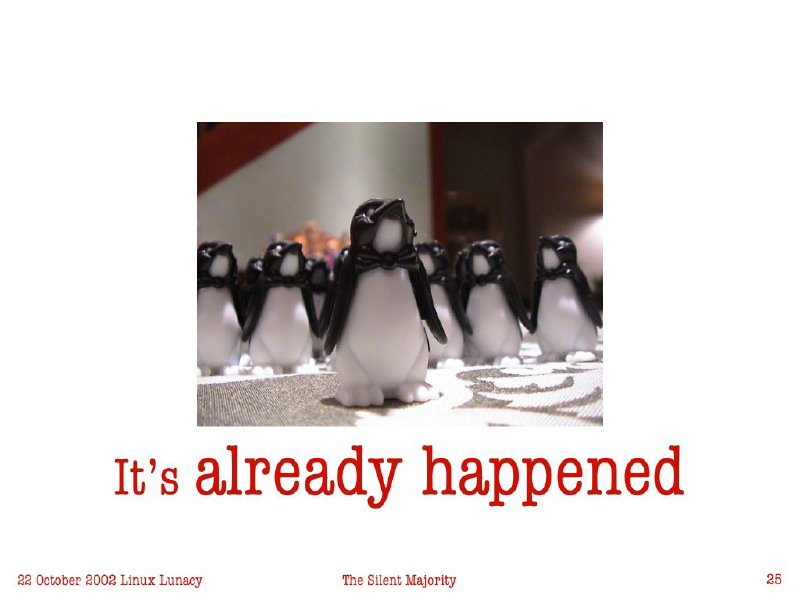
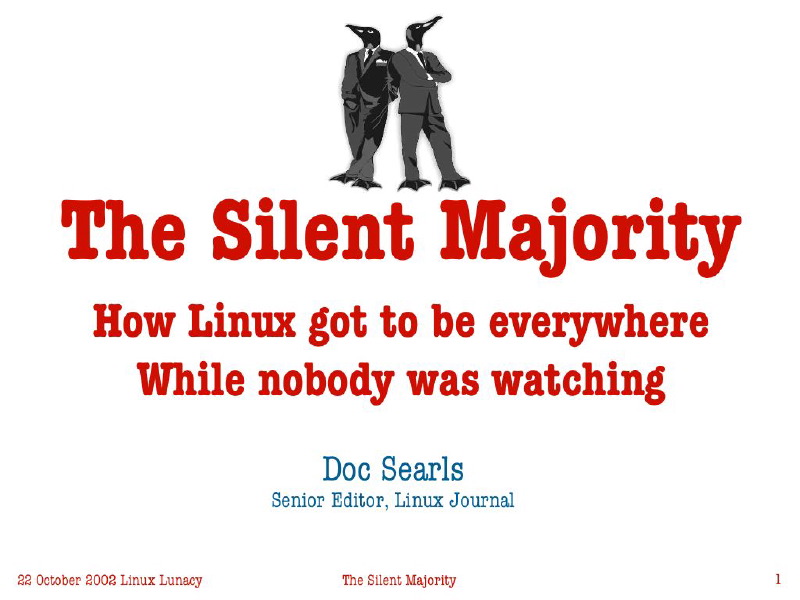
For those of you who missed Doc Searls keynote speech on this year's Linux Lunacy cruise, here's the slideshow.
The Silent Majority:How Linux Got to Be Everywhere While Nobody Was Watching

A Keynote on Linux Lunacy II, a Geek Cruise, 22 October 2002, somewhere off Cozumel, Mexico

By Doc SearlsSenior Editor, Linux Journal

1-25 | 26-50 | 51-75 | 76-100

...........................................................
Slide # 1

Slide # 2

Slide # 3

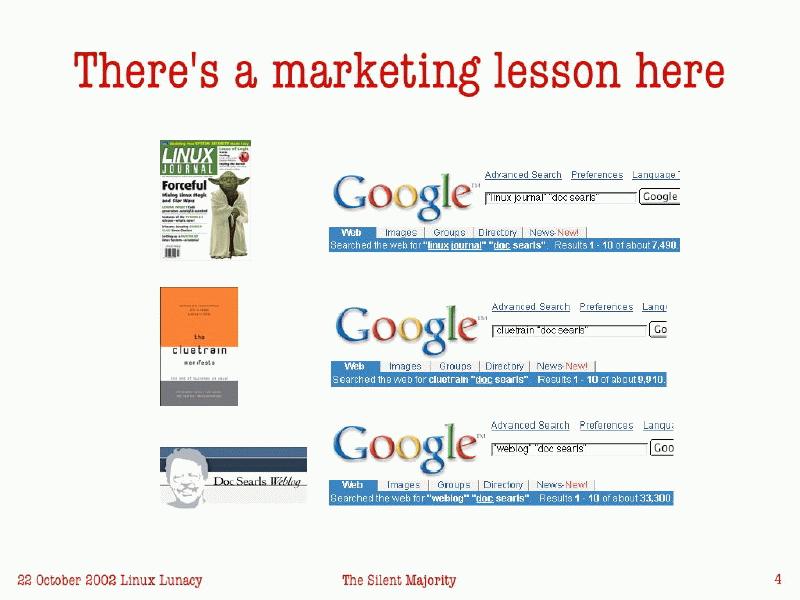
Slide # 4

Slide # 5

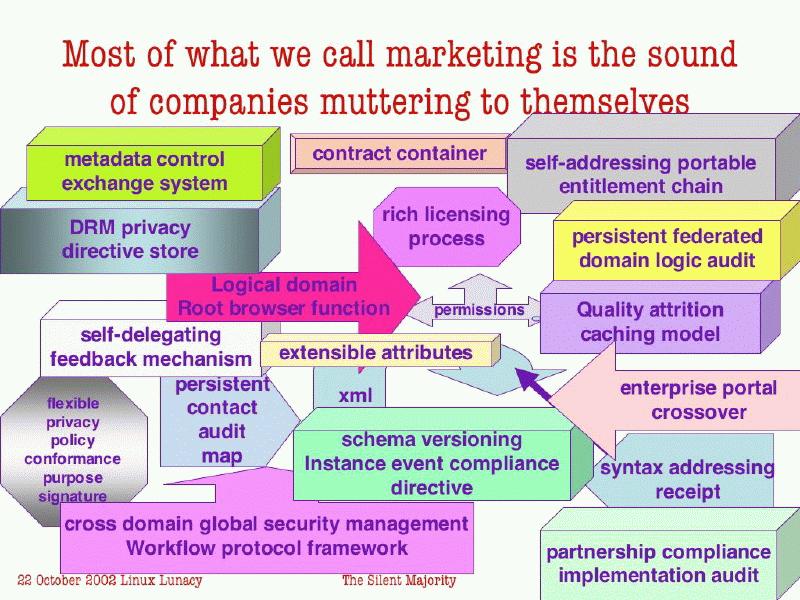
Slide # 6

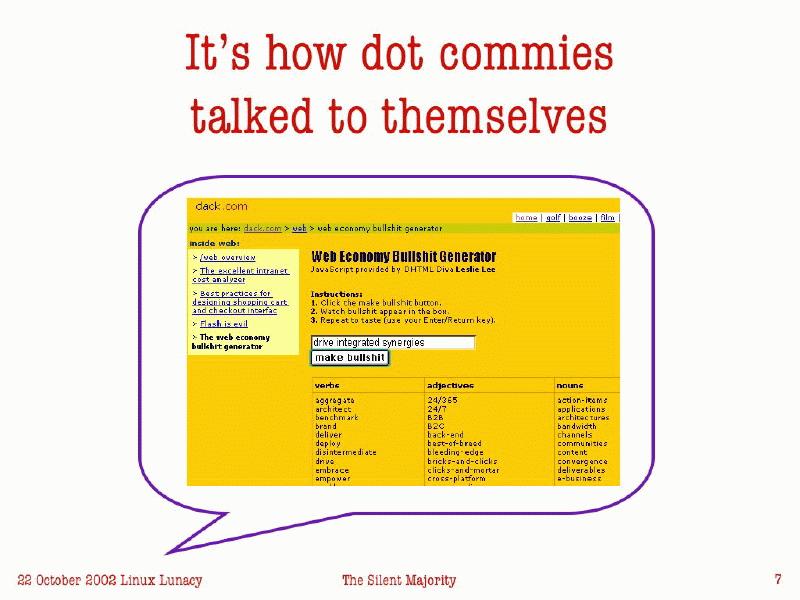
Slide # 7

Slide # 8

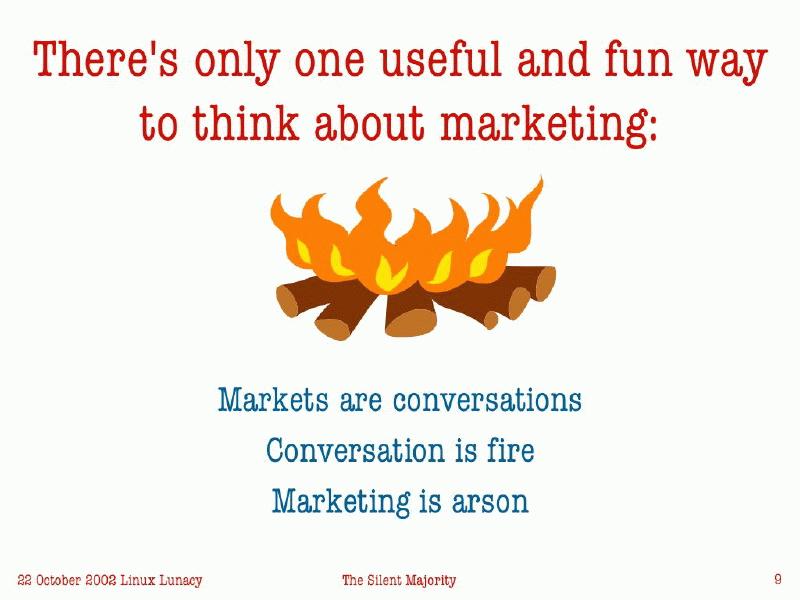
Slide # 9

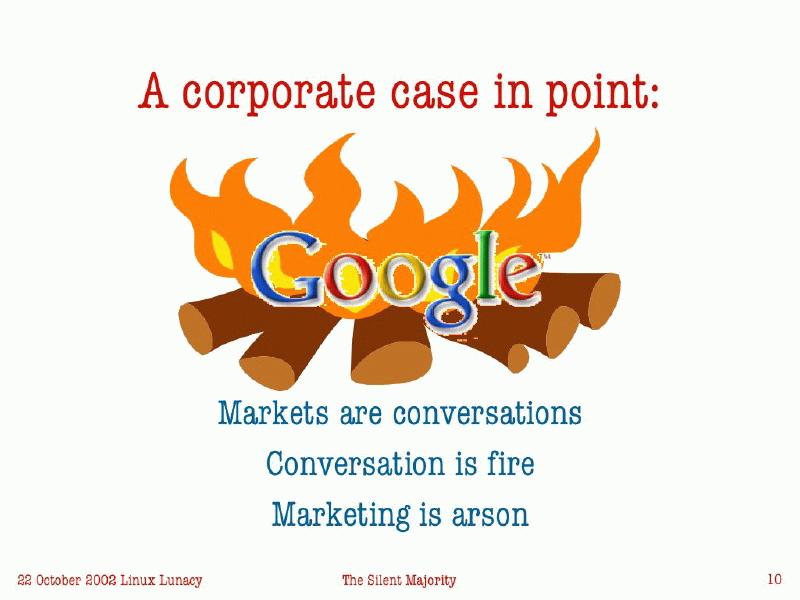
Slide # 10

Slide # 11

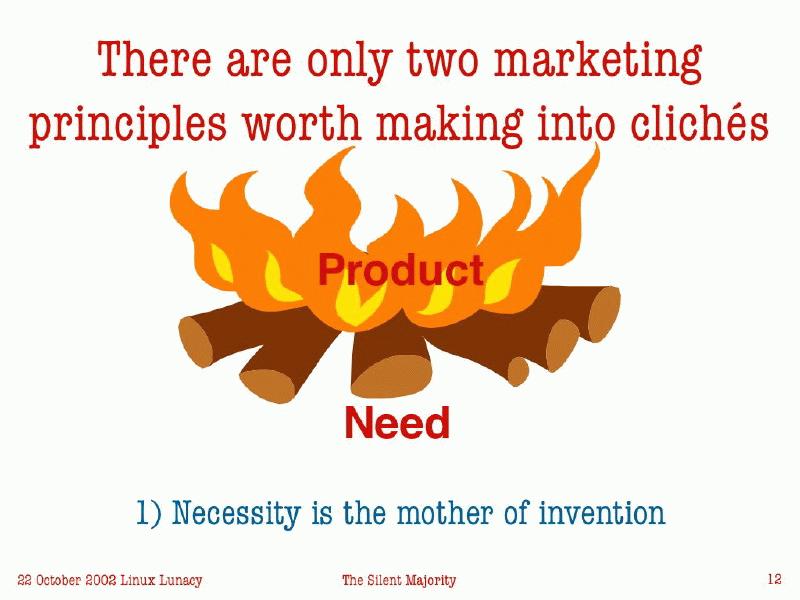
Slide # 12

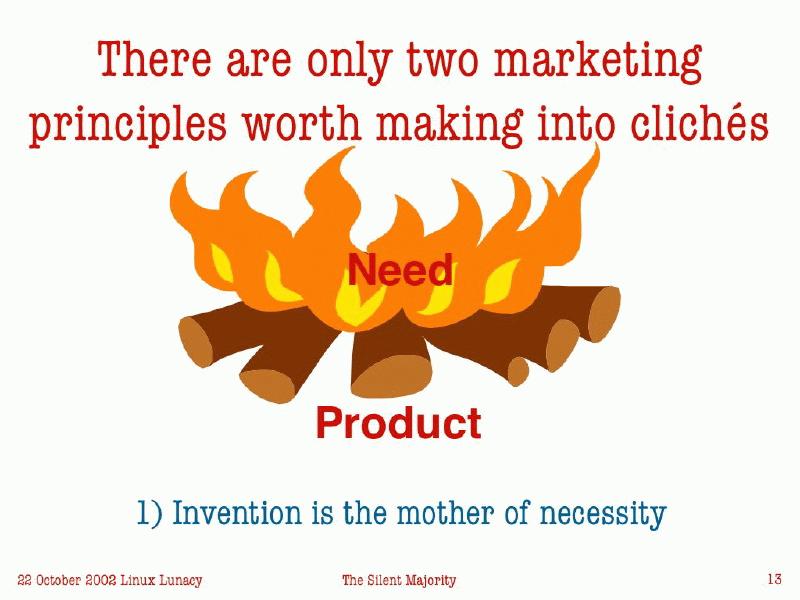
Slide # 13

Slide # 14

Slide # 15

Slide # 16

Slide # 17

Slide # 18

Slide # 19

Slide # 20

Slide # 21

Slide # 22

Slide # 23

Slide # 24

Slide # 25


...........................................................

The Silent Majority: How Linux Got to be Everywhere While Nobody was Watching

A Keynote on Linux Lunacy II, a Geek Cruise, 22 October 2002, somewhere off Cozumel, Mexico

Doc Searls (doc@ssc.com) is senior editor of Linux Journal.

______________________

Doc Searls is Senior Editor of Linux Journal

Comments

Comment viewing options

Select your preferred way to display the comments and click "Save settings" to activate your changes.

Re: Linux Lunacy II: Keynote Gallery

Terry's picture

Hey Doc, how about a link to a single file with all the slides? I'd appreciate that.

Peace,

Terry.

Re: Linux Lunacy II: Keynote Gallery

Anonymous's picture

In my opinion, Linux offers an opportunity to lift the technological highground in this country, something that we need to keep in perspective as we nurture Linux. Surely something that offers the widest possible participation by all without any barriers whatsoever can't be that bad for any industry. In the end the technological landscape will be shaped by the technologies that are the most OPEN and towards that end Linux cannot be beat!

White Paper
Fabric-Based Computing Enables Optimized Hyperscale Data Centers

Today’s modular x86 servers are compute-centric, designed as a least common denominator to support a wide range of IT workloads. Those generic, virtualized IT workloads have much different resource optimization requirements than hyperscale and cloud applications. They have resulted in a “one size fits all” enterprise IT architecture that is not optimized for a specific set of IT workloads, and especially not emerging hyperscale workloads, such as web applications, big data, and object storage. In this report, you will learn how shifting the focus from traditional compute-centric IT architectures to an innovative disaggregated fabric-based architecture can optimize and scale your data center.

Learn More

Sponsored by AMD

White Paper
Red Hat White Paper: Using an Open Source Framework to Catch the Bad Guy

Built-in forensics, incident response, and security with Red Hat Enterprise Linux 6

Every security policy provides guidance and requirements for ensuring adequate protection of information and data, as well as high-level technical and administrative security requirements for a system in a given environment. Traditionally, providing security for a system focuses on the confidentiality of the information on it. However, protecting the data integrity and system and data availability is just as important. For example, when processing United States intelligence information, there are three attributes that require protection: confidentiality, integrity, and availability.

Learn more about catching the bad guy in this free white paper.

Learn More

Sponsored by DLT Solutions