
Free Software in Brazil
Rio Grande do Sul (RS), one of 16 states in the country of Brazil, has been using free software (which they call software livre) for several years as a method of meeting their needs for production software in various areas. By using software livre, RS has been able to cut software costs. The money they do spend on software stays in the hands of Brazilian programmers, who buy Brazilian food, live in Brazilian houses and pay Brazilian taxes. None of the last three points is lost on the political leaders of RS, and these points are being learned not only by the other states in Brazil, but a lot of other countries in South America.
One successful project is called SAGU (sagu.codigoaberto.org.br), a unified open management system used to automate all of the relationships that exist between the academic, financial and administrative aspects of a grade school or university. Highly modular, everything from the entrance exam process to the financial accounting of overdue library book fees is handled by SAGU. As a flexible transaction-oriented database system, it allows for many other functions to be integrated. It can even be integrated with an external accounting and payroll system. Because a large part of teaching these days seems to be generating reports for local, state and federal governments, SAGU has its own reporting tool that generates PostScript documents on the fly. Originally conceived and implemented at Univates, a branch of the central university, it is now spreading throughout the Brazilian school and university system. And (of course) the whole project is software livre, so other school systems in other countries can benefit.
UERGS (Universidade Estadual do Rio Grande do Sul, www.uergs.rs.gov.br) is a project in which software is oriented toward distance learning. Designed for a distributed university with more than 22 campuses, the UERGS Project helps manage the processes involved with that type of learning.
Directo GNU (www.direto.org.br), a corporate mailing solution based on software livre, is also underway. By using this e-mailing solution on the state's 60,000 computers, the state of RS will save over $10 million US. Through the use of local knowledge and expertise in setting it up, they also will guarantee the technological control of the software by RS far into the future. This is an important consideration if you are thinking about buying mission-critical software from outside your country.
Speaking of technological control, I was contacted by a company studying biodiversity in the Brazilian rain forest. Unfortunately, the software the company (located in Rio de Janeiro) needed was produced only in the United States, was prohibitively expensive and was also available only in English. This last point meant that they had to teach English to everyone who needed to use the software, at least as much English as was needed to use the software, read the manuals and so on. By using software livre, they were able to reduce the cost of the software, have it respond in Portuguese, tailor it exactly to their needs and keep Brazilian programmers and scientists paid. Thus, software livre allows a company that otherwise could not exist in Brazil to thrive and do good work.
Likewise, a project called Rede Escolar Livre RS (www.redeescolarlivre.rs.gov.br) will be supplying educational software to more than 2,000 of Brazil's public schools. The savings in individual productivity tools and network operational systems is estimated to be over $24 million US.
In the past few years I have noticed how important geographical information systems (GIS) are to almost everyone in the world. Most of you are familiar with mapping programs like MapQuest, MapBlast and others, but the use of GIS software in planning government and commercial actions is crucial (for more on this, please see www.freegis.org). In recognition of the need for GIS software to be free, the project Geoprocessamento Livre (notice the word “Livre” showing up more and more in these projects?) is a free GIS project to provide inexpensive GIS software. This GIS software is being used in many strategic projects, including those dealing with health and education.
The largest bank in RS, if not in all of Brazil, is using Linux in their new ATM machines. Manufactured by PERTO S.A., the TPC-2100 has the outline of a distinctive penguin on the CRT screen before you start your transactions. Go Tux!

Distinctive Penguin on ATMs in Brazil
Probably the most humanly touching project is headed up by a person named Pascal and concerns the Landless Rural Workers Movement of Brazil (www.mstbrazil.org). Brazil was settled by a few very wealthy families who continue to control the vast majority of land in Brazil today. This land ownership tends to impoverish many in Brazil by withholding the right to grow their own food or to otherwise earn a living. A movement to help these landless workers has formed in Brazil, and they have sent a couple dozen people trained in proprietary software to a central location in RS to be retrained as Linux system administrators. One woman had traveled four days by bus to get to the training and would now have to travel back the same way. It was an intensive month-long course that made each student a part of the fellowship of software livre and the Landless Rural Workers Movement.
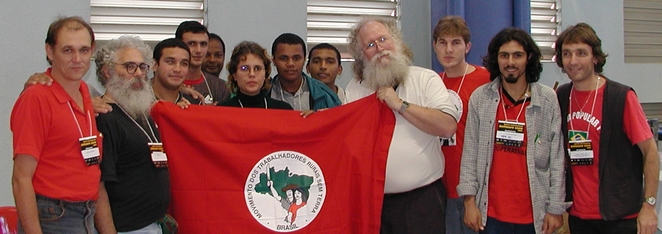
maddog with the Linux System Administrator Class for the Landless Rural Workers Movement
As I travel to various countries that I view to be emerging economies, I see governments realizing that software livre means more than cheap software. It also means software tailored to their non-English consumers. It means jobs for their local programmers. It means industries that can happen inside their own countries, due to the availability of software that allows these industries to flourish. It means control over their own destiny. It literally means software livre.
email: maddog@li.org
Jon “maddog” Hall is founder and executive director of Linux International.
