
Contest Update
Last August we started the idea of a contest where Embedded Linux Journal readers offer an idea, and we give them the hardware to build the system. That first contest was based on the MZ104 board. One hundred finalists were selected, and those people are currently developing their systems with the hardware we supplied.
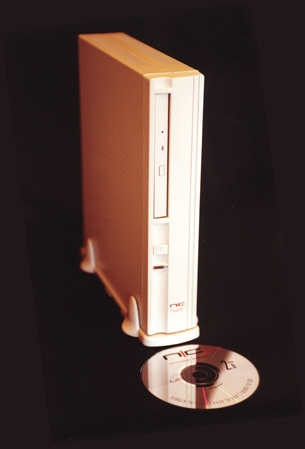
Enter our next contest. In the February 2001 issue of our sister publication, Linux Journal, we reviewed a $200 box called the New Internet Computer or NIC. With its software on a CD, the NIC is designed to be an inexpensive Linux-based box that can be used to get practically anyone on the Internet.

The NIC Configured as an Internet Appliance
After reading the review, I bought one to play with. Let me tell you, it's one cool little computer. Next, I showed it around the office, and geeks and non-geeks alike were pretty excited. Finally, one of our readers wrote in to say he had added a hard drive and turned his NIC into a web server.
Inside the NIC with the CD-ROM Drive Removed
This got me thinking that maybe the NIC would make a good base for an embedded project. After talking to the people at The New Internet Computer Company, we all agreed that the NIC was the right thing for an ELJ contest. So, here goes.
Much like our first contest, there will be two stages. You propose a project, then we pick what we consider the 20 best and send you the computers. After you develop them, we will look at your results and pick one grand prize winner and two runners up. The grand prize winner will receive an all-expense paid trip to Costa Rica. The runners up will each receive a Lego Mindstorms package consisting of the Lego Mindstorms Robotics Invention System, Mindstorms Vision Command, The Unofficial Guide to Lego Mindstorms Robots and the Lego Mindstorms Ultimate Accessory Set.
In addition, all 20 finalists will receive priceless fame, as we will publish articles about the various projects in ELJ.
Because the NIC is a complete commercial product, all entries will be judged on the basis of offering the best commercial use of the NIC in an embedded environment. For the purpose of this contest, what we mean by embedded is having some use other than general-purpose computing or internet appliance. A few possible applications I can think of are:
Information kiosk
Home security control system
Point of Sale terminal
Feel free to expand any of these ideas or, better yet, come up with your own plan. A good place to start is the list of included software from the NIC site (see Sidebar). The more detailed your proposal, the more likely it will be selected, so try to be specific.
email: phil@ssc.com


