
New Products
Lineo's software development kit for embedded developers and device manufacturers is now available.
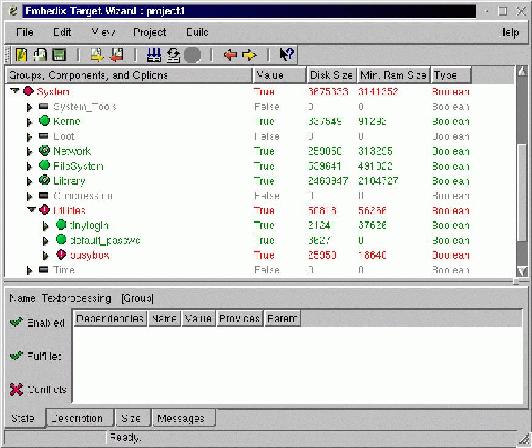
Figure 1. Embedix SDK 1.2 Target Wizard's Main Screen--keeps track of selected elements and respective hardware requirements.
At the Embedded Systems Conference in Maastricht, The Netherlands, Lineo announced the shipment of their Embedix<+H>tm<+H> SDK 1.2. This release adds several important features for developers to the kit, including processor support for the Power PC processor family.
This kit creates an integrated development environment and has real-time capabilities. Embedix SDK 1.2 includes Metrowerks CodeWarrior, combining an editor, compiler, linker and debugger into one integrated application. Another important feature, Target Wizard<+H>tm<+H>, is an automated way to select all of the requirements for a target image quickly and easily and check for software interdependencies. With this fine-tuning, developers can optimize to the smallest possible software image, which then requires less hardware and allows gains in economies of scale.
Embedix UI (a separate module) provides the option to develop a fully customizable and brandable HTML-based user interface. It is especially well suited for controlled-content embedded devices such as Kiosks, webpads and Smart appliances.
Manufacturer: Lineo
Model: Embedix SDK 1.2 (Japanese release: Embedix SDK 1.2-J)
Suggested retail price: $5,000/one developer seat license
Efficiently manage battery-powered devices.
SoftTools Technology has announced another development in their Smart Battery System line, SBS<+H>3<+H>: Smart Battery System Software. It provides a common manager support layer across platforms, is OEM configurable and supports different types of system configurations.
SBS solutions are designed to optimize the information available by gathering data from a complex series of low-level driver and bus information combined with ``smart'' software to allow users to utilize the system. This system will maximize battery life by setting different hardware components in the computer to ``sleep'' and managing the power consumption of the entire device, increasing the overall system operating time. SBS<+H>3<+H> provides support for, such features as battery recalibration and composite information reporting of simultaneous battery charging/discharging.
This solution is a part of SoftTools' focus on reducing the design and manufacturing cost of hardware components by moving functionality out of the hardware and into the software design.
Manufacturer: SoftTools
Model: SBS<+H>3<+H>

Figure 3.
Embedded Planet released Linux Planet 1.2, an application-development platform combining hardware, firmware and software, which supports embedded Linux.
Released in August, Linux Planet 1.2 offers a Linux-based development platform utilizing Motorola embedded PowerPC and featuring USB host and slave capability. They provide a large range of features and available specifications that can be utilized. Check out these features:
tightly integrated hardware and software
Hard Hat Linux from MontaVista
MPC823e PowerPC processor on RPX Lite
I/O daughter card (HI/OX)
Ethernet debug cable kits
CD-ROM with design, reference, and product development information
easy-access purple enclosure
universal (5v) power supply
extended temperature-range testing available on production modules
The physical specifications Linux Planet boast:
USB slave or host
serial cable, RJ45 to 9-pin make, null modem
up to 4 RS-232 serial ports
Ethernet crossover cable, RJ45-RJ45
analog video cable (BNC) connector
audio in/out
i2c
6.5" 640<\#53>480 LCD TFT color display (Sharp and NEC)
standard 4-wire SPI touch screen
Manufacturer: Embedded Planet
Model: Linux Planet 1.2
Suggested retail price: $4,495
email: elj-newproducts@ssc.com

