
upFRONT
“There is none. Get over it.” —Scott McNealy on privacy
“At this stage in my life, the thing that really turns me on is competence.”
—Billy Joel
“Science would be superfluous if the outward appearance and the essence of things directly coincided.”
—Karl Marx
“Certum est, quia impossibile. (It is certain, because it is impossible.)”
—Tertullianus
“What the hell is content? Nobody buys content. Real people pay money for music because it means something to them. Being a “content provider” is prostitution work that devalues our art and doesn't satisfy our spirits. Artistic expression has to be provocative. The problem with artists and the Internet: Once their art is reduced to content, they may never have the opportunity to retrieve their souls.''
—Courtney Love
“Today I want to talk about piracy and music. What is piracy? Piracy is the act of stealing an artist's work without any intention of paying for it. I'm not talking about Napster-type software. I'm talking about major label recording contracts.”
—Courtney Love
“Linux means never having to delete your love mail.”
—Don Marti
“Maturity is when you quit blaming other people for your problems.”
—Craig Burton
“Who is General Failure, and why is he reading my hard drive?”
—Bob (on Slashdot)
“I'm still freaked out by all this. I just wrote a (bleeping) anthropology paper.”
—Eric Raymond
“My hovercraft is full of eels.”
—Monty Python
These days, search engines are praised for their educated guesswork. Each pile of results is presented with an implication: “Here's what we think you want.”
But most serious researchers (i.e., Yours Truly and all Linux Journal readers) often don't want an engine to guess. These users want to search for specific strings—or, as some search engines put it, phrases. These include names, text passages, lines of code, diseases and all other series of words.
On December 3, 1999 and June 27, 2000, I tested fifteen of the most familiar search engines by searching for a relatively unique phrase: “He that by me spreads a wider breast than my own”, which is part of a familiar line from Walt Whitman's Song of Myself. The phrase occurs far from the beginning of the work and can be found in many documents on the Web, including one on my own site, http://www.searls.com/.
It's a tough test. Only those engines that deeply search an enormous range of sites will yield results. The word “breast” is also a common and controversial word, which might invite spurious results.
Testing for strings also isn't easy on the tester, since search engines have different ways of recognizing phrases. Most require quotes. Others (Hotbot, FAST) have pop-out menu commands. One (Yahoo!) requires clicking a radio button in “advanced” search mode. Others (mostly at the bottom in the surveys) don't search phrases at all.
I run this test quite often for my own purposes and rarely record the results. But last December I did record them, and I repeated the test again on June 27—nearly seven months later. This time I added two more tests: one for an obscure blood disorder and the other for a Linux system call. Here are the results:
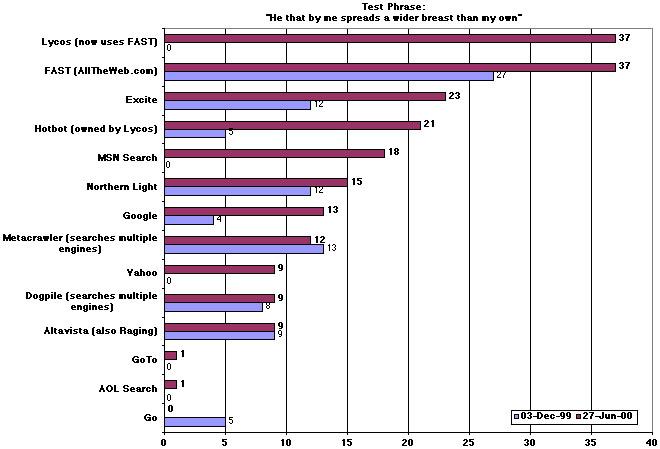
Figure 1. Test Phrase I
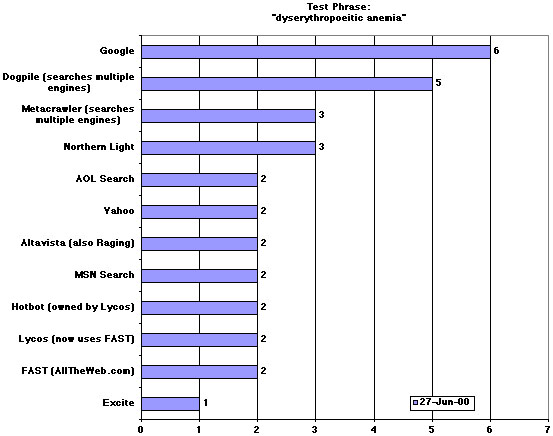
Figure 2. Test Phrase II

Figure 3. Test Phrase III
As you see, FAST won the first search, by a wide margin, just as it did in December. But Google (see Jason Schumaker's “Interview with Sergey Brin”, page ??) is the clear winner of the second and third searches—and didn't do too bad on the first, either.
Near as I could tell, none of the engines fell for the “breast” bait—at least not in phrase search mode. On that one, they all get a passing grade.
Some of the results, however, were amazing. Go.com found “29,024,074 matches” in the first search, but nothing I wanted. The first ten results all related to breastfeeding or breast cancer. No porn, of course. But I did get a banner ad featuring a happy-looking woman in a cleavage bra. “BREAST AUGMENTATION?” it asked. “Looking for breast augmentation from a doctor in your area? CLICK HERE.” Nice guess, guys.
As we can see, search is consolidating as a business category. By the time you read this, Yahoo! will be using Google (in a deal struck one day before this survey). Other partnerships and cross-investments are sure to follow (Lycos recently bought a 15% stake in FAST, for example). My guess is that there will be fewer search engines by the time you read this.
I just hope there aren't fewer good ones.
Doc Searls (doc@ssc.com) is Senior Editor of Linux Journal and co-author of The Cluetrain Manifesto.
If you think the U.S. Patent and Trademark Office is issuing too many bad software patents now, wait until October. USPTO Director Q. Todd Dickinson warns of an imminent “reduction in patent quality” when he has to reduce his staff by 1,000 people, including more than 500 patent examiners, out of a total of about 5,000, and cut back or reduce examiners' access to on-line databases. USPTO now has about 3,200 patent examiners.
In a letter to Howard Coble (R-NC) and Howard Berman (D-CA), Chairman and senior Democrat of the House Subcommittee on Courts and Intellectual Property respectively, Dickinson also warns that many patents may be delayed or not issued at all because of the tight budget for fiscal 2001, which begins in October of this year. The letter is online at www.uspto.gov/c_b_directorresponse.pdf
News for job hunters: the USPTO is hiring patent examiners. As a software patent examiner, you will be responsible for researching and understanding the history of inventions, patented or non-patented, in your field and making the decision to grant or refuse patents. According to the USPTO web site, salaries for patent examiners in Engineering and Computer Science range from $27,778 to $53,544. There's a 10% recruitment bonus for computer science and electrical engineering specialists.
Percentage of people who find packaging annoying: 14
Position of shrink-wrap among most annoying packaging types: #1
Position of CDs among most annoying shrink-wrapped packages: #1
Percentage most annoyed by CDs, among people who find shrink-wrapped products most annoying: 39
Position claimed by Lycos among the world's search engines, after partnering with FAST: #1
Number of Web pages surveyed by FAST, according to Lycos, on June 14, 2000: 340,000,000
Number of Web pages Lycos plans to survey with FAST in he coming year: >1,000,000,000
Number of Web pages in Google's survey index on June 27, 2000: 1,060,000,000
Number of web pages with the word “Doubleclick,” according to FAST: 109,973
Number of web pages with the word “Doubleclick,” according to Google: 1,129,996
Total compensation of Silicon Valley CEOs in 1999: $2.3 billion
Percent increase in 1999 Silicon Valley CEO compensation over the prior year: 89
1999 compensation position of John T. Chambers, CEO of Cisco Systems, among Silicon Valley CEOs: #1
Chambers' 1999 compensation: $121,701,629
Chambers' compensation as a multiple of the combined salary of every certified teacher in the San Jose Unified School district: >2, with $36.6 million left
Number of women in the top ten in compensation: 1
Number of Cisco executives in the top ten: 2
Number of Yahoo! executives in the top ten: 4
Total compensation of all four Yahoo! executives: $325,463,827
Total compensation of Daimler-Benz top ten executives in 1997: $11 million
World position of United States in CEO-to-worker pay ratio: #1
U.S. CEO-to-factory-worker pay ratio in 1999: 34-to-1
Number of women per 175 men among Silicon Valley CEOs: 4
Number of women among the 100 highest-paid Silicon Valley executives: 9
Opening auction price offered by Tracy Cole for her answers to marketing questions: $20
Number of marketing questions Tracy Cole answers for upwards of $20: 378
1-4: Cheskin Research packaging study
5-11: searches and press releases on Lycos, FAST and Google sites
11-24: San Jose Mercury News
25-26 The Standard

The Kerbango Radio, one of the first true Internet appliances, looks like a cross between an old Wurlitzer jukebox and the dashboard of a '54 Buick. It also looks like it'll belong to 3Com soon. On June 27, 2000, 3Com announced that it was buying Kerbango for $80 million in stock. Not bad for a company that was only announced last Fall, employed only 28 people, and still hadn't produced its first and only product. (Though the Kerbango radio is expected to roll out shortly.)
Right now, Kerbango has three unique properties, the radio, its tuning system and its web site, which gives computer users direct access to thousands of stream sources—the “stations” the Kerbango radio will tune when it sits on your kitchen counter, plugged into the household network, listening to streams (those modern “signals”) over your DSL or cable line (or even dial-up, if you're willing to put up with modem-grade lo-fi).
The most significant fact about Kerbango, for our purposes, is the operating system at the heart of the blue box. That would be Linux. We're talking about the same embedded Linux that's the subject of our cover feature this month.
3Com has reason to be eager in this market. IDC expects the Information Appliance business to grow from $2.4 billion to $17.8 billion between 1999 and 2004. This would represent an increase from 11 to 89 million units. Surely a significant part of that 1999 figure is 3Com's own Palm Computing business.
Kerbango was also moving along at a nice clip when the 3Com deal was announced. In a separate agreement, THOMSON multimedia signed a Letter of Intent with Kerbango to brand and distribute an RCA brand Internet Radio that utilizes the Kerbango Internet Radio Tuning Service. 3Com also said it intends to follow a similar licensing strategy with its partners. Presumably that would include Palm.
When this news came in, we got in touch with Jim Gamble, Kerbango's President, and subjected him to a series of snarky questions. Here's how the dialog went.
Doc: Will the name stay?
Jim: Yes.
Doc: Can 3Com actually brand anything?
Jim: Seems like Palm did okay! They grew that from start up to multinational success. I've got no problem re-running that scenario for our radio...
Doc: Will Kerbango remain independent?
Jim: We will be a separate group inside 3Com. They want us to push the radio and our tuning service. In fact, their main input early on has been, “how can we help you do more faster?”
Doc: What will 3Com's “internet audio division” do, and where will Kerbango fit in that? Will the brand include more than the radio?
Jim: The radio and the tuning service is the start. More products will come later too.
Doc: Got any market size projections?
Jim: Most of the projections are for generic “Internet appliances” which conceivably covers a lot of ground. I look at the Arbitron data on Internet radio usage and see that 11 million listeners a month in the U.S. alone is a good market to go after. Too early to say how our numbers will go.
Doc: Will the U.S. finally regain market leadership at the Networked edge of what we've been calling “consumer electronics?”
Jim: I think so. But it will have an international flavor since companies like THOMSON/RCA (who announced they will be shipping a Kerbango powered Internet radio) are thoroughly multinational.
Doc: What we're sensing here at Linux Journal is that there is finally a chance that previously non-communicating devices in the home will become Net native and start relating at least with their owners, if not with each other—and that XML-based Instant Messaging will lead the way. Kerbango as a stand alone company didn't play a very big potential role in this scenario; but perhaps Kerbango as the household appliance brand of 3Com could play a huge role.
Jim: Hope so! We view it more as “building a better radio” rather than “building an Internet appliance”. Maybe just semantics, but it makes sense to us.
Doc: We realize this is blue-sky stuff at this point, but being part of 3Com does open the sky a bit. Or maybe the opposite. 3Com has a fine football stadium, but their mass market presence beyond that hasn't exactly been obvious. Some companies are born to brand and promote and make people want their cool stuff. Is 3Com ready to be the next Sony?
Jim: As we like to say at Kerbango, Stay Tuned!
What were people talking about in June and early July? Below is a sampling of some of the hotter news stories over the past few weeks, as reported in “The Rookery”, Linux Journal's on-line source for news, notes, quotes and reports from the field (updated daily and found at our web site, http://www.linuxjournal.com/):
Marc Ewing and Frank Batten Jr. selling off large numbers of RHAT stock.
Oracle paying private investigators to spy on Microsoft.
An oil spill off the coast of South Africa has endangering a population of approximately 14,000 Jackass penguins.
Red Hat's deal with Dell.
Intel jumping on the Internet Appliance bandwagon.
The release of the CVS repository for the XFree86 development source tree—made available through SourceForge.
SRO jumping on the Linux bandwagon.
Poor Corel, part 2!
Bob Geldof's site running Linux.
The release of StarOffice 5.2

