UpFRONT
Speed achieved by the 350-node Cplant98 cluster running Linux at Sandia National Laboratory: 125.2GFLOPS
Where 125.2GFLOPS places the Sandia system in the current TOP 500 list of supercomputers: 53
Position of microsoft.com among the top sources of visitors to the new linux.com: 1
Number of microsoft.com visitors in the first two weeks of linux.com's operation: 15,000
Total age of Phat Linux's two founders: 30
Number of Net-connected computers whose spare CPU cycles are devoted to searching for extraterrestrial intelligence by SETI: 625,253
Total CPU time of all those computers: 99,799,890 hr 45 min 38.8 sec (11,392.68 years)
Number of “results” returned by all that terrestrial intelligence: 2,258,824
Percentage of those results produced by Linux platforms: 12
Position of Linux among all platforms in results performance: 2
Professional attendees at Linux Expo Paris 99: 5000
Number of exhibitors and vendors at Linux Expo Paris 99: 87
Phat Linux, www.phatlinux.com/about.html
VA Linux Systems, http://www.valinuxsystems.com/
TOP 500, http://www.top500.org/
Linux Today, www.linuxtoday.com/stories/6797.html?nn
SETI site, June 15, 1999, http://setiathome.ssl.berkeley.edu/
Linux Expo Paris press release, June 23, 1999
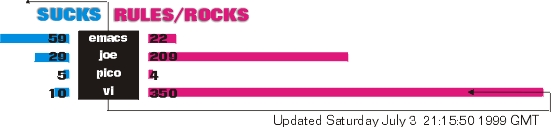
vi rocks. It also rules. So says Vassilii's Editors Sucks-Rules-O-Meter, which mines the verbs on Altavista and pronounces vi the winner over Emacs and all the other editors as a subject of those two superlatives. As of July 3, vi had a 350/10 rules/sucks ratio. And it looks like Linus isn't the only one out there who hates Emacs—a sentiment he shared with us on a recent panel that also featured Emacs creator Richard Stallman. Emacs' rules/sucks ratio is 22/59. This meter can be found at http://www.tarunz.org/~vassilii/srom/and is updated weekly. Thanks to Vassilii Khachaturov.
BARREL SCRAPINGS
Want a new domain name? Good luck. We are at the bottom of the .com barrel, and the .net and .org barrels must be getting fairly low too. While the urban legend says every word in the dictionary has been sold for .com use, “misstep” is still there. So is “dodder”. A lot of two-word combos (such as hunkerdown) are gone as well, but a few (such as stupiddog) are still there. But your chances of getting the domain you want are being reduced every second by the sharks who buy domains from Network Solutions for $70 and then sell them for far higher prices (up to millions of US$) to the unfortunates who came too late to buy direct.
Thus, your only two strategic naming choices are anonymous or strange—or both. Why not create a front company with a camouflage name like “Symnetix.com”, while your actual business will be an enterprise NT replacement service called “Bizfloss.com”? If you do that, remember who your friends are when you file for that IPO (initial public offering).
To save you a bit of work, I went through the familiar whois routine to scope out the possibilities. They are mighty slim. Let's say you are in the bug zapper business and want “bzzt.com”. Well, Allan Henning of Stockton, California has already grabbed that one. How about dropping a z? Nope; “bzt.com” belongs to Hovinga Holding in the Netherlands. How about adding a z? Wrong again; “bzzzt.com” has gone to the Mikluhomaklai Sensation Corp. in Omsk, Siberia. Okay, how about one more z? Voilà! You can have it. Now prepare to spend the rest of your business life saying, “that's bzzzzt.com with four Z's.”
awfulstrange.com
glassgargle.com
spizanch.com
girlfriendfromhell.com
loadolinux.com
thirdwife.com
rsh2god.com
yerassismine.com
pantywad.com
tuxdisk.com
niddle.com
stoptalking.org
stopmakingsense.com
thunderingnerd.com
2manyservers.com
nowgoaway.com
stilldead.org
avatato.com
pocato.com
thbzzz.com
birdgrinder.com
crosslips.com
isobaptist.com
umess.edu
bozoretentive.com
fubar.mil
overdive.com
deathpatty.com
halfcat.com
twitchingannoyances.com
zonecontact.org
flatoutbad.com
placentamix.com
hatefuljavapages.com
java2die4.com
aaaarg.com
obytheway.com
freedeath.com
buildingcozy.com
condomcrobar.com
—Doc Searls
According to International Data Corporation (IDC), there are more than 10 million Linux users worldwide. In 1998, the Linux market grew by 212 percent, and nearly 18 percent of all server hardware licenses sold last year were Linux, according to IDC. Another consulting firm, NetCraft, estimates that Linux or other Open Source software currently runs on more than half of all web servers worldwide.
Some interesting companies/organizations using Linux include:
Boeing
Mercedes-Benz AG
Yellow Cab Service Corporation
Canadian National Railways
United States Postal Service
National Disaster Communication Response Team
World Council of Churches
Sony Electronics
Source: Mercury Information Technology, Inc., http://www.m-tech.ab.ca/linux-biz/
STRICTLY ON-LINE
Adventure by Joseph Pranevich is a nostalgic look at the old “Colossal Cave” game and its various iterations—a fun game and a fun article. Mr. Pranevich tells us a bit of his and the game's history and how to play it.
Remotely Monitoring a Satellite Instrument by Guy Beaver is the story of a small aerospace company involved in a NASA-funded satellite mission to study the atmosphere. A major portion of this experiment involves calibrating and testing the instrument. While done on the ground, the calibrations are monitored remotely using a Linux-based system. Most of the software used was originally Windows-based, but has now been ported to Linux to take advantage of the many open-source products available.
First UNIX/Linux National Competition Held in Ljubljana, Slovenia by Primoz Peterlin and Ales Kosir introduces this competition and the winners. They also present both the problems and the answers that made up the test.
Linux Apprentice: Filters by Paul Dunne gives instructions for simple data manipulation commands in Linux. Covered commands include grep, egrep, tr, sort, head and tail. Mr. Dunne also takes a look at programmable filters such as sed and awk along with their use with pipes.
A book review of The Unified Modeling Language User Guide by Geoff Glasson. If you are a programmer involved in producing object-oriented software systems, you will want to know how this book can help you.
LinuxWorld Conference & Expo, http://www.linuxworldexpo.com/, August 9-12 in San Jose, CA.
O'Reilly Open Source Convention, http://conferences.oreilly.com/, August 21-24 in Monterey, CA.
8th USENIX Security Symposium, www.usenix.org/events/sec99, August 23-26 in Washington, D.C.
3rd annual Atlanta Linux Showcase, http://www.linuxshowcase.org/, to be held October 12-16 in Atlanta, GA.
Although certain people may believe applications, applications and applications are the key to world domination, some of us know the true key—the reason we became interested in computers—is games. While much of our karmic lineage may come from the punch-card generation of computer hackers, for whom so many games may not have been available, many of us grew up in the days of early home machines such as the Spectrum, Commodore, Atari and Amiga. Some younger hackers may even hail from the days of 3-D. (Imagine having grown up with that technology.) Despite slow processors, limited colors, small memories and other obstacles of primitive technology, the years saw numerous ingenious masterpieces, elegant studies in working within limitations, classic games to which we returned time and again, sometimes poking (on BASIC machines) or manipulating with hex editors and disassemblers, but mostly just playing.
Now Linux is developing its own classic games, in a time when limitations on processor speed, color graphics, sound, multitasking, memory, disk space, and networking hardly even seem to exist. Like the classics of old, Linux games have a character all their own; since the games are often developed by a single person or a small group of people, they tend to have a personal, hand-made quality which is missing from their slick, commercial counterparts on other platforms.
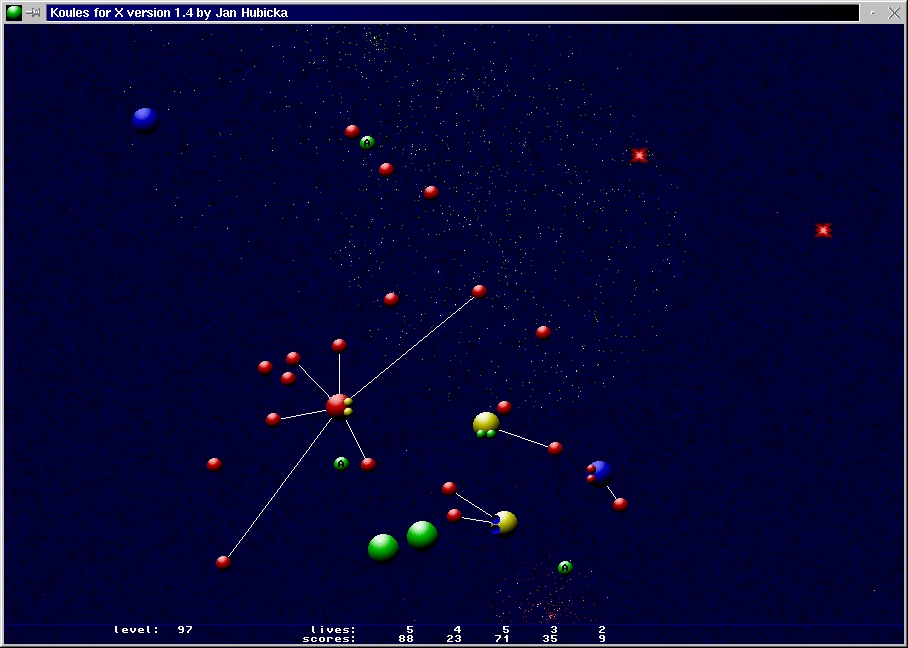
Rather than technological limitations, the main constraint today seems to be development time. Although open-source cooperation solves a large part of this problem, another part of the Linux answer is playability, the mysterious quality possessed by games of old which captured our attentions and imaginations despite 1MHz processors and graphics that weren't even vector-shaded 3-D. One legitimate Linux classic which exemplifies this essence of playability, and is an excellent game for inaugurating this new gaming section, is Jan Hubicka's Koules, found at www.paru.cas.cz/~hubicka/koules/English/koules.html.
The Dark Applepolisher, you see, is up to no good—he has sent his spherical forces to conquer Earth and claim its resources. In order to defend us from these evil Koules, you will have to bump them out of each of the 100 sectors (and finally confront the Dark Applepolisher). Fortunately, you have been transformed into a yellow beach ball. Well, according to Hubicka, mutated into a chest with eyes to make your job easier, of course.
Although the task may seem simple at first, there will come many varieties of Koules, each with different weights and sizes and mysterious abilities. Black holes and stars and other natural dangers appear as well, and the Koules keep coming! Once the first few sectors are cleared, special Koule ablities and secret weapons begin to appear and the game becomes more exciting and visually interesting. Fortunately, you too can gain special abilities from Koule deserters who give you more weight, more speed and even extra lives. A well-stocked beach ball can weigh enough to wipe out even enormous Koules in a single blow.
Koules is simply an excellent idea which, when developed, becomes fantastically playable. Koules supports up to five players, at a single terminal or over a network, and is more fun with multiple players. Keyboard, mouse and joystick are supported, as well as SVGA and X. Sound support is excellent and exists on multiple platforms, and there are multiple difficulty levels.
Even though Koules was developed by a single person and is completely free, it has the finished quality of a professional game along with the personality of a small project. I recommend getting some friends together on a rainy Saturday, defending Earth from and finally defeating the Dark Applepolisher, and going out for pizza to celebrate the victory. When you get home, you can start again!
Also, check out the Linux Game Tome at http://happypenguin.org/.
—Jason Kroll
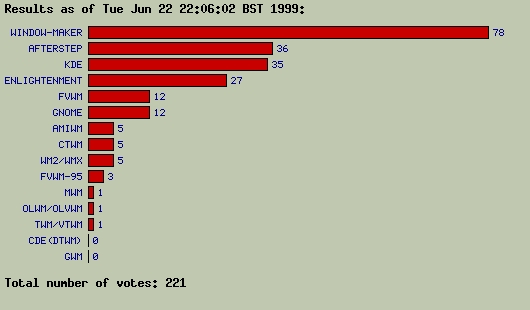
Matt Chapman's web pages at http://www.plig.org/xwinman/are devoted to Window Managers and offer the browser a chance to vote for his favorite. Here are the results as of June 22.
ET PHONE TUX
What kind of computers are doing the most listening for extraterrestrial intelligence when they're not busy grinding cycles on earthbound work? The first answer is obvious. The second isn't (unless you're one of us, of course). The following graph shows the stats from http://setiathome.ssl.berkeley.edu/as of the most recent summer solstice.

Thinkful Wishing
No-partition Windows-based Linux Installs: Seems like everybody's trying to take the fun out of installing Linux. They want to make it easy. They want to give away the ending and spare us the story. They want to make the hacker's OS as hack-free as possible.
Well, maybe they have a point. And if they do, why not go one better? Why not make Linux installable on any Windows box as it stands? Click on your download file and install the sucker right there, from Windows, without partitioning the hard drive.
Sound crazy? Not to Cameron Cooper and Keith Broere, the founders of Phat Linux. These guys have figured out a way to load a full Linux distribution from inside Windows. When it's over, you've got a two-OS box.
The punchline? This isn't new to either of these guys. They've been on the case since they were both 14 years old—last year. Next fall they'll be sophomores in high school. But not the same high school. In fact, not even the same country. Cameron lives in Winnipeg, Manitoba and Keith lives in Sandusky, Ohio (“near the amusement park”). Two guys, two countries, one cool new distribution. Check it out at http://www.phatlinux.com/.
Internet Floppies Revisited: No sooner thought than done. Right on the heels of last month's Internet Floppy idea, the guys at FreeDiskSpace.com have mounted a set of sites that works for all the major platforms, including Linux.
Want extra disk storage—a place to store up to 25MB of files you can pull down from any browser anywhere? Check out http://www.FreeLinuxSpace.com/. Signup is a breeze.
The next step is to make this a value-add for ISPs and anybody else with the space and a way to make money with it. But wait a minute. They do that, too, with an affiliates program, banners and sponsors for the folders in your FreeLinuxSpace directory.
Now, how long will we have to wait for file I/O over the Net? Another whole month?
—Bruce Fryer
It was kind of amusing, really, fielding brickbats from testosterone-pumped twenty-somethings for whom money and Microsoft's survival are so central that they have trouble grokking that anyone can truly think outside that box. On some subjects their brains just shut down—the style reminded me a lot of the anonymous cowards on Slashdot.
—Eric Raymond to Norm Jacobowitz, June 22, discussing Eric's Microsoft speech (Complete interview can be found at linuxresources.com/articles/linux_review/19990623.html.)
At PC Forum in 1997, Jim Barksdale, then the President and CEO of Netscape, said he got the idea for opening his company's browser source code from “this guy Raymond”, and identified the originator of Linux as “Linus Pauling”. He wasn't too far off, because Linus Torvalds' parents actually named their boy after the famous American Nobel prize winner and vitamin C wacko.
And there began the tale of two pronunciations that have done nothing but permute. There is not only no consensus on how to pronounce Linux, but this condition appears to derive from an equal uncertainty about how to pronounce Linus. The Web is full of sound files in which Linus says, “Hi, my name is Leenoos Torvahlds and I pronounce Leenooks as Leenooks.” More or less. That's Jim Choi's phoneticization of the recording.
But let's face it: that's not complicated enough. Since there is only a one-letter difference between Linus and Linux, we thought we'd see how well the two mapped across the Web by searching for the coincidence of Linus and Linux with various phonetic spellings of the same. As you can see, the results are equally absorbing and inconclusive, providing plenty of grist for the disagreement mill.
Oh, by the way, Lin-ux appears to be the winner, with 72 pages showing this pronunciation.
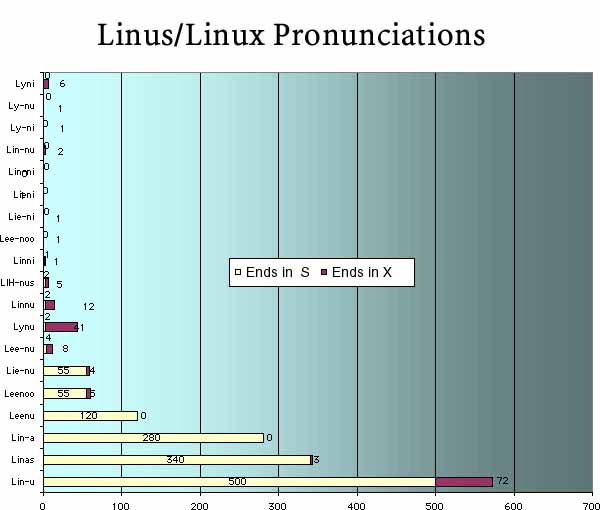
Linus/Linux Pronunciations
The Linux Professional Institute LPI ( http://www.lpi.org/), an industry-wide group developing a professional certification program for Linux, is pleased to announce the creation of its corporate sponsorship program and a number of early sponsors. Several new members have been added to its Advisory Council, including IBM, ExecuTrain and CompUSA. Two sponsorship plans, one for corporations and one for individuals, have been introduced to allow anyone to assist the LPI in its goal of creating a high-quality, vendor-neutral program. The LPI aims to deliver its first certification exams in July 1999.
Ecrix Corporation( http://www.vxatape.com/) announced a key partnership with Penguin Computing Inc.( http://www.penguincomputing.com/), a company focused exclusively on turn-key Linux solutions. Penguin will offer Ecrix's VXA-1 tape drive on all of its Linux servers, providing a new data backup and restore option for its customers. The VXA-1 features a SCSI-2 interface and storage capacity of 66GB and transfers data at 6MB/second. VXA tape cartridges are available in two capacities: the V17 stores 66GB and the V6 stores 24GB.
Cygnus Solutions announced the availability of Sourceware CD, a subscription program for the open-source software projects hosted by Cygnus, at http://sourceware.cygnus.com/. The Sourceware CD provides convenient access to the latest open-source technologies, such as eCos (Embedded Cygnus Operating System), the EGCS compiler, GDB debugger and Cygwin.
Pacific HiTech( http://www.turbolinux.com/) announced it has officially changed its name to TurboLinux, Inc. This change in corporate identity marks the next milestone in the company's ramp-up of its North American operations after announcements in May of partnerships with IBM and Computer Associates. TurboLinux is a global player in the Linux industry with offices in the U.S., Japan, China and Australia. Its product is currently the fastest-growing operating system platform in Japan. When TurboLinux 3.0 was introduced in Asia in December, it outsold Windows NT (2000) at Japanese retail point-of-sale outlets, according to the technology analyst firm Computer News.
Venture capital firm Kleiner Perkins Caufield and Byers has invested in Linuxcare( http://www.linuxcare.com/), a San Francisco-based provider of technical support for Linux. Kleiner Perkins' general partner Ted Schlein is now a member of Linuxcare's board of directors. As part of the investment deal, Fernand Sarrat, former chief executive of Cylink, is Linuxcare's new Chief Executive. Arthur Tyde, Linuxcare's founder, will become Executive Vice President.
SuSE Linux 6.1 is now available at Best Buy, Borders, CompUSA, Fry's, Hastings, Micro Center and Waldenbooks—over 1700 locations nationwide. SuSE Linux can be found in the Operating Systems section of software retailers and in the Computer Books and Software sections of bookstores. SuSE Linux 6.1 features the 2.2.5 kernel and a comprehensive set of applications for home, office, technical and business users.
SuSE GmbH( http://www.suse.com/), the parent company of SuSE Inc., began offering a Business Partner Program targeted specifically at Linux system integrators and consultants. This program is in addition to the recently announced VAR and ISV Partner Programs launched at Spring Comdex '99 by SuSE Inc. The Business Partner Program includes priority support, training, a moderated private on-line forum, and access to a knowledge base, among other features. Qualified Partners are those who seek to offer Linux services and want to benefit from association with the SuSE brand.
O'Reilly & Associates, Digital Education Systems(DigitalEd) and barnesandnoble.com have signed an agreement for barnesandnoble.com to resell O'Reilly/DigitalEd web-based courses. As part of the agreement, barnesandnoble.com will be the exclusive on-line bookstore reselling the courses. The O'Reilly/DigitalEd courses, based on O'Reilly's best-selling technical books, provide a self-paced on-line learning experience that takes full advantage of the Web's interactivity. barnesandnoble.com will offer 12 courses in O'Reilly's web technology series, plus Introduction to the Palm Pilot.
Tripwire Security Systems( http://www.visualcomputing.com/) opened new offices in Washington DC, Chicago and San Francisco to support rapidly growing sales efforts across the U.S., as well as customers in those regions. Tripwire also announced a distributor agreement with Matsushita Inter-Techno Co. in Japan to create broader market awareness for TSS' Tripwire File Integrity Assessment software. The software can identify corrupted systems and files throughout the network, so the servers or workstations can be taken off-line and repaired quickly, minimizing down time and system administration time.
OpenSource Forum, a two-day conference on Linux and other emerging open-source software for IT executives, was held on June 30 and July 1 in Austin, Texas. This event, which I attended, was capably presented by Ziff-Davis.
This was a completely different experience for me than attending shows such as LinuxWorld or Linux Expo. The attendees were dressed casually, but were definitely business and professional people—not the hardcore Linux faithful. These people were there to find alternatives to Windows and determine whether open source was a good fit for their companies. Their minds were open, but not made up.
Keynote speeches by Eric Raymond, Ransom Love and Jon “maddog” Hall were enlightening and gave a good positive start to the proceedings. Eric discussed open-source business models and how to decide if and when to go open or stay closed. Ransom talked about the shift from mainframes to PCs (right-shifting) and the current shift to Internet devices (left-shifting), noting Linux is the perfect Internet device because of its capability to be pared down to a very small footprint, its stability, easy customization, high performance and low cost to implement and maintain. Jon discussed the various ways to make money with Linux and advised companies to “put an ad in Linux Journal”.
Other talks presented a different side. In particular, Jonathan Eunice, President of Illuminata, proclaimed that for large enterprise applications, Linux was definitely not “enterprise-ready” and “free, open-source software is not a panacea”. He pointed out that the market demands a standard for something it can depend on, that UNIX failed because of fracturing due to not being able to agree on open standards, and that when time is of the essence and skills are limited, paying for a commercial product is the way to go.
Z-D's theme for the show was “Build Your Business with Open Source” and the auditorium was decorated as a construction site. Flashing yellow lights onstage proved to be a bit distracting. Attendance seemed low compared to the Expos and could be numbered in the hundreds rather than the thousands, although I did not get any final count. Still, it was a good conference—one that provided a much-needed platform for Linux and Open Source to strut their stuff for the business world.
—Marjorie Richardson

It's that time of year again—time to vote for your favorite products in our Readers' Choice Awards. Voting will be held from September 1 through October 15 on the Linux Journal web site, www.linuxjournal.com/. Help your favorite products receive the fame and adulation they deserve—visit the site and fill out the entry form. In the immortal words of James Hoffa, “Vote early and vote often.” Winners will be announced in our January 2000 issue.
Rumor Mill: Though neither camp would substantiate the rumor, word has it Adobe Systems, Inc. has shown interest in purchasing Corel Corporation. We're sure Adobe would love to hear your opinions on this one.
Factoid: How do penguins sleep? Some species return to their burrows on land for a few hours of rest, but most penguins take only short naps. Some penguins actually sleep at sea, although this has not yet been observed. Overall, they sleep very little—much like programmers!
Another Famous Linus: Linus Van Pelt: better known simply as “Linus”. Famous Peanuts character in the long-running strip by Charles Schultz. Noted for trademark “security blanket” and thumb-sucking. Turns 47 on September 19th. Words to live by: “I love mankind. It's people I can't stand.”
Rumor Mill: James Sasser, the U.S. Ambassador to China, has blamed much of the tension between the two countries on the recent proliferation of “1999: Year of the Penguin” T-shirts. Graphics and T-shirt designer Jesse Judd was unavailable for comment, having retreated to the Olympic Mountains outside Seattle.