
1998 Atlanta Linux Showcase
The 1998 Atlanta Linux Showcase was held October 23 and 24 in downtown Atlanta, GA. Thanks to Greg Hankins and the rest of the Atlanta Linux Enthusiasts, it turned out to be yet another tremendously successful Linux gathering.
One of the most notable aspects of this year's show was the variety of attendees, over 2000 in all. Visitors spanned the gamut from faithful Linux geeks to the merely curious. Coupled with the wide variety of exhibitors and speakers, these guests made the 1998 ALS one of the most diverse crowds ever for a Linux show.
Among the 60 participating vendors were most of the usual suspects, such as Red Hat Software, Caldera, Debian, S.u.S.E. and SpellCaster. Adding to the excitement of the show was the presence of a few noteworthy newcomers. Oracle gave Linux users a sampler CD-ROM of their database system, and Informix also presented their database applications. Corel showed off both the NetWinder and WordPerfect 8 word processor for Linux. San Mehat, NetWinder developer, even showed off his pet project—a ten-processor Beowulf cluster that he carried around in one hand. Even Schlumberger had a booth where they talked about their smart card embedded with the Linux OS (see “Muscle Flexes Smart Cards into Linux” by David Corcoran, Linux Journal, August 1998).
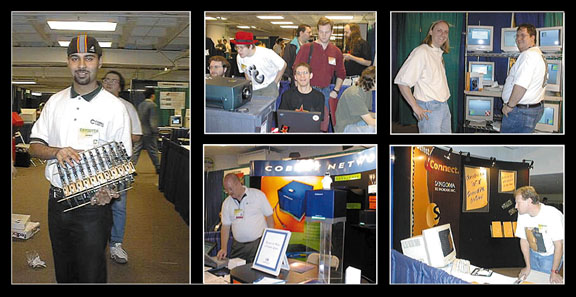
The show was tied together with a one-gigabyte backbone set up by Cabletron. Registration was run on Linux-based PCs. In fact, one Microsoft employee we talked to felt very much in the minority. Hopefully, he ordered a Cobalt Qube or NetWinder to take home.
Other exhibitors included Jeff Bates and Rob Malda of slashdot.org. The GNOME team was out in force, showing us the fruits of their labors. Miguel de Icaza gave a talk on the GNOME project. Several retailers were represented, such as Linux Mall, Linux Central and the Linux General Store.
Many leaders of the GNU/Linux revolution were on hand. Eric S. Raymond was there making his always-brilliant philosophical observations about the power and importance of Open Source software. Also present was Richard M. Stallman: the man who can be said to have started it all.
As expected, a few important announcements were made, in particular by keynote speakers. Allen Miner, Vice President of Strategic Business Development at Oracle Corporation, gave the first keynote speech. Mr. Miner reasserted Oracle's commitment to Linux and announced several key partnerships with other Linux vendors. Look for Linux to figure more prominently in Oracle's future.
Dr. Michael Cowpland of Corel talked about the future of his company's relationship with Linux. He also announced that Word Perfect 8 for Linux would be available as a free download for personal use in the near future. The rest of Corel's productivity applications should be available on Linux by early 1999. Corel also recently announced plans to team with Red Hat to port more software to their NetWinder.
The surprise hit of the show was the caffeinated Penguin Peppermints handed out by LJ representatives, including yours truly. Folks lined up three rows deep at the booth to pick up these treats.
To no one's surprise, this year's Atlanta Linux Showcase was yet another testament of Linux's growth towards complete world domination. As the list of independent software vendors, value-added resellers and retailers supporting Linux grows each day, the outlook for the future of Linux is quite optimistic.
Norman M. Jacobowitz is a freelance writer and marketing consultant based in Seattle, Washington. He can be reached at normj@aa.net.
Today’s modular x86 servers are compute-centric, designed as a least common denominator to support a wide range of IT workloads. Those generic, virtualized IT workloads have much different resource optimization requirements than hyperscale and cloud applications. They have resulted in a “one size fits all” enterprise IT architecture that is not optimized for a specific set of IT workloads, and especially not emerging hyperscale workloads, such as web applications, big data, and object storage. In this report, you will learn how shifting the focus from traditional compute-centric IT architectures to an innovative disaggregated fabric-based architecture can optimize and scale your data center.
Sponsored by AMD
Built-in forensics, incident response, and security with Red Hat Enterprise Linux 6
Every security policy provides guidance and requirements for ensuring adequate protection of information and data, as well as high-level technical and administrative security requirements for a system in a given environment. Traditionally, providing security for a system focuses on the confidentiality of the information on it. However, protecting the data integrity and system and data availability is just as important. For example, when processing United States intelligence information, there are three attributes that require protection: confidentiality, integrity, and availability.
Learn more about catching the bad guy in this free white paper.
Sponsored by DLT Solutions
| Making Linux and Android Get Along (It's Not as Hard as It Sounds) | May 16, 2013 |
| Drupal Is a Framework: Why Everyone Needs to Understand This | May 15, 2013 |
| Home, My Backup Data Center | May 13, 2013 |
| Non-Linux FOSS: Seashore | May 10, 2013 |
| Trying to Tame the Tablet | May 08, 2013 |
| Dart: a New Web Programming Experience | May 07, 2013 |
- RSS Feeds
- Making Linux and Android Get Along (It's Not as Hard as It Sounds)
- New Products
- Drupal Is a Framework: Why Everyone Needs to Understand This
- A Topic for Discussion - Open Source Feature-Richness?
- Home, My Backup Data Center
- Validate an E-Mail Address with PHP, the Right Way
- Tech Tip: Really Simple HTTP Server with Python
- New Products
- Trying to Tame the Tablet
Enter to Win an Adafruit Prototyping Pi Plate Kit for Raspberry Pi

It's Raspberry Pi month at Linux Journal. Each week in May, Adafruit will be giving away a Pi-related prize to a lucky, randomly drawn LJ reader. Winners will be announced weekly.
Fill out the fields below to enter to win this week's prize-- a Prototyping Pi Plate Kit for Raspberry Pi.
Congratulations to our winners so far:
- 5-8-13, Pi Starter Pack: Jack Davis
- 5-15-13, Pi Model B 512MB RAM: Patrick Dunn
- Next winner announced on 5-21-13!
Free Webinar: Linux Backup and Recovery
Most companies incorporate backup procedures for critical data, which can be restored quickly if a loss occurs. However, fewer companies are prepared for catastrophic system failures, in which they lose all data, the entire operating system, applications, settings, patches and more, reducing their system(s) to “bare metal.” After all, before data can be restored to a system, there must be a system to restore it to.
In this one hour webinar, learn how to enhance your existing backup strategies for better disaster recovery preparedness using Storix System Backup Administrator (SBAdmin), a highly flexible bare-metal recovery solution for UNIX and Linux systems.


3 hours 31 min ago
3 hours 54 min ago
4 hours 4 min ago
4 hours 8 min ago
4 hours 38 min ago
7 hours 30 min ago
8 hours 5 min ago
8 hours 6 min ago
8 hours 7 min ago
8 hours 8 min ago