SockMail

Manufacturer: Sockem Software
E-mail: info@sockem.com
URL: http://www.sockem.com/
Price: $295 US
Reviewer: Noah Yasskin
E-mail saves time and money, particularly when you want to send multiple people the same message. One hundred letters can be sent as easily as one letter, and for the same price—absolutely nothing. Because of this, e-mail is the natural choice for distributing identical information to a group of people. Along with its benefits, though, e-mail has brought its share of problems—the biggest one is spam. However, just as there are legitimate uses for bulk mail, there are legitimate uses for mass e-mail mailings.
Smart companies on the Internet are replacing expensive paper mailings with digital mailings whenever possible. It looks antiquated when a company—especially one in the computer industry—sends me a press release by mail. Doing so reflects poorly on its understanding of technology. Physical goods can't be delivered digitally, but information is destined to be transmitted like e-mail: effortlessly and inexpensively. However, many businesses are already having a difficult time managing the flow of e-mail and can easily have numerous mailing lists with thousands of addresses. Sockem Software's first product, SockMail, was created to help organizations effectively use lists of e-mail addresses. SockMail is described by its creators as a “100% Java client/server e-mail list management system”, and it is just that. Web sites overburdened with extensive lists of e-mail addresses will find this application valuable.
Sockem Software is a 100% Java software start-up based in New York City's “Silicon Alley”. The company is focused on Java because it believes the language's multi-platform and networking strengths will be successful in the marketplace. Java will provide the foundation for all of Sockem Software's client/server applications. In the company's eyes, a browser with a JVM (Java Virtual Machine) is the universal client. If Java is the mantra of Sockem Software, e-mail is the mantra of SockMail.
Web sites commonly have a text box in which people can sign up to be included on or dropped from a mailing list. This is usually done by having a CGI (common gateway interface) such as a Perl script send the information to someone who then manually adds and deletes names on a list of subscribers. It is difficult to automate this process with scripts and clumsy to paste names into a mail program in the blind copy field. SockMail's primary goal is to make the whole process of creating, maintaining and sending out information to lists of e-mail addresses as efficient as possible. It's a very simple and focused application that doesn't do much more than that. Users do a lot of the work by adding and deleting themselves from mailing lists. This is its big selling point for companies wanting to automate their web site subscription lists. SockMail's interface is functional but not pretty—it has the look of a shareware application.
Unlike Listserv and Majordomo mail programs where users send commands within an e-mail to add or delete themselves from mailing lists, SockMail's lists are maintained through Java applets. Additionally, SockMail doesn't allow posting to people on a list. It is specifically designed for sending out mail to lists, not to facilitate communication between people on a list. A Listserv or Majordomo system could be configured to have much the same functionality as SockMail, but these systems are more difficult to set up and maintain. SockMail is much easier to install and integrate with a web site or Intranet; however, it could never replace a Listserv or Majordomo program.
SockMail is designed for businesses with mailing lists of no more than 50,000 people. This number should be adequate for all but the largest company mailings and will hopefully dissuade spammers from abusing the application. It is an ideal tool for distributing press releases, e-zines, company updates, invitations or any targeted mailing. A large company could also manage internal mailing lists easily with SockMail. It is not designed for blind mass mailings or spamming. This product could be used to do that, but its potential to send out truly massive lists is limited. The lists have to be loaded into the browser, so available memory limits the potential number of recipients. Additionally, the server may run into memory problems sending to lists of over 50,000 names. In part, this is because Java uses static memory allocation for its applications. By default the server allocates around 20MB of memory, and this limit can be raised or lowered using options in the Java interpreter.
SockMail can be installed via a command line or GUI (graphical user interface). The application installs in literally seconds because the whole thing is only 197KB. It is designed to be purchased and downloaded over the Internet and is not available on CD-ROM or floppy disk. However, because SockMail is truly platform independent, it requires the use of the command line to start the GUI installation. This could be a little confusing for the novice Windows NT user, but a system administrator or anyone used to UNIX should have no problem getting the install up and running.
The install is done with JShield because the company insisted on keeping the application 100% Java; WinInstall uses Windows native code. However, it is not just a case of getting hooked on Java. Since it is 100% Java, the whole program can be installed remotely using TELNET. Most servers have remote administration capabilities, but taking its network-friendly cue from UNIX, everything on SockMail can done without being on a console. On Windows NT, this type of remote installation is rare, and Sockem Software has done a good job of building this functionality into the application.
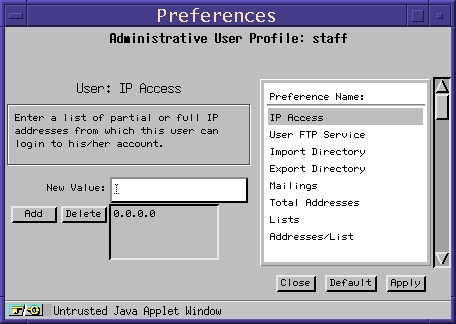
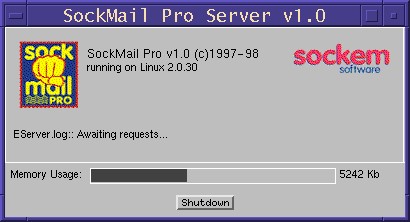
To deliver client applets, the SockMail server must be running on the same computer as a web server, which limits its scalability. SockMail Pro, due out soon, will be able to run independently of a web server. The SockMail server has its own 100% Java database used to store e-mail addresses. It is a proprietary database without JDBC (Java database connectivity) functionality which could lead to problems in an enterprise setting. The server processes all requests from clients to add and delete names from lists and must have access to a local JVM (Java Virtual Machine). Although the server component is 100% Java, it can't function on most Windows 95 or Macintosh desktops, because most JVMs for Windows 95 and Macintosh don't support the TCP/IP socket connections the SockMail server needs. Security must be set up once the server is installed. Security features include an administrative login, IP filtering and separate administrative port. Only one user login is allowed. The server can handle multiple tasks, simultaneously updating one list and mailing to another.
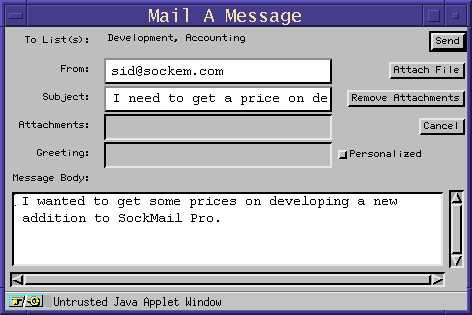
SockMail uses three client applets: one to administer the server, one to add and one to delete addresses. Users can add and delete themselves from lists, but mailings can be performed only from the administrative applet; this applet is just 85KB and loads quickly. The add and delete clients are less than 30KB each. The applets can be customized to fit the look and feel of a particular web site. The clients run on any browser with a Sun compatible JVM version 1.02 or later. In case users don't have a Java-enabled browser, SockMail includes two HTML forms with CGI scripts. These can also be used to add and delete addresses.
SockMail includes the ability to intelligently retrieve e-mail addresses from web sites. A spider can search an entire web site, collect any e-mail addresses and add them to a specified list. This feature could give the product a bad name; however, the spider can search only about 1000 pages before running out of memory. This limits its usefulness as a tool for spamming. For quickly scanning a single URL, however, the spider works well. It is a useful tool for collecting contact information. It only picks up addresses after the mailto attribute.
To be more web friendly, the spider identifies itself as a robot. Webmasters can put configuration files on their pages to inform the spider not to search the site. As these intelligent agents become common, sites not wanting to be searched are starting to deny access to them.
SockMail also includes an easy way to check the InterNIC database for information about an e-mail address. For any registered domain, SockMail can query the InterNIC to find out the technical, administrative and billing contact information.
Sockem Software is a strong supporter of Linux. The company moved its own web site off of Sun Solaris and is a complete Linux shop. SockMail was developed on Linux boxes using Emacs, the newest versions of which have Java editing tools. The biggest advantage to developing Java on MS Windows remains the visual editing tools that are available on that platform. However, many visual development programs use version 1.1. of the JVM, which can lead to incompatibilities with version 1.0 used by most older browsers. By developing on Linux, Java programmers are assured they will be developing 100% Java because there are no proprietary JVMs on Linux. Organizations such as Blackdown (http://www.blackdown.org/) ported the JVM to Linux, and standard distributions of Linux include a JVM.
Sockem Software is planning a SockMail Pro version, due sometime soon. This will address some of the current product's shortcomings. One limitation of SockMail is that it has only one user login. SockMail Pro will allow multiple user accounts with varying levels of access. SockMail Pro will also have its own Java web server to eliminate the need to have it running on the same computer as a site's web server, and will allow people to use the product independently of a web site. The SockMail Pro server will be able to run on a dedicated computer. In addition to a 100% Java version of the server, Sockem Software plans to have a Windows NT version compiled natively. This is being done with Supercede (a Paul Allen company). This NT-only version will also be available with WinInstall, so that the whole installation can be done through a GUI.
SockMail is targeted towards a growing market. E-mail is undoubtedly the most popular application on the Internet. As much as the graphical WWW, it has fueled the astronomical growth of the Internet. E-mail is cutting down the amount of time we spend on the telephone, and may eventually force the handwritten letter to take its place in history next to the carrier pigeon and telegram. Like any other form of communication, though, e-mail requires courtesy and common sense. Nothing is as impersonal as a form letter, except possibly a form e-mail. This lesson applies to SockMail. A potential risk is involved when increasing the amount of e-mail we receive and send. Communication loses its value when it doesn't understand its audience. SockMail allows individuals to easily sign up for mailings they're interested in and drop mailings they don't want. In this way, control over information is as much in the hands of consumers as producers. Let's hope this relationship stays in balance.
Noah Yasskin is a freelance writer living in Brooklyn, New York. He has a degree in History and Social Sciences from Eugene Lang College and attended the Philosophy program at the Graduate Faculty of Political and Social Science for a short while. Instead of Aristotle and Max Weber, he now writes about New Media companies and software programs. He can be reached at nyjup@aol.com.