Ricochet Modem

Manufacturer: Metricom, Inc.
E-mail: info@ricochet.net
URL: http://www.metricom.com/
Price: $350 US
Reviewer: Randy Bentson
First a confession, I didn't have to buy a laptop computer to use the Ricochet modem radio. The reality is that these devices work quite nicely on desktop systems as well as on laptops.
I read of these modems in the local free computer newspaper, but since I was quite happy with my 56Kbps frame-relay connection, I didn't give them much consideration. Then one day my connection failed and I realized I had no backup for Internet access. After a quick trip to a local computer store and a few minutes configuring a PPP connect script, I was back in action. The frame relay was fixed shortly thereafter, but I still have my Ricochet modem. I use it when visiting client sites and when testing firewall configurations, and I used it on the one occasion when the frame went down again. I've also loaned it to friends suffering from phone noise and ISP mismanagement.
Plug it into your serial port. It has two connections: one for external power and one to connect to your computer. The computer sees it as a Hayes-compatible modem with a few additional AT (i.e., standard modem) commands.
I mentioned that I had to fiddle with the PPP connection scripts. As with most computer hardware, Metricom provides software for operation with the Apple and Microsoft operating systems. Since Linux comes with support for PPP dial up, there is no need to load their software. One has only to make some small but crucial changes to the scripts. The ppp-on-dialer script needs to send the strings:
ATZ
ATE0X4Q0V1&C1&D2&K3
to the modem to ensure that the configuration is correct. My ppp-on script needed the line:
route del defaultbecause my system is also on a local LAN and normally gateways through the frame relay. The phone number, 777**PPP, looks unusual; it means “connect to the regular Internet service using the PPP protocol.” The script doesn't need a user name or password because the modem's serial number is used for authentication. As long as your account is current, your connection is established with a dynamically allocated IP address. Listings of these two scripts are available by anonymous download in the file ftp.linuxjournal.com/pub/lj/listings/issue45/2493.tgz.
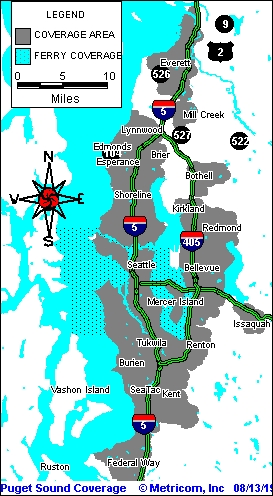
First, the Ricochet is not a cell-phone modem. It is based on an infrastructure which is independent of the various telephone systems. Metricom has been in the wireless communication business since 1985—providing remote-access monitoring of meters to public utilities. The Ricochet division was started two years ago in order to offer wireless Internet connectivity to the public. They're currently offering service in the metropolitan areas of Seattle, San Francisco Bay, West Los Angeles and Washington, D.C. Metricom plans to extend coverage in the Los Angeles area by the end of this year and installation is underway in New York City.
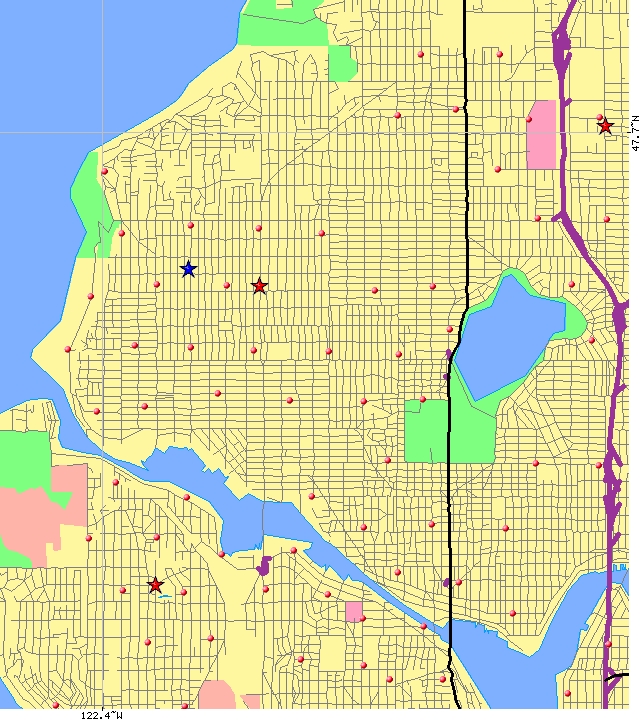
If you pay attention, you'll see cell-phone antenna towers or roof-top clusters appearing everywhere. The Ricochet system is quite a bit harder to spot. There are three elements: the “modem radio” attached to your computer, a shoe box sized “microcell radio” attached to streetlamp poles at quarter mile intervals and “wired access points” to serve thirty or so microcell radios. (Seattle has 1800 microcell radios and 50 wired access points.) For instance, in this map of a Seattle neighborhood the small dots are the microcell radios, the red stars are wired access points, and the blue star is the home of Linux Journal. (The map is a product of a U.S. Census bureau server using the URL (without breaks) http://tiger.census.gov/cgi-bin/mapbrowser? lat=47.676&lon=-122.366&wid=0.10&ht=0.050& on=GRID&murl=http://www.aa.net/~bentson/tms& iwd=640&iht=720. (See Figure 1.)
Just as the Internet uses a store-and-forward model to get data from one place to another, Ricochet packets are forwarded from pole to pole from the modem radio to the wired access point, at which point they enter the conventional Internet routing. Because this service is packet based, you don't consume resources when you're not sending or receiving bits. Therefore, you're welcome to establish a connection and leave it live for as long as you wish. This is a dramatic change from telephone-based Internet services.
Since I got my modem last fall, Metricom has offered two new products: a modem (without battery) for fixed stations and a newer, lighter weight version (8 ounce versus 13 ounce) of the portable modem. An even lighter version is being tested for palm-top computers. In addition, Ricochet has distributed a firmware upgrade that allows a roaming user to remain connected while moving from one wired-access-point coverage area to another.
The current technology operates in the 908-926MHz band, dividing it into 162 channels, each 160KHz wide. Each connection hops among these channels using spread spectrum technology. Modem radios provide a connection with performance comparable to a 28.8Kbps modem, but may burst higher. (That's why they recommend setting the serial port to 57.6Kbps.) Future models will use more channels and other bands to provide better coverage and higher speeds (128Kbps to 512Kbps).
If you're traveling, you'll find service outside of these cities in airports such as Minneapolis-Saint Paul International Airport, Phoenix Sky Harbor Airport and La Guardia Airport in New York City.
Several schools, including Austin College, California Polytechnical Institute, George Washington University, Oregon State University, San Francisco State, Stanford University, UC Berkeley, UC Santa Cruz, University of Miami and University of Oregon, have established local service areas for their students, staff and faculty.
In addition to service provided in big cities, schools and airports, Metricom has teamed up with local utility companies to provide coverage in smaller towns—systems are being installed in Casper, Gillette, Laramie, Lander and Torrington in Wyoming and Scottsbluff, Gering, Kearney, Alliance and McCook in Nebraska. The nature of the Ricochet system allows Metricom to offer localized service wherever there are enough users to support it—I have visions of service in places like Durango, Colorado.
Remember the strange phone number? You can also enter the serial number of another modem radio. If it's nearby and not currently engaged, it will see a “RING” and the other user's program can answer the phone. In this way a peer-to-peer service is established between two modems.
Figure 2. Map of Puget Sound Coverage
There's another form of operation as well—called Star mode. In normal mode, the modem acts like a Hayes-compatible modem; in Star mode, the modem delivers packets into space (the original ether) and other modems see these packets and deal with them in a manner similar to an Ethernet card. This mode only works in modem-to-modem communication; however, the greater bit capacity makes it worth exploring. If you look in the Linux kernel configuration, you'll find support for this mode is already available. With this code compiled in, you and your co-workers and friends can have your own wireless LAN wherever you go. It's very convenient for conferences.
I finally broke down and bought one. Naturally, it runs Linux, and when I'm out of the office, I unplug the PCMCIA Ethernet card and turn on the Ricochet modem.
When the microcell radios are installed, they're configured with their latitude and longitude. One of the extra AT commands causes the modem to report the location and signal strength of up to ten nearby microcell radios. I've wandered around Seattle getting these reports and looking for microcell radios. I edited these reports into the tms file cited in the URL above—that's how I built the map.
Needless to say, I had to check out the roaming feature once I got my laptop. As I drove around town, I issued a ping command directed at my home system. Sometimes the latency was quite high, but it also seemed to go down when a second ping was issued. I suspect that routing tables are updated often enough that the system quickly finds the best route. Now I've got to check it while riding the ferry across Puget Sound.
Visit http://www.ricochet.net/ for more information.
Randolph Bentson has been programming since 1969—writing more tasking kernels in assembly code than he wants to admit. He has been working with Unix for nearly 16 years, and he's been enjoying and contributing to Linux for the last 3 years. Mr. Bentson is the author of Inside Linux, A Look at Operating System Development [1996, SSC]. He can be reached via e-mail at bentson@grieg.seaslug.org.