Linux Means Business to the City of Garden Grove
The City of Garden Grove has been a Pick shop since implementing a Microdata Reality in the late 1970s. The original system supported 24 users. In 1984 the Reality was replaced by a Honeywell/Ultimate machine with over 100 serial ports for terminals and printers. In 1990, the City needed a larger system, so it replaced the Ultimate with a 512 user Data General running DGUX /Advanced Pick. At the same time, the City was beginning to use personal computers (PCs) in the workplace, leading to the need for a PC network. A consultant was hired in 1993, but his equipment recommendation was declined due to budget constraints.
Still needing a network, the Information Systems department needed to develop a phase-in plan, so under the direction of the IS manager, Robert Shingledecker, in June 1993 a mini-lab was set up to evaluate different network solutions for a multi-server environment in. The first network chosen for testing was Novell 4.0, which promised seamless integration of multiple servers. Two Novell network engineers took three weeks to set up the first server and then an additional three weeks to set up a second one. Even then, the integration was not as promised.
Disillusioned with Novell, Bob decided to go out and purchase the newly released Windows NT. The IS staff took only 3 days to get NT up and running. Unfortunately, at that time NT's speed was unimpressive, Netbeui (the only available protocol) was not routeable, and NT was unable to share printers with the existing Unix system.
Since the City was already using Unix, Unix was the next system considered for networking. After researching Unix networking on the Internet, the decision was made to try out a NFS network. Unfortunately, four different commercial NFS clients failed to work with Microsoft's newly released Word 6.0. The first NFS product to solve the Word problem was XFS, a shareware NFS client from Germany, available on the Internet. The Internet soon became an invaluable source of both information and software. The City installed its first production network in July 1994, in the Public Services Department, using an SCO Unix 486 File Server and 16 XFS/Windows 3.1 clients. The PCs had dual connections—Ethernet connections to the local SCO server and serial/mux connections to DGUX/Pick.
In September 1994, IS learned that the City would be moving to a new building, and that our network project would have to be accelerated. The computer systems for each campus building, especially that of the Police Department, would have to be able to “stand alone and be fully functional.” XFS did not run on Windows 3.11 at that time, so we continued to search the Internet for a network solution. That's when we discovered Samba. Samba emulates SMB networks (LanManager, WFW, Windows NT) on Unix, and provides an even easier solution for networking since no additional non-Microsoft software had to be loaded on the clients. The next production network was installed in December of 1994 in the Housing Department, using an SCO Pentium File server and 20 Windows for Work groups (WFW) clients. The Samba network proved faster than any network previously tested, and in addition, it was much easier to maintain. The server was also running a 16 user license of Advanced Pick (AP), so now the clients had only one connection to the server—Ethernet. Immediately following this success, we set up another Samba network for the Police Department that included a 48 user license of AP running on an SCO Pentium file server with 100 WFW clients.
In February 1995, having taken care of all the satellite buildings, we prepared to move City Hall, connect all local buildings via Fiber and plan a Wide Area Network (WAN) including a T1 connection to the Public Services Department. Meanwhile, the discovery of Samba led to the discovery of the Unix Platform it was developed on, Linux. Linux had everything SCO had—plus much, much more including Internet tools. Testing then began on the use of Linux. Linux is amazingly simple compared to SCO, its setup and performance is better than SCO and it's free. In April 1995, the Public Services Network was converted from SCO/XFS to Linux/Samba with noticeable performance improvements. In June 1995, discussion began on what to do with the Data General (DG), as the City planned to move into its new building in November.
Pick systems released a Beta copy of AP/Linux and the City started testing it in September 1995. After discussions with Pick Systems regarding support of AP/Linux, it was decided to leave the DG behind and run the City with the successful Intel/Linux/Samba/Pick network. The City also established a presence on the Internet in September by setting up a web page (http://www.ci.garden-grove.ca.us) hosted by Deltanet Internet Services, with future plans to bring it in house.
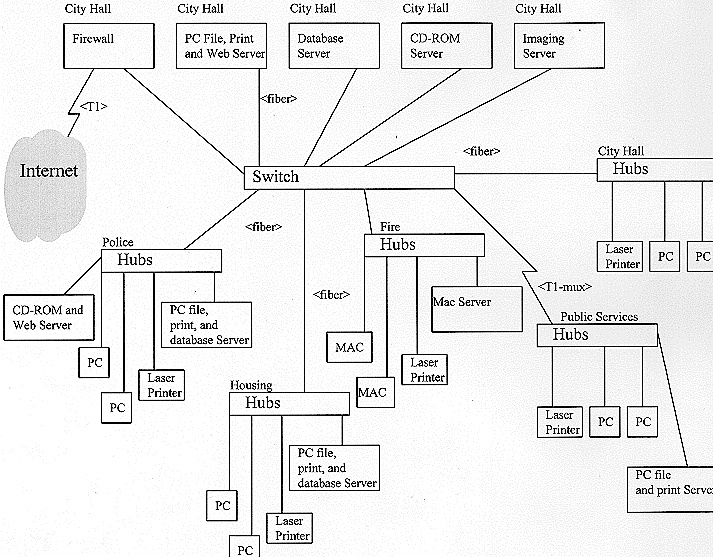
In November, the DG was abandoned, and the new City Hall is now run by two Linux Pentium File servers. One runs Samba and serves the PC network, and the other runs the Advanced Pick database. Together the servers handle 150 WFW clients. Housing's SCO/AP/Samba server was changed over to Linux followed by the conversion of the Police server from SCO to Linux in March. Concurrently, the Fiber backbone was installed throughout the Campus buildings. IS was now prepared to set up an intranet. By this time the network consisted of 8 servers (5 production Linux servers, 2 lab [test] Linux servers and 1 Sun server for imaging). The City Hall Samba Server was now running NCSA's web Server and the City's intranet was born.
The IS staff then began to work with HTML, Perl and Python to create CGI applications on the Web. Next, we decided to get the Pick Server involved. The first web page to extract data from the Pick Server did so with HTML, CGI and Perl. It was done by having the Perl script call a Pick application which wrote to a temporary file in Unix that was then read by the calling Perl script. This method worked, but proved to be slow. Because of the networking features of Linux and AP, we decided that the speed could be improved if the two servers communicated over sockets. The new speed was incredible. Almost instantaneously, the data requested by the web page was returned by the Pick server. The City's intranet was undergoing a growth spurt, and a GUI solution for Pick applications had been found.
In June of 1996, the City added a T1 speed Frame Relay connection to Intelenet Internet Services, adding yet another Linux Server that acts as a firewall between the new Frame Relay line and the City's network. IS is currently in the process of bringing the City's WWW page in house. We can now write applications to make information on the Pick Server available to the world via the World Wide Web. IS is also creating an imaging system based on the WAIS server—so development continues.
Without Linux and Samba, the project could never have come in within budget nor made the time-line for the move. In just a few short months, the City switched from a mini-computer with dumb terminals to a total network environment. The Linux machines run 24 hours a day and have proven to be very stable and reliable. Our thanks go out to all the Internet community for providing such a wonderful environment.
The city now has over 300 486 and Pentium PC92s running WFW, Microsoft Office and Netscape Navigator. All are connected with 10baseT Ethernet cards (NE2000 and 3COM). Microsoft Telnet is used to connect to the Pick Server for legacy applications.
Linux servers are Intel-based Pentiums (100-133) with 64MB RAM, (2) 1GB SCSI drives and a 2GB DAT tape drive.
Printers are all HP LaserJets connected with an internal Jet Direct Card (Ethernet).
The network includes Category 5 cable with a Fiber Optic backbone, T1 line to Public Services, and 1544 Kbps Frame Relay to the Internet, 3COM hubs, patch panels and switch, Prelude and ADC DSU/CSU92s, and a Cisco Router.
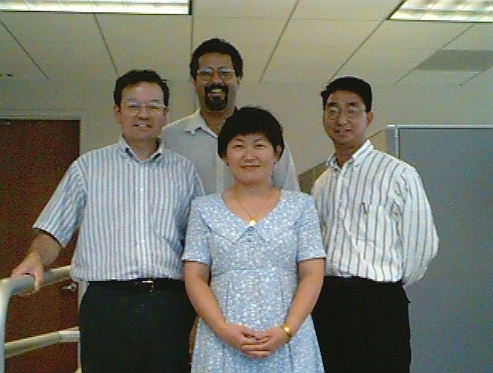
The Informations Services staff consists of a manager, 2 systems analysts and a technician. Robert Shingledecker is the Information Systems Manager for the city of Garden Grove, California. He has written early machine code and assembly language programs. He uses the Internet regularly to research solutions for the city's IS needs and future developments. He can be reached at roberts@exo.com. The authors are the systems analysts. Victor Chang, Information Systems Technician, supports the PC client's needs—he installs and supports software (Windows, MS Office, Netscape, etc.), troubleshoots and fixes hardware problems.
Pyng Chang is a Senior Systems Analyst with the city of Garden Grove, California. Both authors have Pick OS backgrounds, and have gradually moved into the Unix and PC environment since the inception of the project. They are both involved with all aspects of Unix network administration, and are currently writing the GUI interface to the Pick routines with the HTML, CGI and Perl.
Charles Kalil is a Senior Systems Analyst with the city of Garden Grove, California. Both authors have Pick OS backgrounds, and have gradually moved into the Unix and PC environment since the inception of the project. They are both involved with all aspects of Unix network administration, and are currently writing the GUI interface to the Pick routines with the HTML, CGI and Perl.