Linux in Camouflage

As the Army's demand for real-time, battle-command information increased, computer systems became more complex, expensive and unwieldy. To counter the proliferation of single-use systems, the Army's Battle Command Laboratory (http://cacfs.army.mil/) at Fort Leavenworth entered into a rapid prototyping agreement with Mystech Associates to design a new Maneuver Control System for the Army.
Maneuver Control System/Phoenix (MCS/P) was approved by the Department of the Army in November 1995 to be issued to Army units for training and feedback. While not the final answer, it is the best system available for providing interoperation between the Army's “command and control” computer systems. In January 1996, MCS/P was used successfully by the 4th Infantry Division and III Corps in a Battle Command Training Program Warfighter exercise. MCS/P is currently in use in Bosnia and other theaters around the world.
MCS/P and its sister intelligence system, ASAS Warlord Notebook, share the same underlying code and provide the military with the applications shown in the “Applications” box.
Originally developed to run on Sun SPARC 20s, MCS/P and Warlord Notebook have been successfully ported to Linux systems by Mystech. Porting these applications to Linux provided a cost-effective solution to employing these systems on a large scale. The tactical version (hardened and ruggardized) of the SPARC 20 costs the U.S. taxpayer approximately $48,000.00 per machine; the non-tactical or commercial system about $18,000.00. The commercial Pentium 166 machines running the Linux port cost approximately $3,000.
The National Guard Bureau realized the benefits and importance of training its commanders and their battle staffs to operate effectively and efficiently in this information-rich environment. The Leader Development Center (LDC) was given the task of developing and implementing procedures to infuse these systems and technologies into the National Guard. In September 1996, the LDC established a training site at its Fort Leavenworth facility and issued Linux systems to the National Guard's 34th and 38th Divisions. These two divisions will use Phoenix and Warlord Notebook during their 1997 Battle Command Training Program Warfighter exercises at the LDC.
Phoenix and Warlord Notebook provide National Guard commanders at multiple echelons with enhanced situational awareness and a relevant common picture of the battlefield overlaid on digital maps. These two systems provide the commander near-real-time combat information over battlefield communications from their battle staffs, subordinate commanders and intelligence assets.
The software systems are comprised of government owned, GNU licensed and other freely distributed software. The current X Window System is XFree86. To a Linux purist the file structure is wrong. Since the official platform to run these applications is the tactical SPARC, the file structure mirrors that of the SPARC. While confusing at first, this change eliminates the problems caused by operating on multiple systems with different file-system structures and simplifies file transfers.
Each computer has both Phoenix and Warlord Notebook installed, and is its own mail host and web server. The user ID of the individual using the system determines which application system is started.
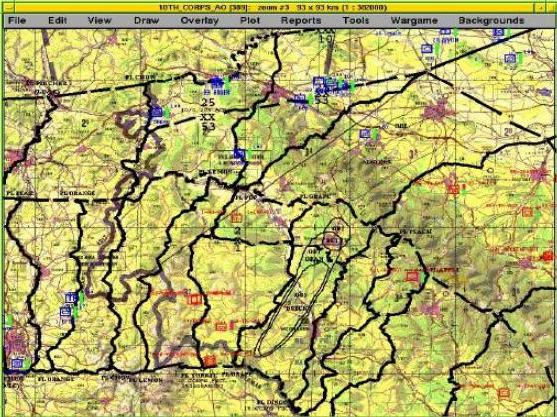
Military operations are map and graphic intensive. Instead of paper maps, digital map products from the National Imagery and Mapping Agency (http://www.nima.mil/) are used. To reduce the bandwidth required for communication, full digital maps reside on each system. The only map or graphic material actually transmitted are the geo-referenced graphics. Geo-referencing allows the re-scaling of maps and graphics without loss of clarity or the danger of graphics being out of position. (See Figure 2)
Information on friendly and enemy unit activities and locations is loaded into the system at the first point of observation or occurrence and is then sent throughout the network. Once entered, the data does not have to be re-entered anywhere along the network. The user is unaware that the majority of information is sent using normal e-mail. He clicks on the operation that he needs to be accomplished, e.g., send updated unit locations, and the system queries the appropriate data bases, prepares the message and sends it.
Operations orders are centered around the maps and maneuver graphics. Now, instead of taking the graphics, converting them to words, transmitting the words which are then converted back into graphics on the receiving end, the information is sent as graphics with a minimum of words. An ingenious use of HTML and CGI provides the capability to build complex operations orders with full graphics and map references. Then, with CGI, these orders are available to be either pushed or pulled throughout the network.
A collaborative white board is built in. This provides the commander with a rapid means to clarify his points or make last-minute changes.
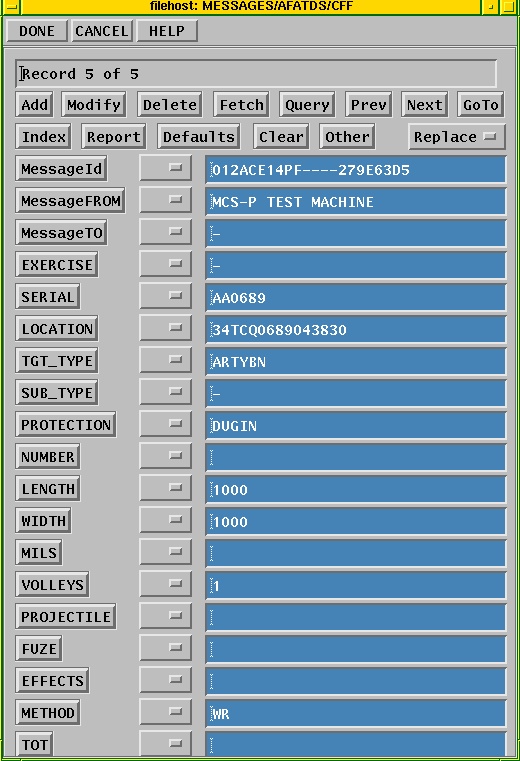
One of the most perplexing problems in data entry on tactical systems used to be that the user had to know a myriad of archaic formats and had to enter those formats as text. Phoenix and Warlord Notebook uses simple fill-in-the-blank forms and lets the computer figure out where the “/” and “.” characters should be placed. (See Figure 3 and Listing 1.)
The Leader Development Center's computer training facility is a networked suite of twelve student systems and one instructor system. A 42-inch Mitsubishi monitor allows the students to easily follow the instructor.
The classes are kept small, with two instructors for twelve students. The students who attend training at the LDC are the key staff and trainers for their division. Our low student-faculty ratio ensures that the students master the concepts and skills required to successfully use these systems with their home units. The student success rate has been extremely high. Some of those who have attended are currently using Linux on their home or business systems or, are systems administrators on Unix or other systems.
Using equipment and software provided by the Leader Development Center, each division has established its own training facility and program. The experience from these division training programs is providing the basis for fine tuning the LDC program for implementation in the other National Guard Divisions.