
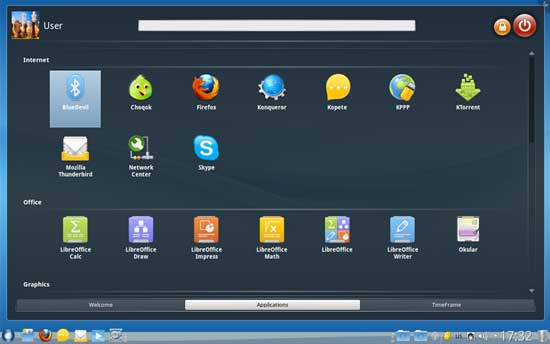
ROSA Desktop 2012

The fact that Russia's ROSA Labs once collaborated with Mandriva is evident in the company's latest release, ROSA Desktop 2012. Nevertheless, since breaking from Mandriva, ROSA Labs has forked the distro onto its own unique development path. ROSA Desktop 2012 is an LSB-compliant distro that features a customized KDE desktop. The free edition sports only free software; the Extended Edition includes nonfree components and proprietary software, such as codecs. ROSA Labs says that by developing ROSA Desktop 2012 with its own software development and build environment—ROSA ABF—the company is able to achieve unmatched technological independence, high quality and up to five years of technical support. Examples of new features include EFI/UEFI support, improved hardware detection and improved compatibility with Windows 8. Supported languages include English, French, German, Italian, Portuguese, Romanian, Russian, Spanish and Ukrainian.

http://www.rosalab.com

White Paper
Fabric-Based Computing Enables Optimized Hyperscale Data Centers

Today’s modular x86 servers are compute-centric, designed as a least common denominator to support a wide range of IT workloads. Those generic, virtualized IT workloads have much different resource optimization requirements than hyperscale and cloud applications. They have resulted in a “one size fits all” enterprise IT architecture that is not optimized for a specific set of IT workloads, and especially not emerging hyperscale workloads, such as web applications, big data, and object storage. In this report, you will learn how shifting the focus from traditional compute-centric IT architectures to an innovative disaggregated fabric-based architecture can optimize and scale your data center.

Learn More

Sponsored by AMD

White Paper
Red Hat White Paper: Using an Open Source Framework to Catch the Bad Guy

Built-in forensics, incident response, and security with Red Hat Enterprise Linux 6

Every security policy provides guidance and requirements for ensuring adequate protection of information and data, as well as high-level technical and administrative security requirements for a system in a given environment. Traditionally, providing security for a system focuses on the confidentiality of the information on it. However, protecting the data integrity and system and data availability is just as important. For example, when processing United States intelligence information, there are three attributes that require protection: confidentiality, integrity, and availability.

Learn more about catching the bad guy in this free white paper.

Learn More

Sponsored by DLT Solutions