
New Products
The raison d'être for Black Duck Software's new Black Duck Export 5.0 is to confront the issue of often undetected encryption algorithms found in the open-source software that developers integrate into their development process. A component of the Black Duck Suite, Export helps companies comply with export regulations by scanning software and identifying the presence of encryption algorithms that might affect a product's legal compliance in various markets. The new version 5.0 covers more than 450 different algorithms. Black Duck also offers a new companion publication, “The Guide to Encryption Export Compliance in an Open Source World”, which can be downloaded at no cost from the company's Web site.

Instantiations concurrently released updates to two popular Eclipse-based GUI development tools, namely WindowTester Pro and WindowBuilder Pro, advancing to versions 4.0 and 7.2, respectively. The new features in WindowTester Pro v4.0 are designed to help developers easily automate recording, test generation, code coverage and playback of GUI interactions. Version 4.0 also provides improvements for test recording; fine-tuning of assertions functionality, including improved Swing assertions support; and improved Linux support and preliminary support for 64-bit Cocoa. WindowBuilder Pro's new features include code generation and parsing improvements to optimize performance, API support for customizing properties, enhanced JFace and RCP support, improved support for Riena and expanded data binding support to make it easier to tie a user interface to an underlying datastore.

In its new ActiveStor Series 9 parallel storage system, Panasas claims to have “the highest-performance file storage system in the world”, a system that combines solid-state drive (SSD) technology with traditional disk drives “to produce a system with breakthrough performance and consolidation capabilities”. Panasas further says that its synchronized hybrid architecture produces both high-bandwidth performance and optimized IOPS and is capable of delivering an estimated 80,000 NFS operations per second, as well as 6 gigabytes per second of throughput. ActiveStor users can save money by consolidating a wider variety of applications and workloads in a single storage architecture, including high-performance clustered applications, single-client applications and technical and commercial applications running NFS and CIFS file protocols.

Version 5.1 of MontaVista Carrier Grade Edition (CGE) Linux is now available, adding support for next-generation LTE and WiMAX 4G wireless networks. The product is a commercial-grade Linux development platform for network equipment developers working with off-the-shelf or custom hardware who require extensive support and want to build on open source. Other additions to CGE 5.1 include full integration of the OpenSAF high-availability middleware consistent with Service Availability Forum specifications and virtual routing and forwarding (VRF) capabilities for secure wireless networks. MontaVista also claims that CGE 5.1 remains the only carrier grade Linux to be compliant with Carrier Grade Linux, IPv6 and Linux Standard Base certifications.

“Can you focus—really focus—for 25 minutes?” queries author Staffan Nöteberg as the subtitle of his new book, Pomodoro Technique Illustrated from the Pragmatic Bookshelf. We all know the pressure of needing to be productive—the to-do list is a mile long and you find yourself getting interrupted every other minute. You'd like to tell everyone to leave you alone, but most of the interruptions are coming from you! You think of a phone call you need to make or a Web site you need to check, and before you know it, you're answering e-mail, checking Twitter and finding a million other things to occupy your time. Author Nöteberg says that the Pomodoro Technique can put you back in charge of your day. You'll apply successful techniques from software engineering to identify what you should be doing today and to help you achieve your goals. Your mind won't wander when it is fully engaged in short bursts of focused activity. You'll learn to work less and accomplish more using nothing more than paper, pencil and a simple kitchen timer. This book is filled with advice on how to get started and how to tailor the method to your own needs.

The latest offering from HPC Systems is the HiPerDisk Storage System, the company's highest density SAS/SATA JBOD storage solution for enterprise applications. The HiPerDisk features 42 hot-swap drives in a 4U rackmount enclosure with up to 84TB of storage that will support high-capacity SAS or SATA drives individually or simultaneously, a feature that enables enterprise customers to standardize on one system for all three application data types: transactional, high-bandwidth and reference data. Designed for no active single point of failure, the HiPerDisk features single- or dual-controller modules, each consisting of three mini-SAS (4x) ports. A hot-swap redundant power supply and fans are provided for optimal enterprise reliability.

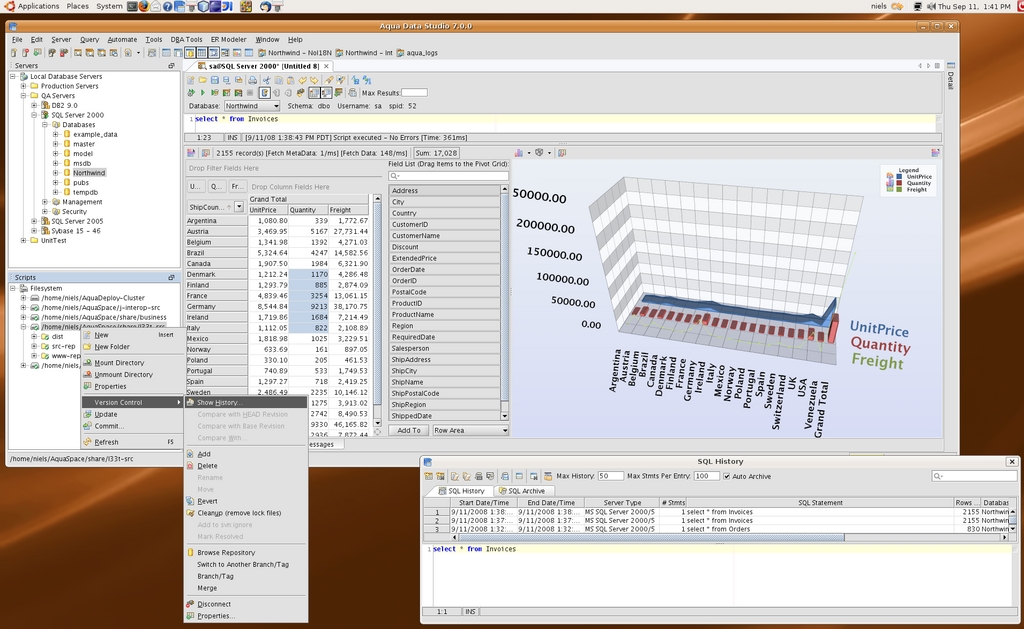
Giving some overdue love to the database sector, AquaFold recently announced version 8.0 of Aqua Data Studio, a universal database administration software that simplifies the visualization and manipulation of multiple relational databases from within a single interface. The new v8.0 of Aqua Data Studio extends native support for the leading data warehousing and high-performance relational databases, including Teradata, DB2 for z/OS, Sybase IQ 15 and nCluster from Aster Data Systems. Thus, users will benefit from the features and functionality they are accustomed to when working with Aqua Data Studio's existing support tools for Oracle, DB2 for LUW, DB2 for iSeries, Microsoft SQL Server, MySQL, Sybase, Informix, Apache Derby and PostgreSQL. Another key feature is the extension of the Entity-Relationship Modeler, now with the ability to convert or translate an ER model from one database to another. Finally, users will enjoy the ability to export to ERX format, import object schemas into existing databases and compare schema objects of different models within the same or different databases.
Publisher Wrox says that Ian Lawrence and Rodrigo Lopes' new book Professional Ubuntu Mobile Development is the world's first on the topic. The platform is quickly being adopted to provide a wide range of services on mobile devices, from Web to e-mail to messaging to GPS and more. This book is intended to show how to implement solutions for original equipment manufacturers and independent software vendors wishing to go to market using Ubuntu Mobile. The material also covers setting up Linux for mobile application development, the difference between developing on a mobile Internet device and a regular desktop environment, step-by-step tutorials and more good stuff.

Please send information about releases of Linux-related products to newproducts@linuxjournal.com or New Products c/o Linux Journal, PO Box 980985, Houston, TX 77098. Submissions are edited for length and content.
