
Indamixx: an On-the-Go Recording Studio?
You've wanted to be a record producer, right? Or, you've wanted to be able to set up and record impromptu interviews and panels at tradeshows and conventions? What if you could do it all, on Linux, with a couple decent mics and a device you can carry in your pocket? Ever imagined being able to produce original content everywhere?
You don't have to imagine anymore. Since November 2008, a little company called Indamixx has been putting out just such a marvel. Built on a Samsung Q1 Ultra chassis, this little handheld does its best to deliver on a very impressive list of marketing promises.
I unwrapped this lovely little toy box and had it virtually glued to my hip for the five weeks I reviewed it. It starts up fast; it works slick; the physical and virtual interfaces are very well put together, functional and fast. It did almost everything I asked of it, and its battery life was impressive on top of it all.
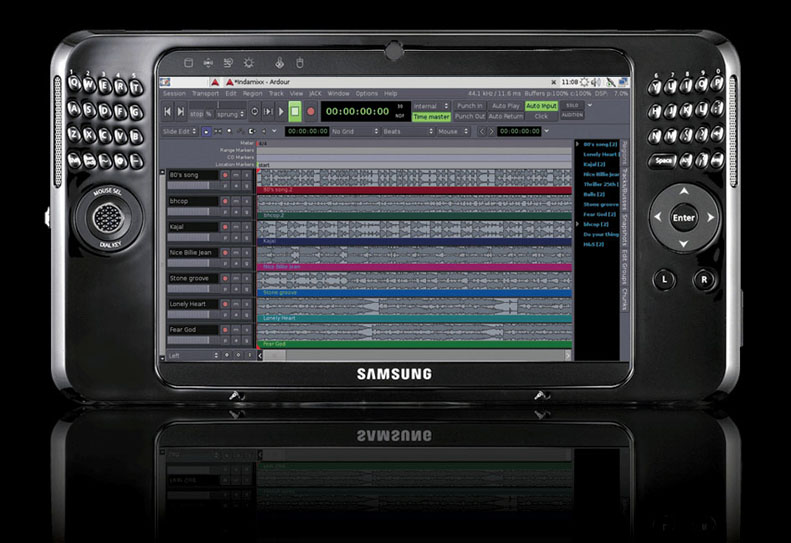
Indamixx/Ardour
In the course of my review, I edited a half-hour radio drama, recorded a five-person roundtable podcast over Skype, did an extensive amount of blogging, wrote two articles for Linux Journal, did a couple photo shoots and composed a couple tunes, and took it round to a club for a shakedown.
In terms of advertised features, the Q1 was an excellent platform to begin with. Touchscreen-based with three USB ports and a monitor jack, it docks easily at a desk and moves quickly with you. The screen is clear and contrasty enough to do work on its own most of the time, at least for work where you don't need a lot of vertical resolution (the drawback of the ultra-widescreen aspect ratio).
It's very small, light and only marginally more difficult to lug around than an iPod. At first blush, it's a hell of a little gadget.
Appropriate for its intended task, it has a pair of built-in stereo microphones that do proper left/right separation and exhibit a serviceably low noise floor for casual interviews and note taking. I put those microphones to the test in a couple interviews and, even while driving, they exhibited good enough discrimination for transcription. Score one for the Indamixx.
Of course, those are all properties of the hardware layer, which is a commodity device made by Samsung and can be had off the shelf for about $800. The real genius of this box is that the folks at Trinity Audio who designed it paid a lot of attention to detail in their choice of software packages as well. The Q1 is a pretty anemic hardware platform from the spec sheet, but Trinity managed to pull out every spare processor cycle from this.
Pro-audio applications in all flavors of Linux—Ardour, energyXT, Rosegarden and so on—all run atop the recursively named Jack Audio Connection Kit (JACK), a real-time server layer that gives pro-audio apps direct, low-latency access to the DSPs and MIDI devices. Digital Audio Workstations (DAWs) built on Linux must play nice with JACK, and “playing nice” can be measured in two ways:
How easy is it to get real-time performance out of JACK?
How many of the distribution's applications come prebuilt for JACK compatibility?
The answer to #1 should be pretty easy, because a real-time kernel patch is available for most distributions, and if it isn't available for yours, you always can build it. But, it isn't all that easy. The processes your distro runs, the other kernel modules you load and a dozen other things about distro architecture can make the difference between a system that will serve you well and one that will drive you bonkers. Because of this, the various Linux distributions do so with varying degrees of success, from the just-plain-awful vanilla SUSE to the tolerable Ubuntu Studio to the excellent 64 Studio.
As for question #2, there is a similar gradient among distributions for JACK compatibility with application packages, from the “just about nothing unless you compile it yourself” end to the “almost anything you could want” end of the spectrum.
So, how does the Indamixx's OS, called Transmission, stack up? Not to put too fine a point on it, but it is hands-down the best-engineered Linux distribution I've ever laid my eyes on. Trinity took the best-of-breed 64 Studio distro and made it better, getting every program to route through JACK, including such normal recalcitrants as Skype and Flash—and did it all so well that I very rarely encountered any xruns, even when recording while I browsed the Web, and even when hooked up to notoriously slow external USB pro-audio gear.
The Indamixx recognized the aforementioned pro-audio gear without batting an eye—both the mixing surfaces and the A/D converters, and pretty much the only thing I found myself wanting was more USB ports (advice: use a hub with this thing). It played nice with Samba (though not NFS) right out of the box. Its Wi-Fi found signals where both of my laptops have trouble locking on, and even with my stubby fingers, the built-in thumb-keyboard and touchscreen were a breeze to operate.
The power management features also worked without a hitch—from blanking to sleep to hibernation, I encountered none of the problems that portable users commonly encounter on Linux. Add that to the startup time of less than a minute, and you've got a device that seems ideal for its advertised ends:
Recording and mixing.
Building dance loops and remixes.
DJing.
Podcasting.
Mastering.
The Indamixx's list of software packages is no less impressive. The selection of programs is deliberate and lean. Everything one needs to accomplish, virtually any audio task, as well as some video and other graphics tasks, comes installed and built with a number of performance enhancements: GIMP, Blender, Ardour, a portable version of Firefox, the commercial DAW program energyXT, SHOUTcast and DJ mixing software, hundreds of LADSPA plugins, a properly functioning VST server (another rarity on Linux), the always-handy Skype and a boatload of remix samples and MIDI voices.
The Capabilities
I found that the Indamixx can comfortably maintain real time on its internal hard disk while recording four tracks simultaneously or when playing back four with reverb and other complicated effects applied.
The Indamixx is advertised as an all-purpose DAW and is heavily marketed to DJs and those who work with live music. That means the people most likely to buy this device also are those most likely to use it in nightclubs and dive bars.
Such environments are filled with a number of hazards that, frankly, the designers of the Q1 and those who picked it as the Indamixx platform didn't consider. Those hazards include such things as spilled drinks, smoke, ash and particulates from pyrotechnics, high humidity and high temperatures, high levels of vibration (from speakers) and so on.
In addition, there are ergonomic issues that make working with the Indamixx in a club situation somewhat less than optimal. Simply put, it doesn't fit anywhere, and it's easily knocked off the edge of a table. There is no custom mounting hardware available for it, which means its hazard risk is at maximum in a club environment.
Let's face it, the Indamixx is flimsy. Despite its solid feel, the Q1 Ultra is made of thin, brittle plastic—difficult to disassemble and upgrade despite being user-serviceable and easy to break during service. Similarly, its touchscreen is ill-protected and prone to scratching (not to mention breaking if dropped), and there is no custom hard case available for the unit that adequately protects the screen. Worse still, it's a hard-disk-based machine, and the hard disk is neither shock-resistant nor mounted with shock absorbers. This means that, when running, a fall from desk height onto a hard floor has a very good chance of irrecoverably crashing the heads. Given the purposes for which this unit is advertised, it isn't in the least bit moisture- or smoke-resistant. Not all the ports have protectors; there's no sealing grommet at the seams, and the ventilation holes have no splash screen.
Of course, very few computers of any form factor are hardened against these kinds of hazards, and even fewer at this price point. Because of that, it might seem kind of petty to complain about those things, but the folks at Trinity Audio have advertised this remarkable handheld as being suitable for tasks that it simply can't stand up to long term, and that's not good for anybody.
A couple other minor points about this unit just aren't pretty, and they also have to do with the marketing literature. The Indamixx's sales brochure advertises the ability to record at 96KHz in 32-bit float format, and although this is technically true (that is, the hard disk will keep up with it), it implies that what you get in the box is what you need to do this, and that simply isn't true. The unit comes with no pro-audio interface, nor did it come with a list of compatible hardware so that someone building a studio around this unit could select an appropriate A/D converter (at the time of this writing, a list of such devices can be found on the Web site, but I have no way of knowing whether the list is included with the product).
The other ugly point is the price. The unit retails for just under $1,200, which is pretty steep.
I love the Indamixx. I wish I could afford one. I had more fun and got more work done with this little thing than I ever expected. It has, bar none, the best multimedia implementation of Linux I ever have seen—the care that has gone into the software design on this unit is nothing short of astounding.
The problem is, this unit is ill-adapted for the very environments I'd use it in most: bars, nightclubs, restaurants, film sets and other rugged on-the-go situations. It's not robust enough to do the very tasks for which it is otherwise ideal.
Because of that, I can't give it my unconditional recommendation, much as I'd like to. If you have the $1,200 to spare and need to do a lot of audio work on business trips, planes or at conventions, this is the ideal machine for you. If you're looking for something that'll hold up well in hard-core production situations, you'd be better off buying the $600 laptop model that Indamixx also sells and spending some of the balance on hardening the machine to make it safe for the environments where you're going to be working. Perhaps dropping some of the spare cash on a good pro-audio interface also would be a good idea. This solution won't give you something quite as portable, but it will give you almost all of the good points of the Indamixx's exquisite portability and software design without being constrained by its profound drawbacks.
How to Clean Your Gear
So, someone has spilled beer on your gear, or it's gotten so gummed up with tar and gunk that it's not working anymore. What do you do?
First, if the offender is a liquid, cut the power immediately. If the unit has batteries, pop them out. If it's plugged into the mains, pull the plug. The sooner you do this, the more likely you are to save the unit. Once this is done, you can proceed on a non-emergency basis.
Second, get yourself some deionized water. It's important that you use completely fresh water that's been filtered by deionization, rather than by any other process. This removes all of the electrical potentiality from the water (as well as the electrolytes), so it's safe to use to clean your gear.
Third, disassemble the equipment and bathe all of the affected parts in the water. Scrub (with a clean, static-free cloth) any tars, residues, sugars or anything else off the gear.
Fourth, seal each piece in a ziplock bag or airtight container with either uncooked rice or (preferably) silica gel to dry. Leave it there for several days.
Finally, reassemble the gear, taking care not to subject it to static discharge.
At this point, so long as you've put everything together properly, your gear should once again be in perfect working order, unless something fried during those first few seconds. This procedure works equally well for mixing boards, amplifiers, laptop computers, hard drives and rack gear.
Dan Sawyer is the founder of ArtisticWhispers Productions (www.artisticwhispers.com), a small audio/video studio in the San Francisco Bay Area. He has been an enthusiastic advocate for free and open-source software since the late 1990s. He currently is podcasting his science-fiction thriller Antithesis and his short story anthology Sculpting God. He also hosts “The Polyschizmatic Reprobates Hour”, a cultural commentary podcast. Author contact information is available at www.jdsawyer.net.
