New Products
Getting cutting-edge IT information from an author's brain to yours more quickly is the mission of Short Cuts, a new line of digital documents from Pearson Technology Group (PTG). Short Cuts are “concise PDF documents about a cutting-edge technology that shows great promise, or an existing technology that has reached the 'tipping point' and is about to take off”, says PTG. The rationale is that when a hot topic comes along, many readers don't want to wait the extra weeks or months needed for the information finally to reach the printed page. Despite the rapid availability, PTG claims that Short Cuts retain the “same level of quality, accuracy, knowledge, and insight” as printed books. The titles span a wide range of IT topics from Pearson's various imprints, including Addison-Wesley Professional, Cisco Press, Exam Cram and Prentice Hall Professional, among others.

ITTIA just released version 1.1 of ITTIA DB, the firm's self-titled, flagship database for deployment in mobile and embedded platforms. ITTIA says that its fully cross-platform database offers developers “fine-grain control over how system resources are used in order to produce efficient mobile and embedded applications...where the limited memory, storage and processing power requirements make software development challenging.” This upgraded version boasts an enhanced C API, increased control over storage size for each file type, an improved interface for accessing BLOB data, modified transaction handling for improved tracking of resource-acquisition bugs and other performance and configuration enhancements. ITTIA notes that many customers utilize its product on embedded Linux platforms, for instance, “HVAC controller systems, physical access control devices and consumer electronics”. You can get an evaluation copy of ITTIA DB from the company's Web site.

The MultiCore Plus SDK from Mercury Computer Systems, now free from the bonds of beta at version 1.0, is a seamless package of software development tools and libraries that enables its users to exploit the Cell Broadband Engine (BE) and other multicore processors fully. According to Mercury, the SDK “includes a comprehensive programming framework, highly optimized math libraries and a graphical IDE with powerful debug and analysis tools”. Furthermore, supported on the open-source Linux distro for the Cell BE processor, the SDK complements components of the IBM SDK. The beta version of the product has been present in applications, such as aerospace and defense, seismic/geologic, semiconductor, life sciences, digital media and national labs. Both Mercury and IBM also offer a range of Cell BE processor-based products.

Yes, folks, RaveHD is a bit esoteric...but that's what makes it so cool! RaveHD's producer, SpectSoft, recently released a major new upgrade to its non-version-numbered product, which is a combination video transport recorder (VTR) and file server for film production. Utilizing Linux and its own in-house software app, RaveHD stores industry-standard DPX frames and makes them accessible via the network, or it can feed those frames to an onboard I/O board as a video stream. DPX frames allow timecode, audio and other material to be packed into each individual frame. The RaveHD hardware must sustain 300Mbps for a video stream for both ingest and playout. However, the hardware exceeds this by far, making RaveHD an ideal file server to feed these frames into other apps. Other tools support particular work flows in the film industry, “such as VFX for dailies and feature film for ingest on-set”, says SpectSoft. RaveHD's latest major features include an auto-router, which “allows the easy routing of any of the SD, HD or Dual Link formats to the various features within the I/O board”, as well as a JPEG push that converts any frame to a JPEG and pushes it either to the RaveHD GUI or any browser. Hey Mom, I know what I want for Christmas!

The KiBS CRM is a Web-enabled, SaaS-based CRM module for small- and medium-sized businesses, offering “integrated sales, marketing, customer service and support” together in one package. It is the first application in the Kyliptix Integrated Business Suite (KiBS), which is targeted at small- and mid-sized businesses. Kyliptix claims that KiBS “is capable of integrating with existing front- and back-office applications”, meaning that customers are “no longer forced to engage a system integrator to create problematic patch code to ensure interoperability and communication between the multiple software applications”. By working with existing data rather than replicating or porting data to other locations, says Kyliptix, “KiBS eliminates compatibility issues and errors stemming from improper synchronizations”. KiBS is built upon a LAMP platform and utilizes an Ajax methodology. Additional modules are forthcoming, according to the company.

Getting your TV fix delivered to you via IP is becoming ever more common, and one way to understand that universe better is with Joseph Weber and Tom Newberry's new book, IPTV Crash Course. This work is an “accessible overview” of IPTV—that is, the convergence of the Internet and digital video technology. Its mission is to “explain the fundamentals of IPTV”, as well as “how the business models of service carriers will change” due to the utilization of new technologies. Although much of the tech stuff will be familiar to most of us, the societal and economic impacts that are covered here are likely to tickle both the suit and the geek alike.

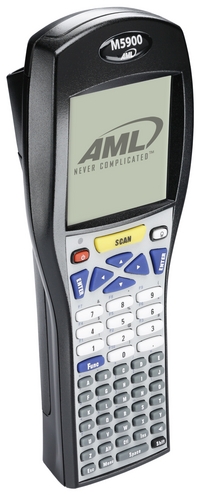
AML has graced this page numerous times with its offerings, and this time around it has a new data-capture device, the M5900, which aims to “supply big-business functionality at a small-business price”. AML's target customer is one needing “high performance for everyday, all-day data collection applications, including inventory control, factory-floor management, price verification, shipping/receiving, asset tracking” and so on. Feature-wise, one will find 32MB RAM/16MB Flash ROM memory (with 10MB of user-available non-volatile memory), a 200MHz ARM9 processor, a rechargeable lithium-ion battery (plus backup), backlit LCD display, a 55-key keypad and an SQLite database engine—with an embedded Linux OS running the show, of course. Other options include industrial or general-purpose configurations, as well as four different laser choices.