
Letters
Questions on Internet Radio to Podcast Article
Great article in LJ, September 2005 [“Internet
Radio to Podcast with Shell Tools” by Phil Salkie]!
There is a slight problem: in your final bash script you sleep for 2.1
hours and leave for the script to then figure out what the process id
number of mplayer is. More than two hours seems to be quite an extended period
of time on which any process may be forked onto the background, and
then that subsequent process would be the one killed.
Why don't you capture the PID of mplayer onto a local variable and
then kill that PID stored on that variable?
—
Juan C. Müller
Error in Kernel Korner
There is an error in the code samples for the Kernel Korner article
[“Sleeping in the Kernel” by Kedar Sovani] in
the September 2005 issue: wait_event() and wait_event_interruptible() should
not be passed the address of my_event, but my_event itself. That is
because they are macros, and their implementations will wind up using
the address-of operator (&) to take the address of the parameter they
are passed.
—
Bob Bell
On Patents
In Don Marti's editorial reply to Darin Riedlinger's letter “Multimedia Lock-in?” he states, “You can create your own media in patent-free formats you can use on any OS.”
I seriously doubt this. If, for example, OGG would become very popular such that MP3 players (of the hardware version) would start to come out without MP3 support, with the intent of not paying the royalties for the MP3 patents, then those holding the patents on MP3 would be quick to find a patent that also applies to OGG.
Currently, patents are granted on way too obvious things. “Audio compression by omitting nuances that the human ear cannot detect” is a description I heard of a patent that Fraunhofer supposedly holds. On an authoritative-looking Web site I found titles as short as: “method for coding an audio signal”, which with a bit of fantasy can really apply to, say, OGG.
Thus, a statement that implies that media formats like OGG are patent-unencumbered cannot be made. The only thing that you can say is that nobody has stepped forward to claim that he or she owns a patent on something in a format like OGG.
The intent of patents has always been to protect:
The small inventor who invents something that nobody would have invented, but is somewhat obvious after the fact (for example, a chain with differently sized gears to drive the rear wheel of a bicycle). An inventor like this may need some time to set up a factory and earn a fair compensation for his “brilliance”.
The big companies who spend big bucks to develop something interesting. These need a “grace period” to earn back their investment.
The whole patent application process has become too expensive for the first type of inventors. And the big corporations are claiming that they actually do have millions of “inventions” that warrant the second type of protection. But way too many “the time is right” type of things are being patented.
I'm convinced that any serious application, open source or not, will violate several patents. If some smaller company happens to have patented something later seen in say Microsoft Word, then they might get up the nerve to step up to Microsoft and ask for royalties. In return, Microsoft will research whatever the smaller company is making and try to find a patent infringement on something they hold. Most likely it will turn into a “we won't pay for the use of your patent in return for the use of ours.”
Big companies have an arsenal of patents they can use for this type of stuff. Remember when IBM first was approached by SCO? Within a month, IBM had found a bunch of patents of theirs that SCO was violating. Only if the other party becomes “annoying” do the big patent monsters come out of hiding and start to throw threats around.
Becoming “annoying” can be done in several ways: cutting into royalty
payments on another patent (MP3/OGG), asking for royalty payments for
some obscure patent (small company/Microsoft example) or filing a big
lawsuit (SCO/IBM).
—
Roger Wolff
ALSA Problem
In the article “A User's Guide to ALSA” in the August 2005 issue, Dave
Phillips
mentioned having a desktop system with a SoundBlaster Live! Value sound
card.
This caught my attention because I have the same kind of sound card in my
system. I have been unable to use ALSA, however, because I have digital
speakers
and have been unable to determine how to tell ALSA to switch my card to
digital
output. I am able to switch to digital output under OSS using a utility
from the
emu10k1 package available at sourceforge.net/projects/emu10k1. The
actual
command line that I use is emu-config -d with the
-d meaning “switch
output
to digital”. I would like to begin using ALSA, however, because it
appears that
development on the emu10k1 package has been discontinued, and the days
for OSS
appear to be numbered. Perhaps Mr Phillips or one of your readers
might have an
answer to my dilemma.
—
Mark Iszler
Dave Phillips replies: the SBLive is certainly a complicated beast. Alas, I don't have digital speakers, so I can't provide a direct answer to your question. However, I suggest checking your mixer for channels named IEC958-whatever. These are the SBLive digital (S/PDIF) channel controls as they appear in alsamixer and in qamix.
Be sure your digital speakers are connected to the digital output of the card. (Sorry, just trying to be complete.)
I'm a little unclear as to whether you're actually using ALSA yet. Also, let me know what kernel version and ALSA release you're using; this makes a difference.
More on Linux Hardware Support
Robert Love's article “Project Utopia” [October 2005] is a great overview of the direction in which Linux hardware support is moving.
We have developed some programmable network hardware for the PCI bus, and
are in the process of developing Linux drivers for it.
We would love to see more articles on HAL, udev and ssyfs, explaining how
they fit together, examples of how to use them and so forth.
—
Greg Watson
And More Requests
I would love to see more articles about installing and tuning a Linux Debian distro on a PPC box. I dual-boot into OS X 10.3.9 and Ubuntu on a G3 iBook and have yet to find anyone on-line who knows how to get ALSA drivers working on it.
I love the Linux platform and realize the imminent move to the Intel
hardware might make some of this moot, but there are people out there
right now with PPC machines who want to do sound and video using free
Linux tools.
So, how about an article or column dedicated to getting ALSA drivers
working on a PPC?
Keep up the great work—love LJ!
—
Kim Cascone
Getting Organized
I appreciated the article in the October 2005 Linux Journal by Sacha Chua [“Taming the TODO”]. Emacs has been on my list a long time, but I still haven't started using it; I just got started with vi and didn't want to learn something new. Maybe I'll give Emacs a try now.
I also appreciated your acknowledgement of the index card method. I use that a lot, especially when at a customer site without my laptop or guaranteed Internet access.
Another solution you didn't mention is the wiki. Although not as formal or
organized as an issue-tracking system, it does revision control on your
documents
and makes them publicly accessible via a Web browser. I use wiki for
my
personal TODO list as well as communal TODO lists for several projects.
—
SamU
Open the Name Linux
One indication that Linux(R) will have reached mainstream would be if there were so many companies supporting Linux listed in the Yellow Pages that the phone company has to create a separate Linux category. However, this ideal seems distant, because attractive Linux company names are being declined by the Linux Mark Institute (LMI).
One recent example of an unacceptable name was discussed on our local Linux mailing list. An entrepreneur learned from LMI that “Linux of Sacramento” was unacceptable—a name likely to generate many phone calls.
An LMI representative said that they are assigned the responsibility to protect the health of the Linux mark by keeping it from being diluted. When I asked the representative for an explanation of how a mark could become unhealthy by dilution, his explanation was too obtuse for me to understand. However, I could understand that a Linux name license would be approved if the name did not imply an exclusive source of Linux in an area. But how would an exclusive source of Linux make the name unhealthy?
I pressed the representative for a case study of a trademark becoming unhealthy by dilution—Kleenex(R) or Xerox(R)? No, they may become generic—another issue entirely.
Linux will become mainstream when the Linux mark saturates
the public. Efforts to prevent saturation is counterproductive;
instead, decision-makers should consider further opening up
the Linux name.
—
Tim Riley
Sweet!
Here is a photo of a bag of sweets, popular here in Thailand. Comes in menthol flavour as well!
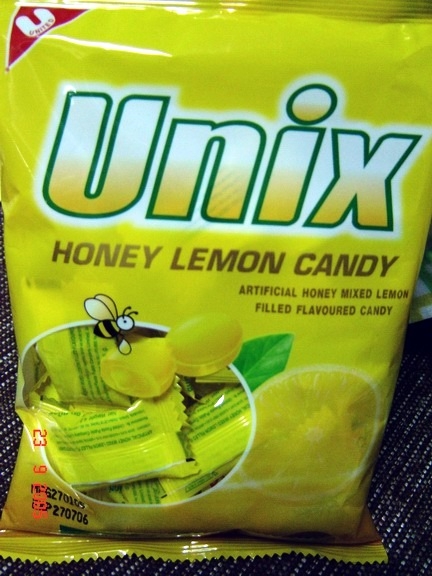
Great magazine by the way.
—
Andrew
Errata
Regarding the article “The Ultimate Linux Lunchbox” by Ron
Minnich in the November 2005 issue of LJ: the first
minicluster by Sandia was the brainchild of both Rob Armstrong and Mitch
Williams. This system was built in 2001, not 2000 as was stated in the
article.
—
Ron Minnich
