
2005 Linux Journal Readers' Choice Awards
Editor's Note: This article has been updated since its original publication..
We overhauled the voting process for this year's Readers' Choice Awards in the hope of creating a fairer system that voters were involved in every step of the way. As such, we accepted nominations from readers in 31 categories and then held two rounds of voting to get this final list of your favorites.
Some readers were surprised by the list of candidates that made it to the final round. For instance, the big-name distributions, such as Debian, Red Hat and SUSE, were nowhere to be found. Although these absences may seem odd, we call these the Readers' Choice awards because they are exactly that—these are the products and tools our readers are using and loving this year.
Here we present the top two vote-getters in each category. In categories where vote totals were particularly close, we have listed the top three finishers.
XMMS
amaroK
For the sixth year in a row, XMMS is the first-place finisher in the audio tool category. So you know XMMS plays MP3, OGG, WAV and CD audio file formats. You also probably know that it supports a whole bunch of third-party input plugins. But do you know about its equalizer and playlist capabilities? Do you know about its advanced plugins for file I/O, special effects and visualization? If not, you must have missed Dave Phillips' article on “Getting the Most from XMMS with Plugins” (see the on-line Resources for links to articles), which covered some of the functionality that helps keep this classic tool a favorite.
Amanda
Bacula
We split backups into two categories this year to differentiate between simple tools that can back up a single system (see Favorite Backup Utility below) and more complex programs administered centrally to back up multiple machines. Although not as flashy as some other backup systems, Amanda (advanced Maryland automatic disk archiver) offers “a reliable platform for many Linux and UNIX users who are comfortable with a command-line interface”, according to Phil Moses, who wrote about it for us in “Open-Source Backups Using Amanda”. Apparently, many of our readers agree.
tar
rsync
Even though many backup tools are available from vendors, we know that our readers often prefer to stick with the basics. Thus, your favorite backup utilities, tar and rsync, are basic command-line tools that were separated by less than a hundred votes in this year's competition. You can do a lot with tar, from building basic single-file archives to creating multivolume backups. Sometimes, though, the most tried-and-true tools are the ones we take for granted, so to learn more about what you can do with tar and rsync, take a look at these past LJ articles: “The Skinny on Backups and Data Recover, Part 3”, “LVM and Removable IDE Drives Backup System” and “rsync, Part I and Part II”.
MySQL
PostgreSQL
Celebrating its tenth anniversary this year, MySQL once again scores the top place in this year's voting. Besides offering more features than ever, MySQL also is being included in more big-name vendor products, thanks to the ever-increasing popularity of LAMP applications. In “An Open Letter to the Community from MySQL Founders David Axmark & Michael ‘Monty’ Widenius”, the founders offered these impressive stats: “over 100 million copies of MySQL have been distributed” through the Web site and operating system distributions; approximately 40,000 new downloads every day; more than 1,500 projects on SourceForge.net are using MySQL; and current users include Craigslist, Slashdot, Wikipedia, Bugzilla, Technorati and the Human Genome Project.
KDE
GNOME
The dot.kde.org site carried a link to the Readers' Choice voting page this year—did the extra promotion to KDE fans make the difference? As detailed below, this year's favorite distribution is GNOME-based while the favorite language is the base language for KDE. People seem to be using the best technologies from both environments.
Dell
Apple
Monarch
People like Dell's boxes, but it's still confusing to buy anything but a top-of-the-line workstation from them if you want to run Linux. And even then, according to the Dell Linux Engineering page, “all Dell N-Series Precision Workstation desktops are available and supported with Red Hat Linux. For help running other Linux distributions on your Workstation, you might consider posting to or viewing the linux-precision mailing list.”

Dell Precision 380 Workstation
GCC
KDevelop
Eclipse
Wait a second before skipping to the next category—this result isn't as boring as you might think. Yes, GCC won again, but it's a whole new GCC world out there. Earlier this year, Tom Tromey wrote that GCC “has undergone many changes in the last few years. One change in particular, the merging of the tree-ssa branch, has made it much simpler to write a new GCC front end.” Find out why in “Writing a GCC Front End”.
Ubuntu
CentOS
Fedora Core
Judging by the comments posted on the LJ Web site during the voting process, a lot of voters were “shocked” and “flabbergasted” that the brand-new Ubuntu made it to the final round, while Red Hat, Debian, SUSE and other big names were absent. Maybe it's a passing phase of Ubuntu mania, but as Steve Hastings wrote in his LJ review, “Ubuntu Linux is an excellent choice for anyone who wants to run Linux on a desktop system. It's easy to install and to administer. Everyone from beginners to experts can use and appreciate it. And it's free.”
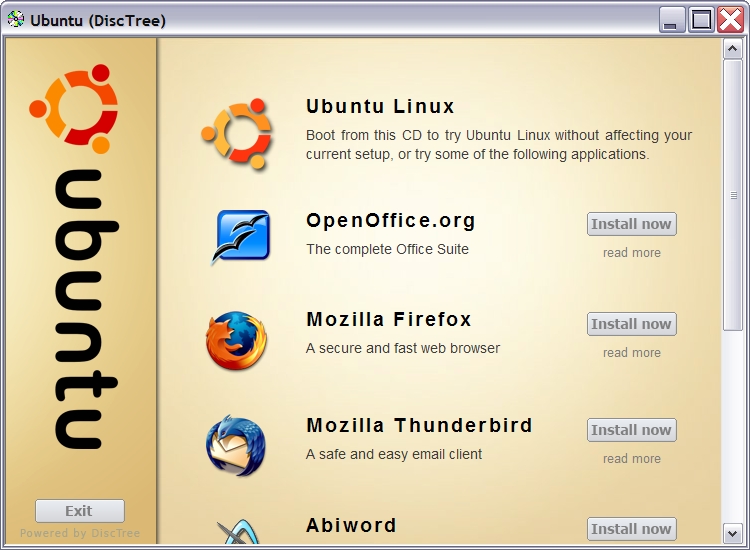
Ubuntu: Linux for Human Beings. Linux users around the world have surged to Ubuntu this year. You have to feel good about using a distribution whose name means “humanity to others”.
Mozilla Thunderbird
Evolution
In the early days of the Readers' Choice Awards, the top finishers in this category always were mutt, pine and other text-based programs. The last couple of years, though, the majority of readers—at least the voting ones—have given up the basics for one of the smooth new GUI-based clients. And Thunderbird seems to be responsible for a lot of these conversions.
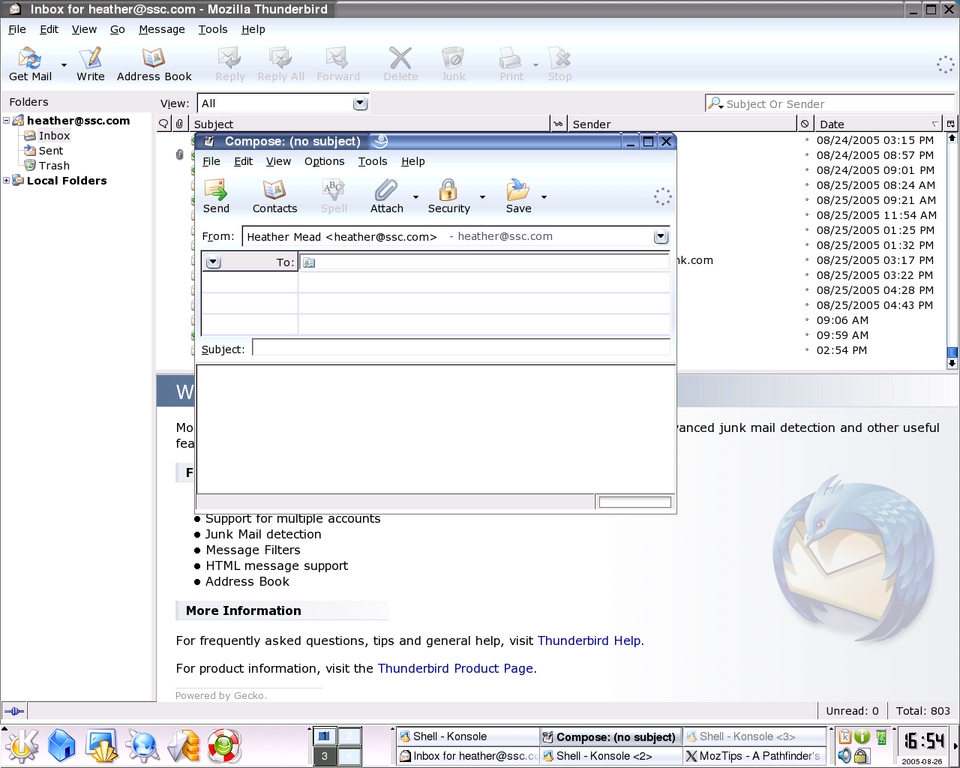
Thunderbird's interface will look familiar to users of other GUI-based and Web e-mail programs. But it's better.
Qtopia
LFS
OpenZaurus
Nitpickers might say that Qtopia isn't a distribution because it doesn't include the kernel, but it's a full-featured embedded development environment. Qtopia is built on Qt/Embedded, the C++ GUI and platform development tool for Linux-based embedded development. You get all the source code and can do whatever customization you want. Everyone from Samsung to Motorola and Phillips is using Qtopia for PDAs, cell phones and other cool new gadgets.
The GIMP
Inkscape
Everyone knows The GIMP rules this category and has for practically the past decade. But wow, there are a lot of votes for Inkscape this year. Our editors selected it for an Editors' Choice Award earlier this year as well. So maybe it's time the rest of you take a look at Inkscape, especially if you're concerned about making your graphics look good at a variety of screen sizes by using a vector format.
Gaim
Kopete
Gaim integrates with both GNOME and KDE, thereby setting a desktop application paradigm for the future—an application that plays standards, not desktop wars. Besides that, the selection of smiley-face icons is great for adding a touch of sarcasm with a well-placed smiley-face wearing a halo or shedding a tear.
Running Linux, 4th Edition
Gentoo Handbook
A Quarter Century of UNIX
Here's a fun project for a cold fall evening: compare the table of contents in the first edition of Running Linux to the one in the fourth edition, and see how much more you can do now and how much less time you need to spend tweaking low-level stuff. Much space in the first edition, for example, was used to explain things such as kermit and elm—it even brought up troff (shudder). The fourth edition, however, talks about KDE and GNOME, not to mention the final section on Web development with LAMP.
Frozen Bubble
Unreal Tournament 2004
We know it's not your fault that you keep playing Frozen Bubble. We can't stand the pitiful little noise the penguin makes when we lose either.

You guys are suckers for cute animation.
IBM
lintraining.com
Novell CLP
Yes, we know training is important and the horrors of what can happen when a poorly trained sysadmin is set loose in a server room. But we don't know why IBM won; in the ads, that kid who looks like Eminem's little brother seems pretty bored. Maybe a Mick Bauer live security intrusion demo would hold his attention a little better.
Slashdot.org
Distrowatch.com
LinuxJournal.com
LWN.net
Readers always will have a special place in their hearts for a Web site that, on one page worth of headlines, offers updates on PSP 2.0, marketing strategies for Firefly (Joss Whedon's canceled TV show that made it to the big screen), Google's new IM client and house-sitting robots in Japan.
Cooking with Linux by Marcel Gagné
Paranoid Penguin by Mick Bauer
At the Forge by Reuven Lerner
Oh, François, the readers, they love you still. Un affair de coeur, c'est tr� beau, non? 2005 was pretty significant for the second- and third-place finishers, as regular Paranoid Penguin columnist Mick Bauer turned it over to a rotating author list and Reuven Lerner celebrated his 100th At the Forge.
MPlayer
Xine
Kaffeine
We know our US readers aren't actually running MPlayer because of the software patent situation, but it's nice to see what people in countries with more sensible patent systems can do.

For our readers living outside the US, MPlayer really does run on anything—even your Zaurus.
Astaro Security Gateway
Cyclades AlterPath ACS
thinklogical Sentinel32
Besides the fact that Astaro works well, our readers appreciate that the Astaro box isn't just a “firewall” in the ordinary packet-filtering sense. It also comes with antispam, antivirus, intrusion detection and a Web proxy—features that would be expensive add-ons for other firewalls.
OpenOffice.org
KDE Kontact
LaTeX
Garnering over a thousand votes more than the second-place finisher, OOo has built a strong following in the Linux and Open Source community, thanks to its compatability and usability—not to mention our monthly Web column by Bruce Byfield, OOo Off the Wall. Check out his past columns on the LinuxJournal.com site for great documentation on using fields, creating templates and organizing work flows. And don't miss the reader comments, where questions are asked, answered, debated, clarified and argued some more.
IBM ThinkPad
Apple PowerBook
Dell Latitude
We're all in suspense about what the new ThinkPad company, Lenovo, is going to do Linux-wise. Although ThinkPads are a common sight at Linux conferences, every one has to be tweaked or ordered through a company, such as EmperorLinux, that does a custom install for you. Do a Google search for ThinkPad, and right after thinkpad.com comes a Linux site, and six of the top ten results are Linux-related. HP's Linux laptop mysteriously vanished from the company's Web site without a trace, but maybe Lenovo will listen to their Linux-using fans instead of falling prey to mysterious marketing conspiracies.
x86-64
POWER
IA-64
Readers were waiting for it, they needed it, coveted it, and once the 64-bit next generation of x86 became available, first from AMD, then from Intel, things just haven't been the same here. It's not even close anymore. We shouldn't talk, though; we've featured x86-64's 64-bit processing power in the last three Ultimate Linux Box articles. More power is good.
Coffee
Tea
Water
Mmmm, coffee, that sounds great. Can you get me a triple-shot Americano, please? #c0ffee is even a valid hex color to try on your Web site.
C++
Python
PHP
Back in early 2003, Don Marti asked the following question regarding C++: “Now that we have GCC 3.2.x...and an increasing collection of interesting free software using C++, is it time to take a second look at this perhaps unfairly maligned language?” He didn't expect that a mere two years later, C++ would win here. A lot of that has to be the rapid growth of Linux to include the world's C++ coders—welcome to Linux, all of you.
HP ProLiant
Monarch Empro Custom Rack Server
Unisys ES7000 Family

Last year, the HP ProLiant BL20p G2 won the Editors' Choice Award for Server Hardware. Now the readers are singing the ProLiant's praises.
A note to HP: please take this first-place win here, where second-place votes were less than half of what you received, as proof that we like your boxes, so you can cut out the pointless marketing poo-flinging at Sun, already.
OpenSSH
Webmin
YaST
Looking back at past LJ articles on OpenSSH, we found titles such as “Doing It All with OpenSSH 1”, “Doing It All with OpenSSH, Part 2” and “The 101 Uses of OpenSSH”. So combining that with its big win here, it looks like you can do a whole lot with OpenSSH—and you are.
Vim
Kate
Emacs
What, use something besides Vim? What do you have against orphans? Don't you know that “Vim is Charityware. You can use and copy it as much as you like, but you are encouraged to make a donation for needy children in Uganda. Please visit the ICCF Web site”; URLs available in the on-line Resources.
Subversion
CVS
GNU Arch
The LinuxJournal.com editor would like to point out that the site published “Setting Up Subversion for One or Multiple Projects” back in 2004. Print was snoozing and covering Arch while the Web site was doing the Subversion stuff that was a hit with readers used to CVS-style development. Yay Web!
VMware
Xen
Virtualization is becoming bigger news these days. VMware lets you run an unmodified guest OS and has been around for longer than the rest, so one or both of these factors matters to voters. If you're new to VMware, we suggest you start by reading “VMware 5 Workstation Edition Reviewed” to get an overview of what it can do. Meanwhile, Xen is a solution that's easy to get started with for Linux-on-Linux setups.
Mozilla Firefox
Konqueror
Firefox, so good everyone from our editors to the government recommends you use it. For more under-the-hood stuff, check out Nigel McFarlane's article “Fixing Web Sites with GreaseMonkey” from the October 2005 issue.
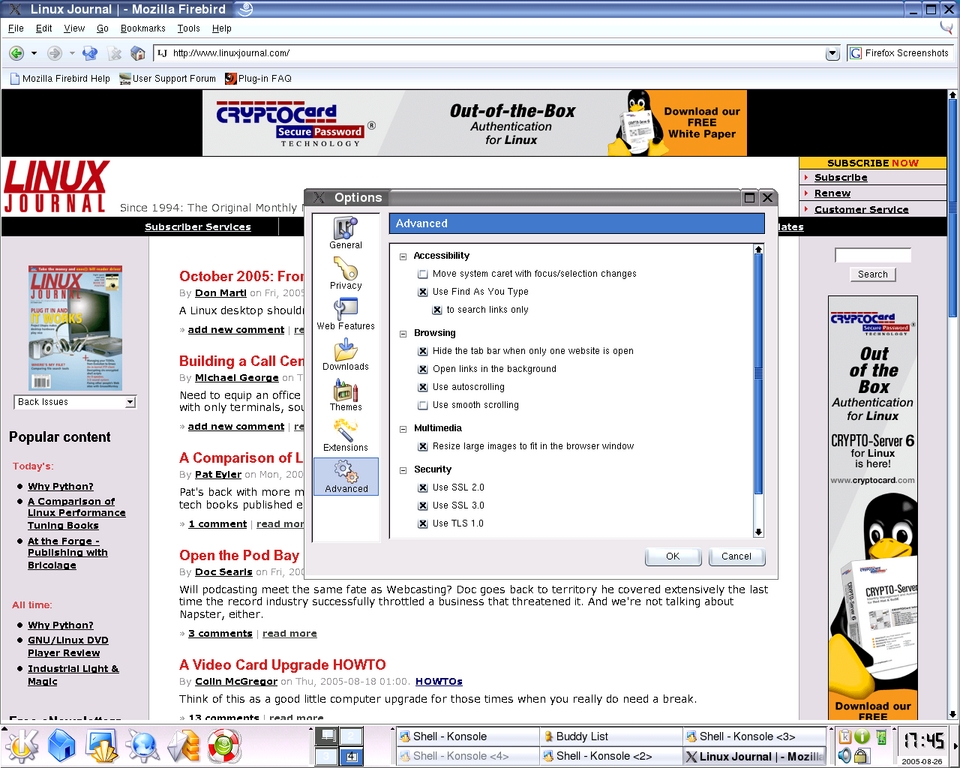
When everyone, including the United States Computer Emergency Readiness Team, recommends users switch to your browser, you have to know you're going to win the Readers' Choice Favorite Browser award.
Rackspace Managed Hosting
1&1 Internet
Rackspace won here, although this category didn't collect a ton of votes. It did, however, manage to start a comment debate about a host's responsibilities when its clients are the subject of secret search warrants. (“Final Voting in 2005 Readers' Choice Awards”, see Resources.)
That's it for this year. Let us know what you think of the new voting process. And thanks to the 2,358 of you who voted.
Resources for this article: /article/8525.

