New Products
Supermicro Computer announced the launch of Intel dual-core products, the SUPER PDSG4 and SUPER PDSGE motherboards, which support PCI-X 133/100 expansion cards. Based on the Intel 955X chipset, the SUPER PDSG4 ATX form factor board supports one Pentium Processor Extreme Edition, featuring two processing cores with a 1066/800/533MHz system bus. It also offers 8GB of ECC unbuffered DDR2-667/533/400 SDRAM; a user overclock feature in the system BIOS; PCI-Express x16/x1; three 32-bit PCI, two PCI-X 133/100 and four SATA ports (3Gbps); RAID 0, 1, 10 and 5; eight USB 2.0 ports; onboard AC97 audio; single PCI-Express Gigabit LAN; and U320 single-channel SCSI. The SUPER PDSGE is based on the 945G/P Express and supports one Pentium D Processor, featuring two processing cores with a 1066/800/533MHz system bus; 4GB of unbuffered DDR2-667/533/400 SDRAM; a user overclock feature in the system BIOS; PCI-Express 1x16/2x1; four 32-bit PCI and four SATA ports (3Gbps); eight USB 2.0 ports; onboard AC97 audio; single PCI-Express Gigabit LAN; and integrated Gfx graphics. Both boards are RoHS-compliant, lead-free and optimized for Supermicro's SC733T-645 and SC733i-645 mid-tower chassis.
Supermicro Computer, Inc., 980 Rock Avenue, San Jose, California 95131, 408-503-8000, www.supermicro.com.

Capricorn Technologies introduced the PetaBox Product Family, designed for massive data storage. The PetaBox supports petabyte-class storage with state-of-the-art density, low power consumption and a low total cost of ownership. The PetaBox is scalable from individual terabyte nodes to a full petabyte cluster. A single 19-inch rack can support up to 64TB of raw disk space, a density achieved through a design that consumes as little as 50 watts per terabyte. Four models of PetaBox currently are available: the GB1000, a 1.0TB node; the GB1600, a 1.6 TB node; the TB40, a 40TB rack; and the TB64, a 64TB rack. Each node has four hard drives per node, an ATA interface, rotational vibration compensation, 8MB of cache, 8.5ms of typical latency and an EZ-Latch disk mounting system. Nodes also feature a 1GHz VIA C3 CPU, up to 1GB of DDR266 RAM, two USB 2.0 ports, 10/100 or 10/100/1000 Ethernet and an optional 16x2 character LCD.
Capricorn Technologies, 1021 Mission Street, San Francisco, California 94103, 415-722-2149, www.capricorn-tech.com.

Trolltech released version 4 of it Qt cross-platform development software. New features for Qt 4 include improved heavy-duty graphics capabilities. Qt's painter now supports semi-transparency, anti-aliasing, optional floating-point coordinate system, painter paths and gradients. Support for interchangeable underlying paint engines and off-screen rendering also has been added. Trolltech also extended Qt's multithreading capabilities, along with its database integration and XML support for building both desktop and server-side applications. In addition, Qt 4 offers seamless integration with Microsoft Visual Studio .NET, allowing Visual Studio .NET developers to create applications that can run on Linux, Mac OS and other desktop platforms. Furthermore, Qt 4 for Microsoft Windows is available under the GPL. Three editions of Qt 4 are available: Qt Console, Qt Desktop and Qt Desktop Light.
Trolltech, Inc., 1860 Embarcadero Road, Suite 100, Palo Alto, California 94303, 650-813-1676, www.trolltech.com.

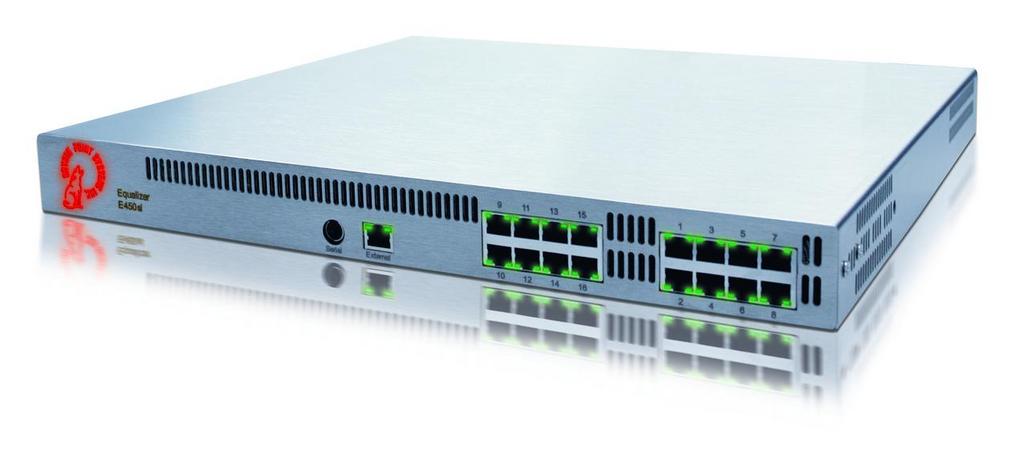
Coyote Point recently introduced a new line of Web server performance appliances designed to address core availability and performance requirements of Web sites and server farms. The Equalizer SI Series systems integrate an enhanced version of Coyote Point's adaptive server load-balancing and traffic management software, consolidated switch intelligence and Intel processor-based performance. Three systems are available: the enterprise-class E450si, the mid-range E350si and the entry-level E250si. Their features include consolidated switching capacities of up to 16 ports; support for up to 8,000,000 concurrent connections; incrementally scalable load balancing and traffic management for an unlimited number of virtual servers and up to 64 servers per cluster; adaptive protection against DoS attacks; built-in Flash memory for zero-downtime reliability; SSL acceleration for up to 4,000 encrypted transactions per second; and an enhanced Web interface for point-and-click operation of configuration options.
Coyote Point Systems, Inc., 675 North First Street, Suite 975, San Jose, California 95112.
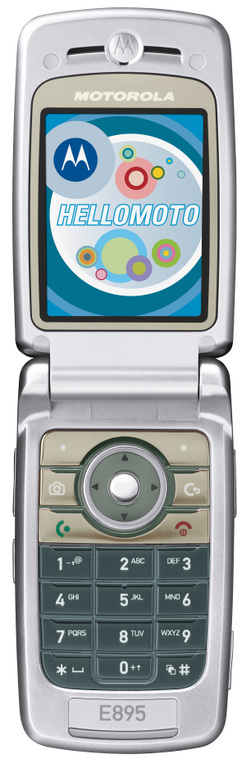
Motorola announced the release of the E895 multimedia clam-shell handset, built on Motorola's EDGE technology, Linux and Java. The E895 offers a suite of intuitive multimedia tools, including a 1.3 megapixel camera, video record and playback options and an optional removable memory. E895 features include 3GPP video streaming and the ability to view files as they download, Bluetooth wireless technology and Bluetooth Stereo Headset, SyncML, streaming audio, shared media player with multiple audio codecs and stereo through the enhanced mini-USB headset jack, up to 10MB of embedded memory, and TransFlash removable memory for up to 512MB of optional memory. The E895 also offers a full HTML/XHTML Web browser, multimedia messaging service (MMS) and instant messaging.
Motorola, Inc., www.motorola.com/motoinfo.