
Letters to the Editor
Use the Archives, Luke
Just wanted to say thanks for an article
by Michael Johnson from July of 1996
(/article/1237). This
was an article about diff and patch. Although I've
been a UNIX/Linux admin for ten years, I have never
patched source and needed a quick lesson. This did
the trick. Thanks again!
—
Scott Martin
Or We Could Have Put an Infiniband Card on the Cover
My wife Regine is a belly dancer with the Shimmering Sands here in Alice Springs, Australia, so when I pulled my latest copy of Linux Journal out of the mailbox, my first thought was “Our worlds collide!” As the semi-official photographer for the Shimmering Sands and a longtime Linux enthusiast, I had already experimented with using The GIMP, gthumb, Nvu and other open-source tools to manipulate some of the hundreds of belly dance photos that I've taken.
But, I never really thought that much about the many
ways in which my Linux hobby and my wife's belly
dance hobby might potentially overlap. Thank you for
opening my eyes. I'm now looking into open-source
music packages such as the Hydrogen virtual drum
machine, which seems like it may be quite useful for
producing some wicked belly dance practice beats.
Now if I can just find out what happened to the
apparently defunct TablaBeat Project....
—
Brian Haynes
You might want to see if the tools in “Music Education with Linux Sound Tools” (www.linuxjournal.com/article/7606) can help for dance practice too. —Ed.
Mmmm, Cake
Planning a big wedding is HARD. Two things I planned were having Larry Ewing's Tux on my cake (Linux is part of my life and my job) and a helicopter to take my bride and me from the ceremony to the reception. Kelly, my bride, was all for having Tux—she made the switch to Linux before I did.

—
Chris Turner
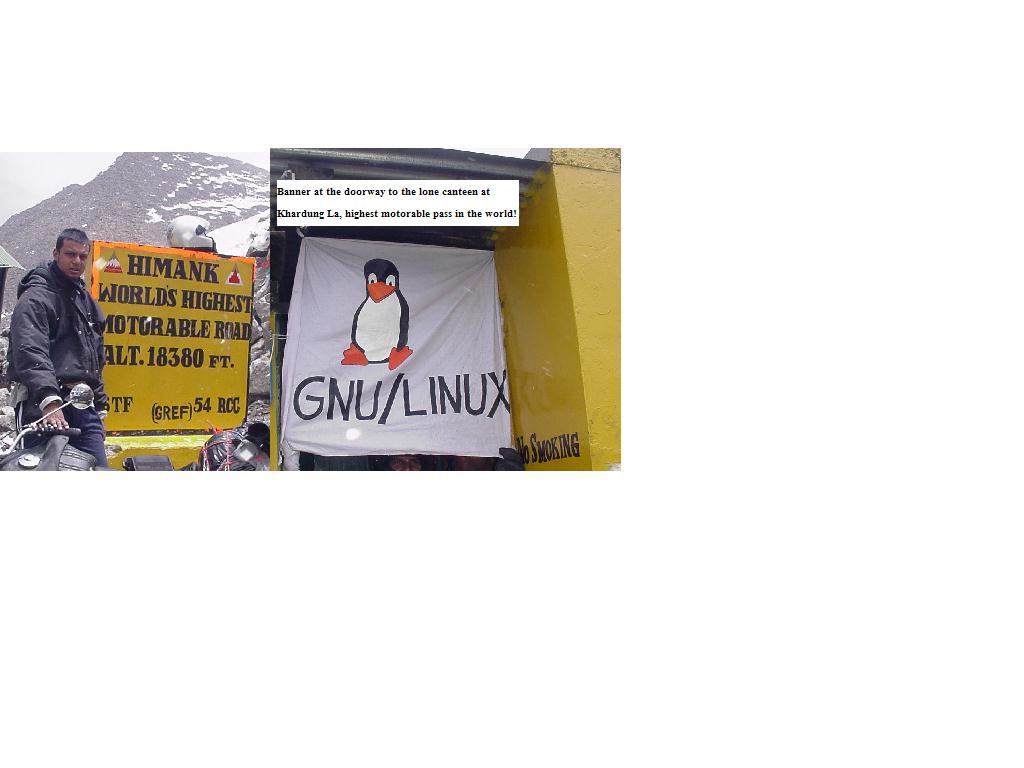
Photo of the Month: Ride in the Himalayas
While I was working in Bangalore, India, I
started a Royal Enfield Bullet Owner's group
(bullet-bangalore.org) and a few of our guys
rode to the Himalayas on their bikes. They saw this
interesting banner on the only tea stall at Himank,
the world's highest motorable road, put up by another
group of bikers before them. Take a look. The picture
was taken by Sandeep Menon.
—
VaibhaV Sharma
Photo of the Month gets you a one-year extension to your subscription. Photos to ljeditor@linuxjournal.com. —Ed.
WLAN Configuration Question
I have followed the last three issues of Linux Journal and the article “Securing Your WLAN with WPA and FreeRADIUS”. I think that the article was very good and helpful, and now I am trying to implement that same solution.
I have one question: in Part III where you are configuring eap.conf you have:
private_key_file = ${raddbdir}/certs/bt_keycert.pem
certificate_file = ${raddbdir}/certs/bt_keycert.pem
The names don't match any of the previously created certificates.
Which certificates/private key are those? The ca's, the server's
or the client's?
—
Tulio
Mick Bauer replies: Oops, Listing 3 is incorrect! Those lines should instead read:
private_key_file = ${raddbdir}/certs/server_keycert.pem
certificate_file = ${raddbdir}/certs/server_keycert.pem
That is, these lines both specify the path to the server's key/certificate file. Sorry for the confusion!
Why Call It DRM?
Digital Rights Management? Isn't that a five-dollar
euphemism for “Copy-Protection”, which is a
perfectly good, accurate description of the
practice? Indeed the DRM term arose because
“copy-protection” had become such a negative brand
that no one would dare offer a product afflicted
with it. So why are we cooperating with these people
and using their phoney sanitized term?
—
j.g. owen
DRM went beyond just controlling copying, and sometimes even keeps you from using functions such as fast-forward. And having a vendor “manage” our digital rights just sounds wrong. —Ed.
/var/spool/fanmail
Linux is my one friend here in jail, and this
one friend communicates with me through Linux Journal. Thank you for this superb magazine.
—
Steve Zimmerman
Good Intro Book?
I am a longtime Microsoft user and am interested
in opening some Web pages and Web-based businesses.
I would appreciate any recommendations for books or
other literature that you could give me for someone
just starting out in Linux with the idea of running
a server.
—
Richard Tewell
Readers, let's help out Richard out here. To vote for your favorite intro to Linux book, visit our Readers' Choice awards page at www.linuxjournal.com/article/8272. We'll cover the winning titles in our November 2005 issue. For getting started running Linux servers, we like Linux Network Administrator's Guide, Second Edition, by Olaf Kirch and Terry Dawson, and our own Mick Bauer's Linux Server Security, Second Edition. —Ed.
Samba Stays Up, Training Program Doesn't
To the faithful subscriber with no computer access—you're not alone! I too am incarcerated—Florida D.O.C.
Your magazine is my only source of computer information. We used to have a computer program, but it was removed along with several other vocational programs in the name of cost savings. There is now no more skill training in most of the state's prisons.
In the two years prior to the removal of our program, we were able to replace three servers with an all-Linux back end using Samba, Postfix and NFS/NIS. With only a few minor adjustments to the clients, the students experienced only about 40 minutes of down time. Not bad for a class of 65. In fact, the conversion of Windows servers to Linux was unnoticed by any of the students.
Our project allowed us to purchase new hardware for the students that otherwise would have been used to upgrade our servers. Using Linux saved us from the first round of budget cuts as we saved over $5,000. But sadly the great state of Florida feels it's better to offer no eduction to people. Still, for a while we were able to enjoy “freedom”.
Keep your informative articles coming. And to all the
pending new Linux users—our time will come—mine
will be June 2006, and I have the goal of starting
a local computer service that specializes in using
open-source software.
—
Benjamin Davis
Labels over Covertext
Every month the subscription label covers some text describing the contents. And, the label is sometimes horizontal and sometimes vertical.
If you move the barcode and price to the lower left
corner of the cover and leave mailing label (plus
safety factor) room around it, the problem will be
resolved. Subscribers don't need the barcode/price,
and retail sellers don't care on which corner the
bar code and price are located.
—
Rich
Garrick Antikajian responds: we try to place text and the other cover elements in a way that achieves the best possible cover design. The mailing label placement is decided by our printer. These factors sometimes result in text being partially obscured. We appreciate your input on this matter and apologize for any inconvenience this may cause.
New Installer for icalendar
In the article “Dynamically Generated Calendars”
in the June 2005 issue, Mr Lerner states that the
package does not install automatically. I've been
using this package myself for a commercial product I'm
developing and found that the Web site he referenced
was an old, outdated page which has been quietly
replaced. The old site, unfortunately, makes
no acknowledgement of the new site, which resides
at codespeak.net/icalendar. It contains
newer versions, which amongst other things, add
an installer.
—
Eric Windisch
Loop, Loop, Loop
Mike Mattice suggested that I deserve a UUOF award (Useless Use of For) [Letters, June 2005] for the for loop I used to list all the entries in a directory using only bash built-ins [“My Favorite Bash Tips and Tricks”, April 2005].
echo * will print all the filenames with only a space between them, wrapping the output to the next line as necessary. This can be harder to read when there are many files in the directory. The use of the for loop prints each filename on a line by itself.
Using a for loop also allows the insertion of a read after each echo, as a crude form of scroll control:
for file in *;
  do echo -n $file;
  read;
done
After each filename is printed, it will wait for you
to press Enter before printing the next filename.
—
Prentice Bisbal
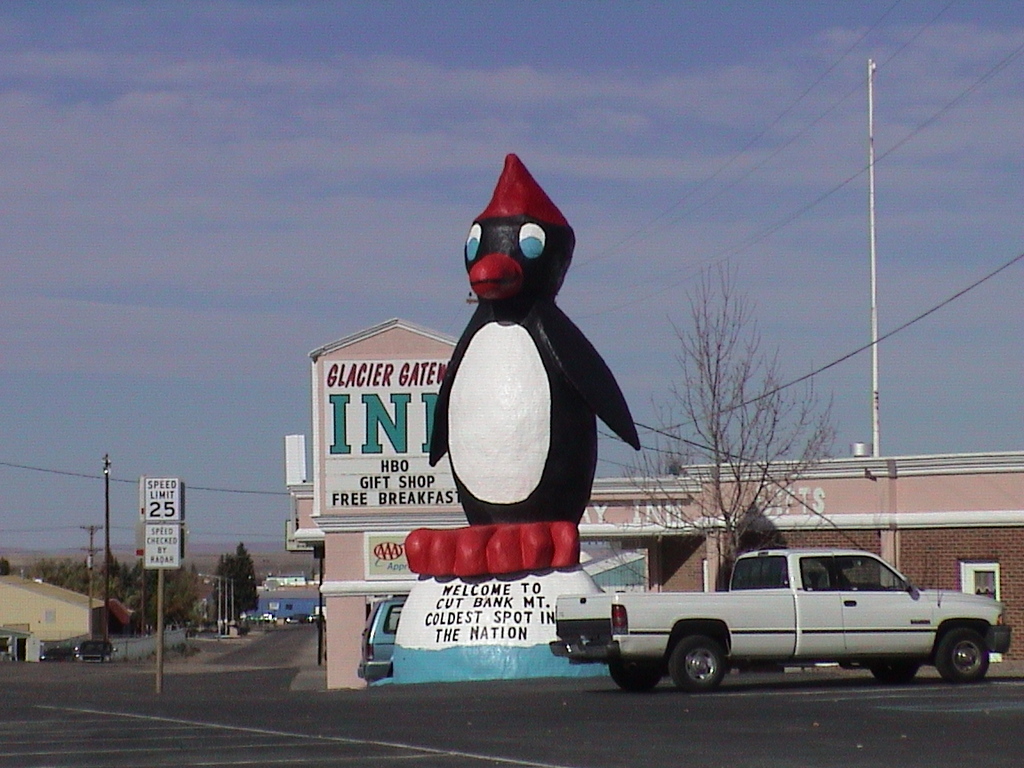
Cold Enough for You?
On a recent trip to the Northern Montana town of Cut Bank I spotted this rather large penguin.
—
Herb
