
New Products
Penguin Computing announced the BladeRunner Cluster-in-a-Box server system, which integrates blade servers, Ethernet switches, storage subsystems, management software and cluster OS software in a single 4U chassis. The BladeRunner cluster comes installed with Scyld Beowulf, a distribution designed for cluster management that provides a single point of installation, login and administration. The single master node blade has dual 2.4GHz Xeon LV processors, a 2GB PC2100 DDR RAM drive and a 60GB fixed 2.5" IDE drive. The 11 slave blades also have dual Xeon LV processors and PC2100 DDR RAM drives and are PXE boot-enabled diskless nodes. BladeRunner configurations can be scaled by adding additional 4U chassis and connecting the integrated Ethernet switches, up to a 42U rack with 240 processors.
Penguin Computing, 300 California Street, Suite 600, San Francisco, California 94104, 888-736-4846, www.penguincomputing.com.

Outblaze-SME is an e-mail platform designed for VARs targeting the small- to medium-sized enterprise (SME) market. Outblaze-SME features administration and collaboration tools that enable SMEs to purchase and allocate storage, as well as administer e-mail, calendar and file-cabinet services through a Web interface. Its collaboration tools allow employees to share calendars, contacts and files, and SME administrators can self-manage user accounts, storage, group lists and global address books. Outblaze-SME also includes POP3, IMAP4 and SMTP protocols for access to e-mail through the Web and mail clients. Outblaze-SME also comes with Outblaze's Sentry antivirus and antispam services.
Outblaze, 10 Marshall Street, Old Greenwich, Connecticut 06870, 203-286-1424, www.outblaze.com.
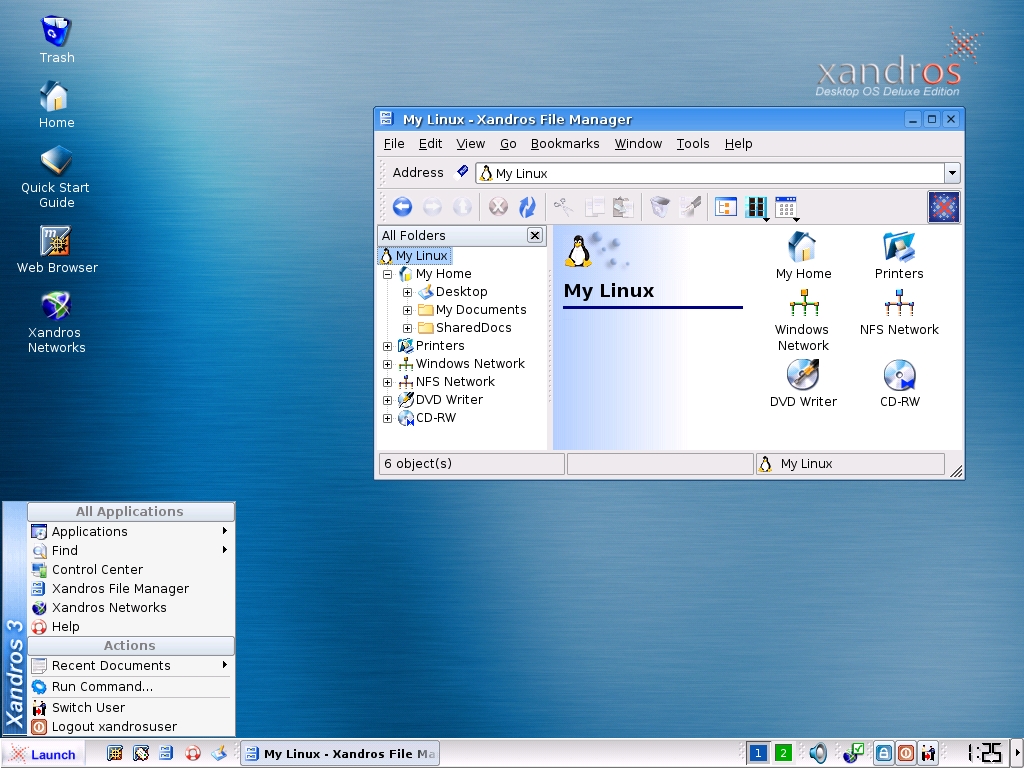
Version 3 of the Xandros Desktop OS now is available for desktop and laptop systems. Version 3 is built on the 2.6.9 Linux kernel and includes a customized version of KDE 3.3. New features in version 3 include drag-and-drop DVD burning in Xandros File Manager, Xandros Personal Firewall, Intel Centrino and wireless card support, automatic encryption for user files, secure access PPTP VPNs, CrossOver Office 4.1 and automatic alerts to Xandros Networks updates. Xandros Desktop Version 3 enables users to drag and drop files from anywhere, including Windows network shares and FTP sites. Users also benefit from automatic spam filtering and virus protection.
Xandros Corporation, 301 Moodie Drive, Suite 200, Ottawa, Ontario K2H 9C4, Canada, 613-842-3494, www.xandros.com.
EmperorLinux announced a new workstation, the Kiwi T1x0, based on the Sony VAIO, models T140, T150, T160 or T170. This three-pound laptop has a 1280 × 768 wide-aspect LCD (10.6"), which X runs in native mode. The Kiwi T150 has been certified for Fedora, Red Hat Enterprise, Debian, Slackware and SuSE. The Kiwis have 1.1GHz Pentium-M 733 CPUs with 2MB cache, 512–1,024MB of RAM, 40GB hard drives and CDRW-DVD or DVD-RW drives. The Kiwis also offer full support for X at 1280 × 768, 24bpp, i855gm; internal 10/100 land-line Ethernet; internal 802.11 a/b/g Wi-Fi Ethernet at 11–54Mbps; USB 2.0; IEEE 1394 FireWire; CardBus cards; and ACPI Hibernate. All versions of the Kiwi come with the EmperorLinux care package and one year of toll-free phone and e-mail tech support.
EmperorLinux, Inc., 900 Circle 75 Parkway, Suite 1380, Atlanta, Georgia 30339, 770-612-1205, www.emperorlinux.com.
M-Systems introduced a new line of DiskOnChip devices featuring up to 8GB of storage capacity, designed for use in music and video handsets. The 4GB DiskOnChip H1, the first product released, offers 90 nanometer process MLC NAND Flash, x2 technology and M-Systems' TrueFFS Flash filesystem, making it capable of managing MP3 and other multimedia files at high capacities in a single chip. The DiskOnChip H series features a legacy NOR-compatible interface, allowing it to be used with any mobile chipset. The H1 offers support for major mobile operating systems, including Symbian OS, Windows Mobile, Palm OS, Nucleus and Linux, and it is compatible with all major CPUs and multimedia processors.
M-Systems, Inc., 555 North Mathilda Avenue, Suite 220, Sunnyvale, California 94085, 408-470-4440, m-systems.com.

