
gnuLinEx 2004 Launched
Editors' Note: Click here to read this article in Spanish.
In August 2004, the new version of gnuLinEx, the operating system used by the government of the Autonomous Community of Extremadura, Spain, was released. This new release confirms that the regional government is determined to bet on free software.
Extremadura is one of 17 autonomous communities in Spain. Each one of these communities includes one or more provinces and has considerable independence from the central government, including the right to decide, among other things, its educational system.
Extremadura is located in southwestern Spain, by the border with Portugal, in the middle of a triangle formed by Madrid, Seville and Lisbon. The region contains about 8% of the country's land, and its population, 1,073,574 people, equals 2.6 % of the country's total. The population is scattered among 383 towns and villages, and only the city of Badajoz (136,319 people) has over 100,000 inhabitants.
Extremadura also is the poorest region in Spain, and the fifth poorest region in the European Union. In its recent history, we have seen how diverse factors have increased the economic and social breach between the region and the rest of Europe. In 1998 an alert arose--the Internet was going to increase the gap.
For that reason a unique project was started. A regional network called Intranet Extremadura was created, and it currently connects more than 1,400 dispersed points, including regional administrative centers, schools, hospitals and centers for public access.
The importance of this network is fundamental. Fifty-seven percent of the population of Extremadura live in towns with less than 10,000 inhabitants. This fact combined with the low per-capita income of the population make Extremadura a non-profitable region for Internet service providers.
Apart from creating the network, some changes were necessary in classrooms across to region in order to provide and maintain 68,000 computers for students. In addition, an internal network for each educational establishment had to be created. An average high school of 600 students requires 15 miles of structured wiring inside the building.
In 2001, the necessary infrastructure for Intranet Extremadura was available, but something was missing--the operating system. The government analyzed all options. After calculating the expenses for each, it was determined that the cost of MS Windows licenses surpassed 20,000,000 Euros. And that figure did not include educational and administrative applications; those applications would have to be developed or bought and adapted to the local infrastructure.
After an analysis of cost and adaptability, the government decided to develop a customized and regionalized version of GNU/Linux. It would be called LinEx. The first version of LinEx, based on Debian Potato, was ordered from a private company. From version 3.0 onward, the development of LinEx has been made totally by the staff of the local government, the Junta of Extremadura.
The installation of LinEx was gradual until it finally reached all of the high schools in Extremadura. Since 2002, Extremadura has the highest density of computers per student in Europe, with a median of one computer for every two students.
The use of LinEx does not reach only the traditional educational system, however. It also is used in some public administration centers, hospitals and centers of technological qualification. The centers of technological qualification, called New Centers of the Knowledge, are special schools that train people to use new technologies. These centers offer people who have left school the opportunity to become familiar with computers.
Additionally, private and enterprise development is of extreme importance to the LinEx project, which is the reason why Vivernet was created. Vivernet is a program designed to foster the creation of companies in the region that offer support and solutions based on LinEx. Up to now, 70 companies have been created.
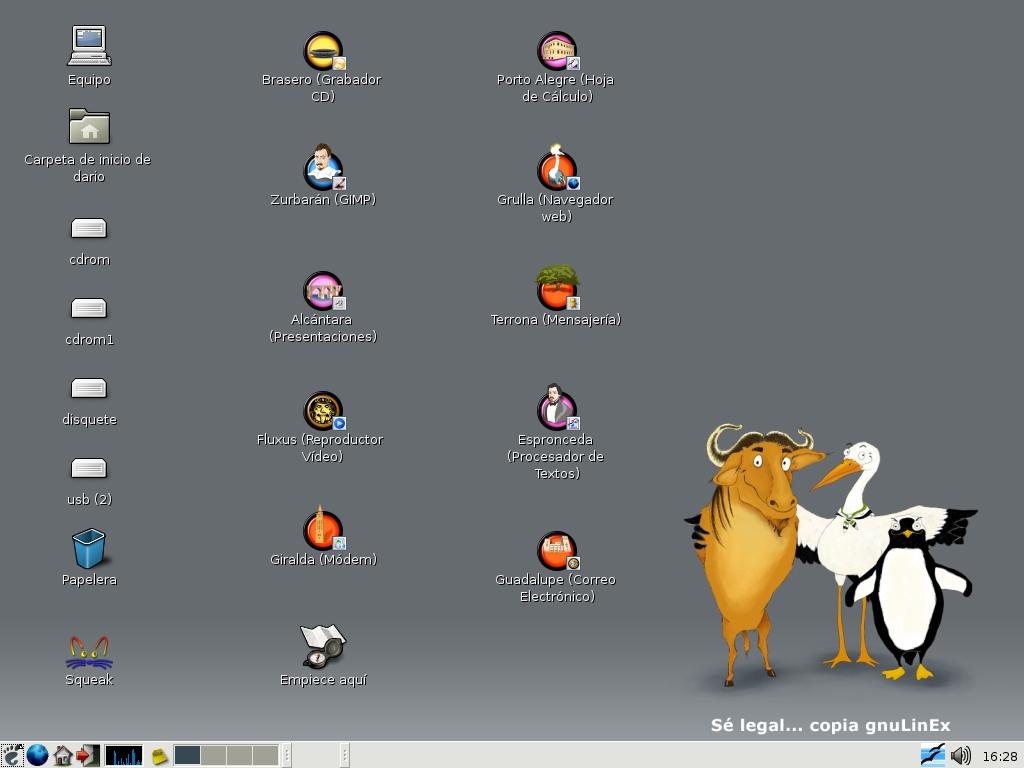
From its beginnings, LinEx has been based on Debian GNU/Linux, and our development efforts have focused on adapting the operating system, translating applications needed by the educational system and simplifying the installation process. Last August, gnuLinEx, the 2004 version of LinEx, appeared and brought with it something more than a new name.
For the installation process, the Debian port of Anaconda made by Progeny is used. Any GNU/Linux user who installed Red Hat or Fedora previously should be used to Anaconda already. This installer offers a simple and graphical way of partitioning the hard disk, choosing which components to install and setting the look and feel of the desktop. It also allows a friendly configuration of the graphical environment and diverse system settings.

gnuLinEx uses the 2.6.7 kernel and offers support for diverse devices found in Spain. It is patched with supermount to allow easy access to removable devices from the desktop.
During the installation, the user can choose between Personal Desktop or Lightweight Desktop profiles. The first one includes GNOME 2.6, while the second option consists of a XFCE4 for low-end computers. In both profiles, special emphasis is placed on the look and feel of the desktop, from the design of subjects and regional icons to the generation of simple tools for updating the operating system. Also the installation of additional applications, such as Squeak, is facilitated.
Of the educational applications available in gnuLinEx, the most impressive one is Squeak. Squeak is a powerful multimedia and educational environment, a live implementation of Smalltalk-80, whose image for the Spanish-speaking world is actively contributed to by the government of Extremadura itself.

But the new features of gnuLinEx are not only for the end user. This distribution is one of the first ones to use component technology in the building of the distribution. This technology, part of the Componentized Linux (CL) project, allows one to think of a GNU/Linux distribution as a set of interchangeable parts or, in terms of CL, components.
Componentized Linux is a new project founded by the Debian Project founder Ian Murdock. As he says, CL is a new way of constructing Linux distributions, built bottom-up as a set of interchangeable parts rather than top-down as a difficult-to-change whole. Under this new model, a distribution builder could add support for MySQL simply by adding the respective component; he also could exchange the GNOME 2.6 component for the KDE 3.2 one if he prefers. All of this is accomplished without the complexity of handling thousands of packages and greatly simplifies the management.
The base component of CL, also included in gnuLinEx, is LSB 2.0. It contains all the necessary software needed to enable total compatibility between different GNU/Linux distributions, fulfilling specification 2.0 of the Linux Standards Base (LSB).
In addition to component LSB 2.0, other components, such as lsb-devel, have been included to provide basic development tools. Also included are audio and graphical support components and all the accompanying ones for hardware detection.
The component model did not help only in the building of gnuLinEx; it continues to help in the building of derived works too, such as LinEx Company and LinEx Gamer. The first one is oriented to the enterprise world, and the second one is for all of us who enjoy using computers for more than work.
The benefits of the component approach do not apply only to Extremadura. Guadalinex is the localized version of Debian GNU/Linux used by the autonomous community of Andalusia, Spain. The people of Andalusia and Extremadura reached an agreement to unite their efforts in the creation of a respective operating system for the 2005 version, and they are starting with a considerable common base. Each team will be responsible for maintaining only its own components, which then will be shared with the other team. This will allows both teams to concentrate on other subjects, such as accessibility, usability and hardware support.
In June of 2004, during the International Forum of Free Software held in Brazil, the Brazilian Portuguese version of gnuLinEx was introduced and welcomed warmly. At the moment, an Italian version of gnuLinEx also is being developed.
Beyond the local efforts, other cooperation agreements are in the works with Colombia, Argentina and a number of European regions interested in the information society model of Extremadura.
If you are a Spanish speaker and a GNU/Linux enthusiast, and you want a complete Debian system with a graphical installation or you are interested in the use of computers in education, you should take a look at gnuLinEx 2004.
Dario Rapisardi left Argentina to follow the gnuLinEx dream and the good ham, so he finally settled down in Spain. He currently is a gnuLinEx developer and can be contacted at dario@rapisardi.org.


