
Letters
Letters
Buoyant Reading Material
Hello from Munich. This is one more in the long and famous series of “Man reading a newspaper on the Dead Sea”. The newspaper of course is special. Hope you like it. I still like your magazine, it is so refreshingly different from what we have here.

—
TB
Learning select() Already?
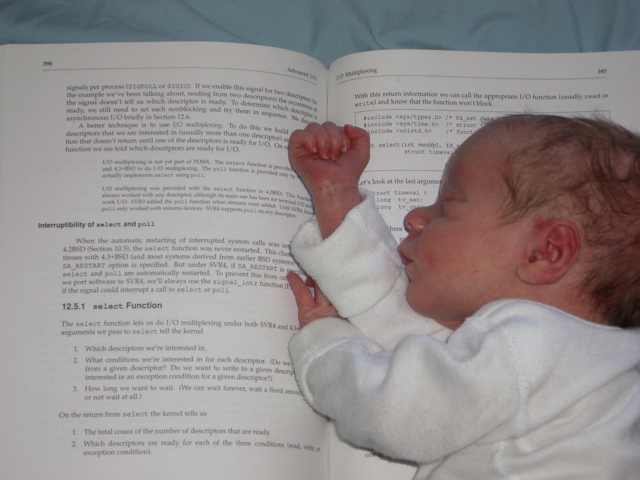
My new 2.5-month-old twin daughters are already expressing an interest in daddy's line of work. Here's little Kathryn studying up on her Stevens so that she can write high-performance Linux socket code.
—
Jeff Squyres
Reading the Boa Web server source code is a good way to understand select() too. —Ed.
Sharp Dressed Baby
The attached picture is of my 6-month-old son Ethan, all set on Halloween to promote his favorite OS.

—
Ulrich
Photo of the Month: Love Is Pain
Hey, I am just sending this picture in to share. It is a picture of the Tux tattoo I got on my back. In the picture it's pretty red, but that's because the picture was taken a few hours after it was done. The tattoo artist said two seconds after he finished, in his big burly voice, “DUDE! It's cute!” I responded with, “You mean it looks bad ass and powerful?” He laughed and I went home.

—
Leigh Martell
Photo of the month gets you a one-year extension to your subscription. Photos to ljeditor@linuxjournal.com. —Ed.
PowerPC, Please
I enjoy Linux Journal. I would like some articles on PowerPC
Hardware, comparisons between Pentium and PowerPC
performance, how to build a PowerPC computer and info on
motherboards that can run Linux.
In particular, I want to build a fanless computer, and I
believe that the PowerPC might offer more performance
than a Pentium for a given power consumption.
—
Ramer W. Streed
Desktop Success
I'm an intermediate user of Linux, running two different
versions of Red Hat on two different machines. My only formal
training in computing was on Atari 800s and Windows 3.1 boxes. I use my
Linux boxes as desktop machines primarily, although I do run one as my
home server. In response to the letter in the December 2004 issue about failed
opportunities in the desktop world, I strongly disagree. I've taught
myself everything I know about Linux and have converted two of my best
friends to use it on their home desktops. I'm currently tutoring my
friend who works in small business providing technical support and
computers to home users and business clients. He's already installed two
different Linux machines into his home and is considering a Linux server
for a major client he works with. I thought I'd just say thank you
LJ
for your indispensable aid in my learning process as well as that of my friends.
My next big Linux projects include getting my co-workers, parents and
grandparents to switch to Linux (wish me luck) and hacking my Xbox.
—
Andrew James Ford
Which Distro?
As we all love Linux, it would be nice if you and other
staff members let us know about what distro you are using in
your computers.
I love LJ. Good work.
—
Mário Costa
Most of the editorial staff uses SuSE, but some of us run Debian, Fedora or Gentoo. We're also trying out a new one called Ubuntu, so watch for some observations about that next issue. —Ed.
Controversial Ads
Brian Proffitt of Linux Today is claiming that Linux Journal has run print ads for the Microsoft “Get the Facts” campaign. I quote, “Linux Journal and Linux Magazine have both run full-page print ads for the Get the Facts campaign.”
Is this true? I've subscribed to Linux Journal for
years and have never seen such an ad. I have nothing
against Microsoft ads per se, but the so-called
“Get the Facts” campaign is just a load of crap.
Thanks for a great magazine.
—
Doug Wright
Our VP of Sales and Marketing Carlie Fairchild responds: Linux Journal has never in its history run an ad for Microsoft. My position from day one has been that when Microsoft has a product for the Linux community, I will be more than happy to run its ad. We request a copy of the ad they'd like to submit each time they come to us looking to advertise. Based on the content of that ad, and that alone, we make our decision. To date, I've found their ads to be counter-productive to our editorial and advertising missions. We love our friends at Linux Today and appreciate their struggle with this. I don't wish to represent that our position is the only right one. It's just what suits our mission best.
