
PHP 5 Power Programming by Andi Gutmans, Stig Bakken and Derick Rethans
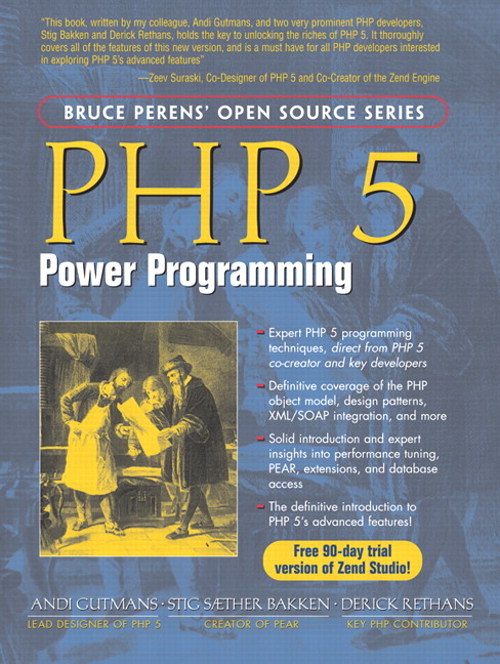
PHP, arguably the world's best Web scripting language, recently received a significant overhaul. Version 5 expands the object model of the language, adds support for new MySQL 4.x features and speeds up execution.
However, PHP 4 scripts may not work in PHP 5 without some rewriting. PHP 5 Power Programming is an excellent book for PHP 4 developers in need of a PHP 5 introduction. It's also a good book for anyone proficient in another programming language, such as Java, Perl or Python, who now wants to get started with PHP.
The book is co-authored by Andi Gutmans, Stig Bakken and Derick Rethans, three key contributers to the PHP language. They bring an intimate knowledge of the language to the book and provide anecdotal evidence as to why PHP has developed in the manner it has. Their writing style is clear, focused and enjoyable.
For PHP developers looking for a PHP 5 transition guide, this book works perfectly. The authors are candid about what they've broken in the transition from PHP 4 to PHP 5. It doesn't stop there, either; coverage of the new PHP 5 object model is excellent. Some PHP developers may not understand the usefulness of new OO concepts introduced in PHP 5, so the authors included a chapter on applying OO design patterns to PHP.
PHP and MySQL go together like peanut butter and jelly. The improved MySQL libraries for PHP further cement this relationship. PHP 5 introduces native support for SQLite, a powerful database option for PHP developers without access to another database.
This book belongs on the desk of anyone considering a move to PHP 5. It serves as a road map for upgrading to the latest incarnation of PHP and as a reference for anyone who wants to expand their PHP object-oriented design skills. My copy already has a dozen or so sticky notes marking important sections and twice as many dog-eared pages. It has been an invaluable resource in my exploration of PHP 5.
Realizing the promise of Apache® Hadoop® requires the effective deployment of compute, memory, storage and networking to achieve optimal results. With its flexibility and multitude of options, it is easy to over or under provision the server infrastructure, resulting in poor performance and high TCO. Join us for an in depth, technical discussion with industry experts from leading Hadoop and server companies who will provide insights into the key considerations for designing and deploying an optimal Hadoop cluster.
Sponsored by AMD
If you already use virtualized infrastructure, you are well on your way to leveraging the power of the cloud. Virtualization offers the promise of limitless resources, but how do you manage that scalability when your DevOps team doesn’t scale? In today’s hypercompetitive markets, fast results can make a difference between leading the pack vs. obsolescence. Organizations need more benefits from cloud computing than just raw resources. They need agility, flexibility, convenience, ROI, and control.
Stackato private Platform-as-a-Service technology from ActiveState extends your private cloud infrastructure by creating a private PaaS to provide on-demand availability, flexibility, control, and ultimately, faster time-to-market for your enterprise.
Sponsored by ActiveState
| Non-Linux FOSS: libnotify, OS X Style | Jun 18, 2013 |
| Containers—Not Virtual Machines—Are the Future Cloud | Jun 17, 2013 |
| Lock-Free Multi-Producer Multi-Consumer Queue on Ring Buffer | Jun 12, 2013 |
| Weechat, Irssi's Little Brother | Jun 11, 2013 |
| One Tail Just Isn't Enough | Jun 07, 2013 |
| Introduction to MapReduce with Hadoop on Linux | Jun 05, 2013 |
- Containers—Not Virtual Machines—Are the Future Cloud
- Non-Linux FOSS: libnotify, OS X Style
- Lock-Free Multi-Producer Multi-Consumer Queue on Ring Buffer
- Linux Systems Administrator
- Validate an E-Mail Address with PHP, the Right Way
- Introduction to MapReduce with Hadoop on Linux
- RSS Feeds
- Weechat, Irssi's Little Brother
- New Products
- Tech Tip: Really Simple HTTP Server with Python
Featured Jobs
| Linux Systems Administrator | Houston and Austin, Texas | Host Gator |
| Senior Perl Developer | Austin, Texas | Host Gator |
| Technical Support Rep | Houston and Austin, Texas | Host Gator |
| UX Designer | Austin, Texas | Host Gator |
| Web & UI Developer (JavaScript & j Query) | Austin, Texas | Host Gator |
Free Webinar: Hadoop
How to Build an Optimal Hadoop Cluster to Store and Maintain Unlimited Amounts of Data Using Microservers
Realizing the promise of Apache® Hadoop® requires the effective deployment of compute, memory, storage and networking to achieve optimal results. With its flexibility and multitude of options, it is easy to over or under provision the server infrastructure, resulting in poor performance and high TCO. Join us for an in depth, technical discussion with industry experts from leading Hadoop and server companies who will provide insights into the key considerations for designing and deploying an optimal Hadoop cluster.
Some of key questions to be discussed are:
- What is the “typical” Hadoop cluster and what should be installed on the different machine types?
- Why should you consider the typical workload patterns when making your hardware decisions?
- Are all microservers created equal for Hadoop deployments?
- How do I plan for expansion if I require more compute, memory, storage or networking?


12 min 14 sec ago
22 min 34 sec ago
27 min 34 sec ago
2 hours 37 min ago
2 hours 38 min ago
3 hours 23 min ago
4 hours 12 min ago
4 hours 36 min ago
6 hours 12 min ago
6 hours 14 min ago