
PHP 5 Power Programming by Andi Gutmans, Stig Bakken and Derick Rethans
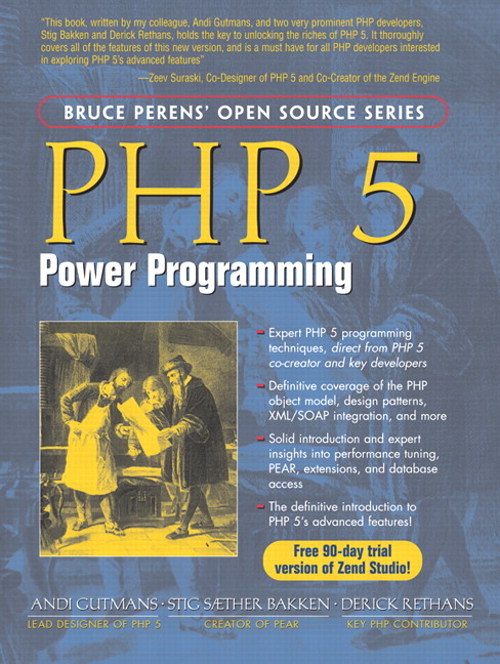
PHP, arguably the world's best Web scripting language, recently received a significant overhaul. Version 5 expands the object model of the language, adds support for new MySQL 4.x features and speeds up execution.
However, PHP 4 scripts may not work in PHP 5 without some rewriting. PHP 5 Power Programming is an excellent book for PHP 4 developers in need of a PHP 5 introduction. It's also a good book for anyone proficient in another programming language, such as Java, Perl or Python, who now wants to get started with PHP.
The book is co-authored by Andi Gutmans, Stig Bakken and Derick Rethans, three key contributers to the PHP language. They bring an intimate knowledge of the language to the book and provide anecdotal evidence as to why PHP has developed in the manner it has. Their writing style is clear, focused and enjoyable.
For PHP developers looking for a PHP 5 transition guide, this book works perfectly. The authors are candid about what they've broken in the transition from PHP 4 to PHP 5. It doesn't stop there, either; coverage of the new PHP 5 object model is excellent. Some PHP developers may not understand the usefulness of new OO concepts introduced in PHP 5, so the authors included a chapter on applying OO design patterns to PHP.
PHP and MySQL go together like peanut butter and jelly. The improved MySQL libraries for PHP further cement this relationship. PHP 5 introduces native support for SQLite, a powerful database option for PHP developers without access to another database.
This book belongs on the desk of anyone considering a move to PHP 5. It serves as a road map for upgrading to the latest incarnation of PHP and as a reference for anyone who wants to expand their PHP object-oriented design skills. My copy already has a dozen or so sticky notes marking important sections and twice as many dog-eared pages. It has been an invaluable resource in my exploration of PHP 5.
