
Open Source Solutions for Small Business Problems by John Locke
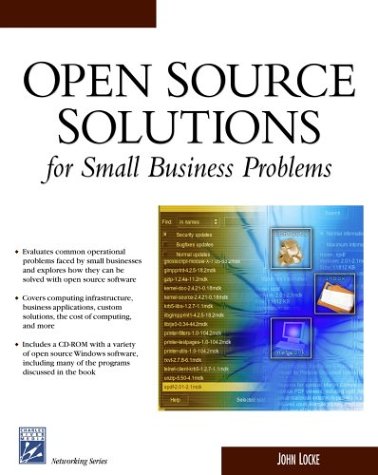
Charles River Media, 2004

ISBN: 1-58450-320-3

$39.95 US

Working for a number of small businesses, I have seen first hand how Linux and open-source software can be used to solve specific problems. It is great to see a good book detailing open-source solutions for small businesses. John Locke takes an excellent approach to this subject by addressing both the business manager who must decide what solutions to implement and the IT administrator who must implement those solutions.

Locke covers all of the software you need for your small business, including e-mail, customer relationship management, finance and disaster recovery. Each chapter provides valuable background information aimed at helping the nontechnical reader understand both the problem and the solution, as well as the details necessary for an intermediate Linux or Microsoft Windows administrator to implement the solution. Locke wisely chooses software that has the features you need, as well as strong community support. He recommends Postfix for e-mail because of its security, performance and feature set. He also recommends RetrieverCRM for customer relationship management and SQL-Ledger for financial management. Most of the solutions Locke presents will run on Windows as well as Linux, for an easy transition into the open-source world.

Although Locke provides good instructions on how to implement these solutions, there is not enough room in his book to provide all of the details you may need. For this reason he provides many references at the end of each chapter, pointing you to books, articles and Web sites that can provide the details you need. Written for a beginning to intermediate user, Locke does a great job of keeping the chapters simple and easy to follow.

______________________

Comments

Comment viewing options

Select your preferred way to display the comments and click "Save settings" to activate your changes.

comment:

Email Solution For Small Businesses's picture

Nice post. Thanks for sharing.

White Paper
Fabric-Based Computing Enables Optimized Hyperscale Data Centers

Today’s modular x86 servers are compute-centric, designed as a least common denominator to support a wide range of IT workloads. Those generic, virtualized IT workloads have much different resource optimization requirements than hyperscale and cloud applications. They have resulted in a “one size fits all” enterprise IT architecture that is not optimized for a specific set of IT workloads, and especially not emerging hyperscale workloads, such as web applications, big data, and object storage. In this report, you will learn how shifting the focus from traditional compute-centric IT architectures to an innovative disaggregated fabric-based architecture can optimize and scale your data center.

Learn More

Sponsored by AMD

White Paper
Red Hat White Paper: Using an Open Source Framework to Catch the Bad Guy

Built-in forensics, incident response, and security with Red Hat Enterprise Linux 6

Every security policy provides guidance and requirements for ensuring adequate protection of information and data, as well as high-level technical and administrative security requirements for a system in a given environment. Traditionally, providing security for a system focuses on the confidentiality of the information on it. However, protecting the data integrity and system and data availability is just as important. For example, when processing United States intelligence information, there are three attributes that require protection: confidentiality, integrity, and availability.

Learn more about catching the bad guy in this free white paper.

Learn More

Sponsored by DLT Solutions